Anna's Hummingbird (Plate 425)
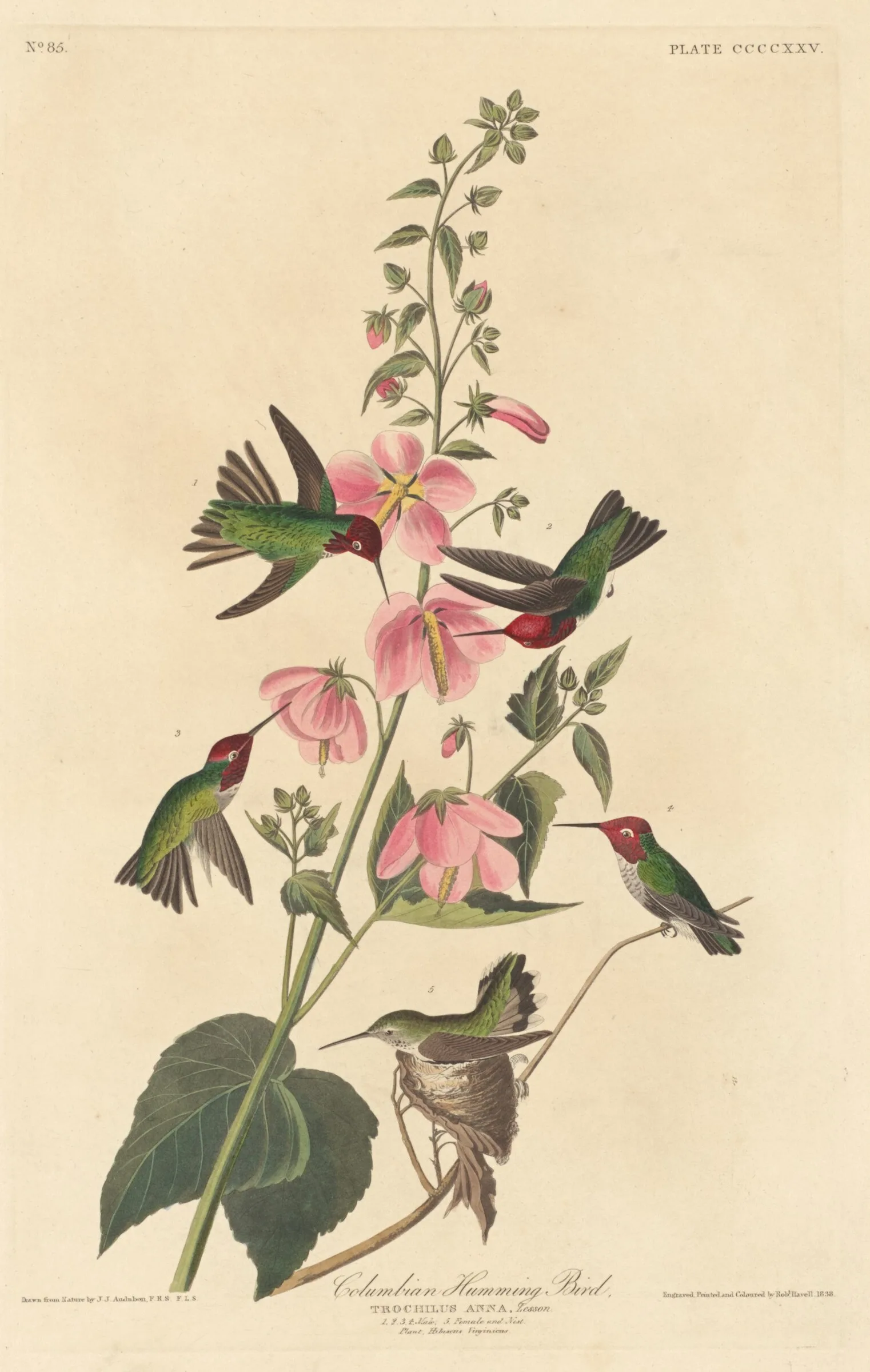
Audubon's “Columbian Humming Bird”, The Birds of America, plate CDXXV
Click or press Enter to enlarge
Open the full-resolution image (2852 px, National Gallery of Art)
| Plate | 425 (CDXXV) |
|---|---|
| Audubon's name | Columbian Humming Bird |
| Modern name | Anna's Hummingbird |
| Scientific name | Calypte anna |
| Status | Least Concern |
| Engraved by | Robert Havell, after Audubon's watercolor |
| Date | 1838 |
| Medium | Hand-colored engraving and aquatint on Whatman wove paper |
| Size | plate: 49.2 x 31.1 cm (19 3/8 x 12 1/4 in.) sheet: 99.5 x 68.3 cm (39 3/16 x 26 7/8 in.) |
| Collections | Hummingbirds |
| This impression | National Gallery of Art, Washington, 1945.8.425; Gift of Mrs. Walter B. James |
About this plate
Plate 425 shows several figures of Anna's Hummingbird, with males showing the rose-red crown and throat and a female beside a small cup nest. Audubon drew the nest and the female from specimens given to him by Thomas Nuttall. He drew the males from skins lent by George Loddiges of London, whose hummingbird collection he called unrivalled.
The plate was engraved as the Columbian Humming Bird, but in the text Audubon used the name Anna Humming Bird, Trochilus anna. René Lesson had named the species for Anna Masséna, Duchess of Rivoli. It is now Calypte anna. Audubon noted that it was only the fourth hummingbird then known within the limits of the United States.
Anna's Hummingbird is the only hummingbird in which the male has an iridescent red crown as well as throat. It lives year-round along the Pacific coast and was once almost confined to California and Baja California. Garden plantings and feeders have allowed it to spread north to British Columbia and east into Arizona. It nests as early as December. The male's courtship dive ends in a loud chirp made by its tail feathers. It is listed as Least Concern.
Nuttall found the nest on a low oak bush while travelling from the Rocky Mountains toward California. He caught the sitting female in his hat while the male buzzed around him. Audubon measured the nest, made of willow down and catkin scales, at an inch and a half deep.
In Audubon's words
My good friend Thomas Nuttall, while travelling from the Rocky Mountains toward California, happened to observe on a low oak bush a Humming Bird's nest on which the female was sitting. Having cautiously approached, he secured the bird with his hat. The male in the mean time fluttered angrily around, but as my friend had not a gun, he was unable to procure it. The nest, which he has presented to me, is attached to a small branch, and several leaves from a twig issuing from it, which have apparently been bent down for the purpose. It is very small, even for the size of the bird, being an inch and a half in depth, and an inch and a quarter in breadth externally at the mouth, while its internal diameter is ten-twelfths, and its depth eight and a half twelfths. It is of a conical form, and composed of the cottony down apparently of some species of willow, intermixed with scales of catkins and a few feathers, and lined with the same substances.
John James Audubon, Ornithological Biography, vol. 5 (1839), “Anna Humming Bird”. Read the full chapter.