Rufous Hummingbird (Plate 379)
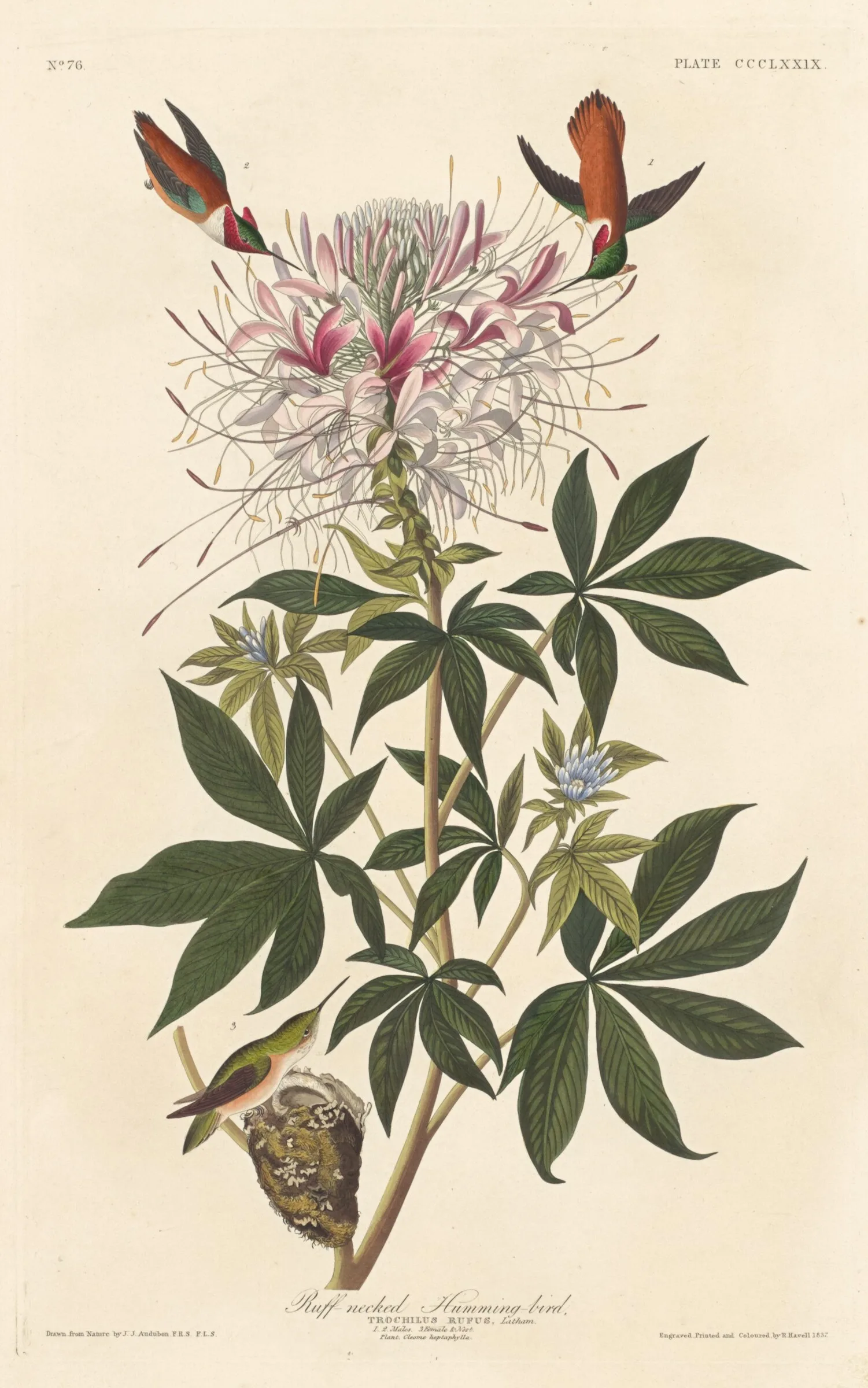
Audubon's “Ruff-necked Humming-bird”, The Birds of America, plate CCCLXXIX
Click or press Enter to enlarge
Open the full-resolution image (2914 px, National Gallery of Art)
| Plate | 379 (CCCLXXIX) |
|---|---|
| Audubon's name | Ruff-necked Humming-bird |
| Modern name | Rufous Hummingbird |
| Scientific name | Selasphorus rufus |
| Status | Near Threatened |
| Engraved by | Robert Havell, after Audubon's watercolor |
| Date | 1837 |
| Medium | Hand-colored engraving and aquatint on Whatman wove paper |
| Collections | Hummingbirds |
| This impression | National Gallery of Art, Washington, 1945.8.379; Gift of Mrs. Walter B. James |
About this plate
Plate 379 shows a male and a female Rufous Hummingbird. The male is bright orange-rufous on the back, sides and tail, with a glittering scarlet-orange throat that he can flare out like a ruff. The female is green above with rufous flanks and a spotted throat.
The species was found at Nootka Sound on Captain Cook's third voyage. Gmelin named it Trochilus rufus, and it is now Selasphorus rufus. Audubon's name Ruff-necked refers to the male's expandable gorget.
Rufous Hummingbirds breed farther north than any other hummingbird, from Oregon to southeastern Alaska. Most winter in Mexico. Their migration is one of the longest of any bird for its body size. They are aggressive at flowers and feeders. Breeding-bird surveys show long-term declines, and IUCN lists the species as Near Threatened.
Audubon never saw the bird alive and drew on specimens and notes from Nuttall and Townsend. Nuttall described males along the Columbia in April, compared one to a breathing gem, and recorded being dive-bombed near a nest. The dives came with a strange bleating sound that he at first took for an animal on the ground.
In Audubon's words
We now for the first time (April 16.) saw the males in numbers, darting, burring, and squeaking in the usual manner of their tribe; but when engaged in collecting its accustomed sweets in all the energy of life, it seemed like a breathing gem, or magic carbuncle of glowing fire, stretching out its gorgeous ruff, as if to emulate the sun itself in splendour. Towards the close of May, the females were sitting, at which time the males were uncommonly quarrelsome and vigilant, darting out at me as I approached the tree probably near the nest, looking like an angry coal of brilliant fire, passing within very little of my face, returning several times to the attack, sinking and darting with the utmost velocity, at the same time uttering a curious reverberating sharp bleat, somewhat similar to the quivering twang of a dead twig, yet also so much like the real bleat of some small quadruped, that for some time I searched the ground instead of the air, for the actor in the scene.
John James Audubon, Ornithological Biography, vol. 4 (1838), “Ruff-necked Humming Bird”. Read the full chapter.