Ruby-throated Hummingbird (Plate 47)
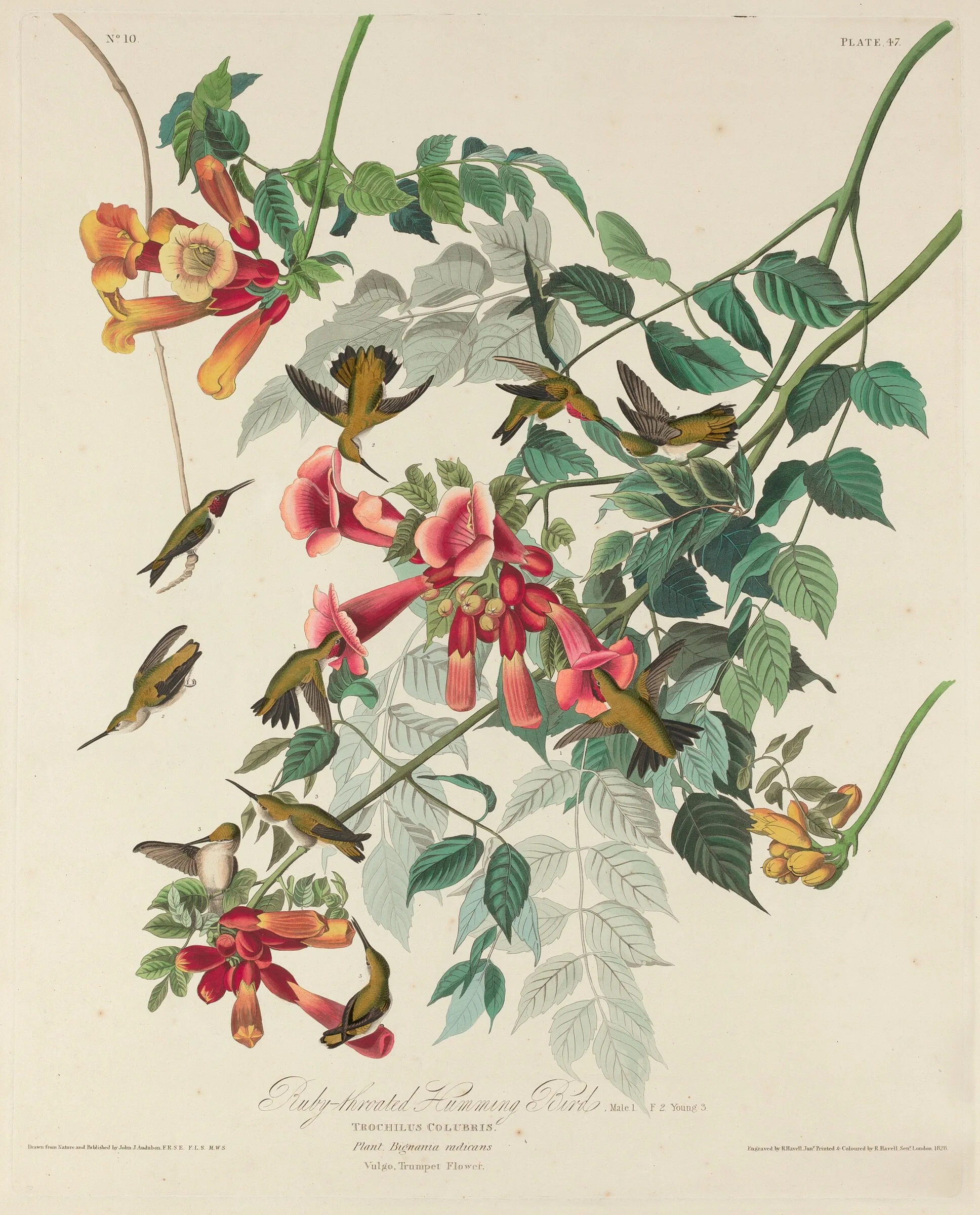
Audubon's “Ruby-throated Humming Bird”, The Birds of America, plate XLVII
Click or press Enter to enlarge
Open the full-resolution image (3405 px, National Gallery of Art)
| Plate | 47 (XLVII) |
|---|---|
| Audubon's name | Ruby-throated Humming Bird |
| Modern name | Ruby-throated Hummingbird |
| Scientific name | Archilochus colubris |
| Status | Least Concern |
| Engraved by | Robert Havell, after Audubon's watercolor |
| Date | 1828 |
| Medium | Hand-colored engraving and aquatint on Whatman wove paper |
| Size | plate: 66 x 52.5 cm (26 x 20 11/16 in.) sheet: 100 x 67.6 cm (39 3/8 x 26 5/8 in.) |
| Plants and setting | Trumpet Creeper (Campsis radicans), in flower and seed |
| Collections | Hummingbirds |
| This impression | National Gallery of Art, Washington, 1945.8.47; Gift of Mrs. Walter B. James |
About this plate
Plate 47 shows several Ruby-throated Hummingbirds around a flowering vine of Trumpet Creeper, Campsis radicans, with orange tubular flowers and long seed pods. Adult males have a glittering red throat. Females and young have white throats. Some birds hover and others probe the flowers. The plate was engraved by Robert Havell in 1828.
Audubon opened the chapter by calling the hummingbird a glittering fragment of the rainbow. He described seeing newly hatched young no bigger than bumblebees, and the despair of the parents flying within inches of his face until he left the nest untouched. He wrote that he had seen hummingbirds in Louisiana as early as 10 March, but rarely before mid April in the Middle States. He thought they probably migrated at night.
The name is unchanged: Ruby-throated Hummingbird, Archilochus colubris. Audubon used Linnaeus's name Trochilus colubris. It is the only hummingbird that breeds regularly in eastern North America. Audubon's guess about night migration was partly right. Many cross the Gulf of Mexico in a single nonstop flight of about 500 miles in spring.
The species breeds from the Gulf coast to southern Canada and winters from Mexico to Panama, with some in southern Florida. Its spring arrival is timed to flowering plants and the sap wells drilled by sapsuckers. It is listed as Least Concern. Trumpet Creeper is often called hummingbird vine.
In Audubon's words
Could you, kind reader, cast a momentary glance on the nest of the Humming Bird, and see, as I have seen, the newly-hatched pair of young, little larger than humble-bees, naked, blind, and so feeble as scarcely to be able to raise their little bill to receive food from the parents; and could you see those parents, full of anxiety and fear, passing and repassing within a few inches of your face, alighting on a twig not more than a yard from your body, waiting the result of your unwelcome visit in a state of the utmost despair,—you could not fail to be impressed with the deepest pangs which parental affection feels on the unexpected death of a cherished child. Then how pleasing is it, on your leaving the spot, to see the returning hope of the parents, when, after examining the nest, they find their nurslings untouched!
John James Audubon, Ornithological Biography, vol. 1 (1831), “The Ruby-throated Humming Bird”. Read the full chapter.