Greater Prairie-Chicken (Plate 186)
Audubon's “Pinnated Grous”, The Birds of America, plate CLXXXVI
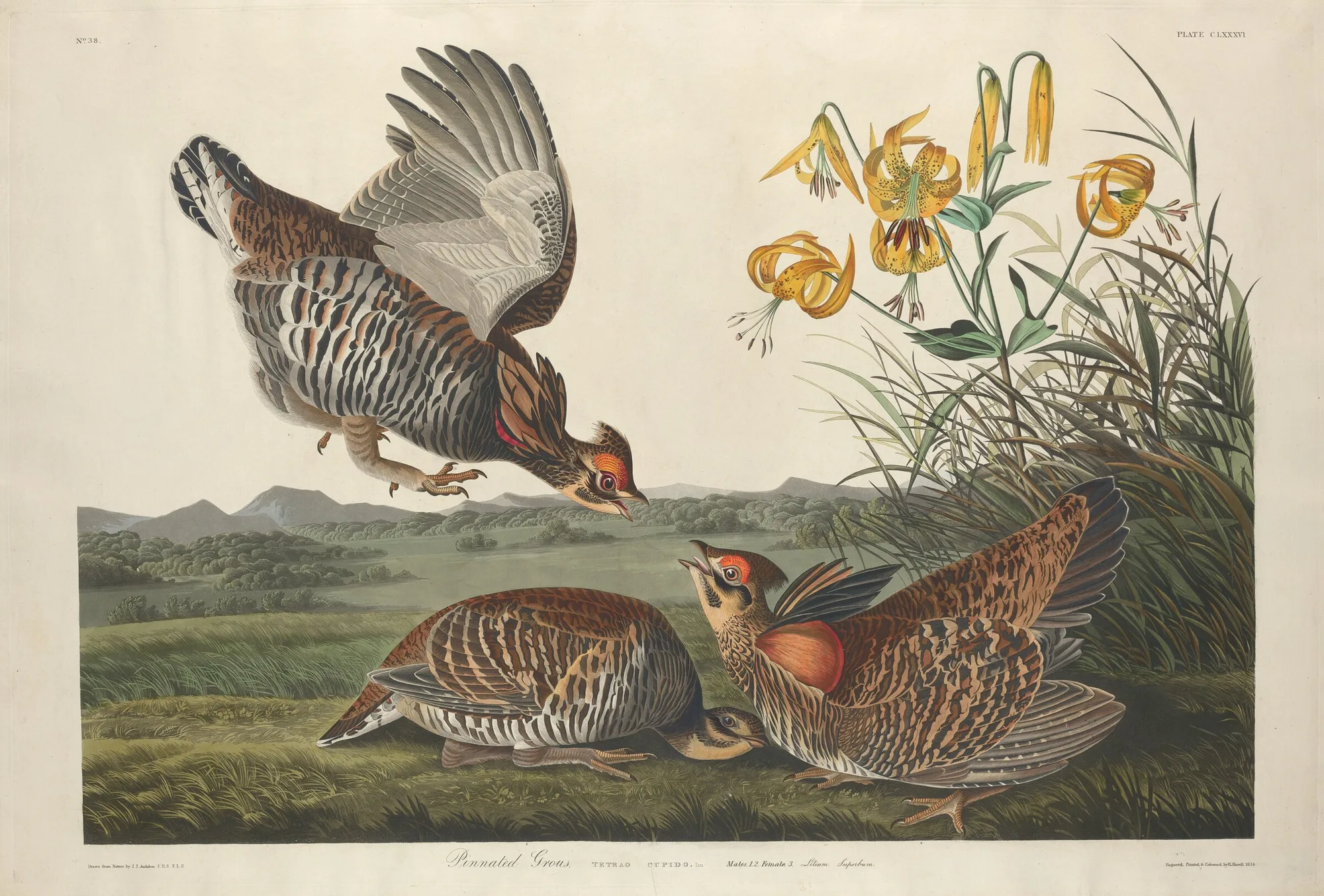
Click or press Enter to enlarge
Open the full-resolution image (4668 px, National Gallery of Art)
| Plate | 186 (CLXXXVI) |
|---|---|
| Audubon's name | Pinnated Grous |
| Modern name | Greater Prairie-Chicken |
| Scientific name | Tympanuchus cupido |
| Status | Vulnerable |
| Engraved by | Robert Havell, after Audubon's watercolor |
| Date | 1834 |
| Medium | Hand-colored engraving and aquatint on Whatman wove paper |
| Collections | Turkeys, Grouse and Game Birds |
| This impression | National Gallery of Art, Washington, 1945.8.186; Gift of Mrs. Walter B. James |
About this plate
Plate 186 shows Greater Prairie-Chickens, which Audubon called the Pinnated Grous after the long feather tufts, or pinnae, on the sides of the male's neck. On display the male raises these tufts like horns and inflates bare orange air sacs on his neck to make a low booming sound.
Audubon called it Tetrao cupido. It is now Tympanuchus cupido. It once lived on prairies and grassy openings from the Great Plains east to the Atlantic coast, where the eastern form was the Heath Hen. The Heath Hen survived last on Martha's Vineyard and was extinct by 1932. The prairie birds still live in scattered areas of the Great Plains and Midwest, but plowing of tallgrass prairie has cut their range sharply. The species is listed as Vulnerable, and the Attwater's subspecies of Texas is critically endangered.
Audubon knew the bird in Kentucky, Indiana, Illinois and Missouri more than twenty-five years before he wrote. He described his first sight of the Kentucky Barrens in June, which he had expected to be bare rock but found full of flowers, wild grapes, strawberries and groves, with grouse bursting from the black-jack oaks.
He recorded how fast they vanished. When he moved to Kentucky they were so common that no hunter bothered to shoot them and they sold for a cent apiece. Twenty-five years later scarcely one was left there, though he said they were still abundant in Illinois and on the plains of the Missouri and Arkansas.
In Audubon's words
I recollect having caught several in a stable at Henderson, where they had followed some Wild Turkeys. In the course of the same winter, a friend of mine, who was fond of practising rifle-shooting, killed upwards of forty in one morning, but picked none of them up, so satiated with Grous was he, as well as every member of his family. My own servants preferred the fattest flitch of bacon to their flesh, and not unfrequently laid them aside as unfit for cooking. Such an account may appear strange to you, reader; but what will you think when I tell you, that, in that same country, where, twenty-five years ago they could not have been sold at more than one cent. a-piece, scarcely one is now to be found? The Grous have abandoned the State of Kentucky, and removed (like the Indians) every season farther to the westward, to escape from the murderous white man.
John James Audubon, Ornithological Biography, vol. 2 (1834), “The Pinnated Grous”. Read the full chapter.