Boat-tailed Grackle (Plate 187)
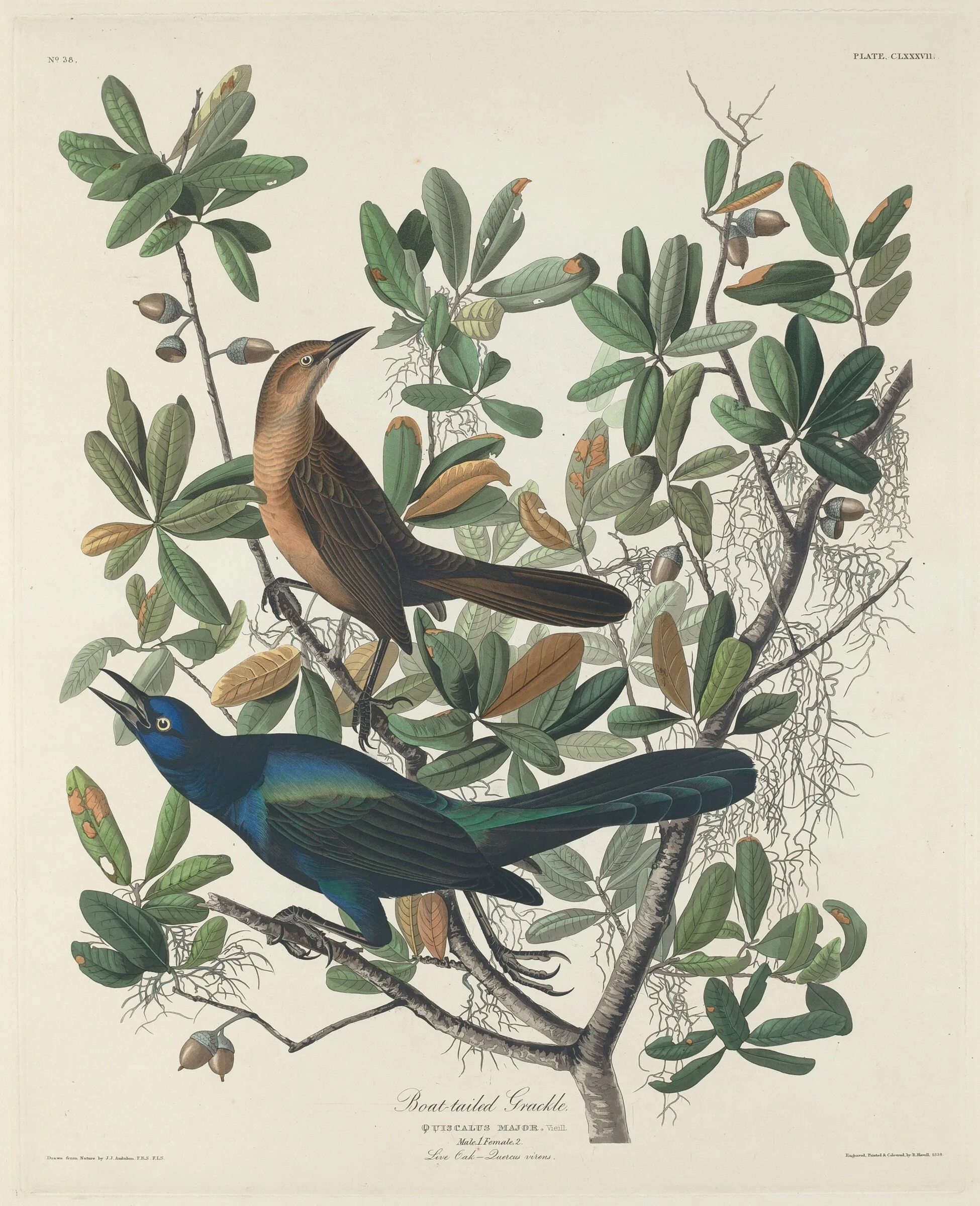
Audubon's “Boat-tailed Grackle”, The Birds of America, plate CLXXXVII
Click or press Enter to enlarge
Open the full-resolution image (3235 px, National Gallery of Art)
| Plate | 187 (CLXXXVII) |
|---|---|
| Audubon's name | Boat-tailed Grackle |
| Modern name | Boat-tailed Grackle |
| Scientific name | Quiscalus major |
| Status | Least Concern |
| Engraved by | Robert Havell, after Audubon's watercolor |
| Date | 1834 |
| Medium | Hand-colored engraving and aquatint on Whatman wove paper |
| Collections | Songbirds |
| This impression | National Gallery of Art, Washington, 1945.8.187; Gift of Mrs. Walter B. James |
About this plate
Plate 187 shows a male and female Boat-tailed Grackle. The male is glossy blue-black with a long keel-shaped tail that he folds into a V, the boat shape behind the name. The female is much smaller and brown, with a shorter tail. Audubon described the male displaying from the top of an evergreen oak, drooping its wings and tail and swelling its breast.
Audubon called it the Boat-tailed Grakle or Great Crow Blackbird, Quiscalus major, and the scientific name is unchanged. The species lives in salt and brackish marshes along the Atlantic and Gulf coasts from New Jersey to Texas and throughout Florida, where it also lives inland. It has spread north along the Atlantic coast since Audubon's time. Audubon wrote that it was not found north of the Carolinas. It is listed as Least Concern. The larger Great-tailed Grackle of the West was once treated as the same species.
Audubon described large flocks feeding in salt marshes and rice plantations and roosting in tall Spartina marsh grass. He wrote that their main food was fiddler crabs, along with insects, shrimps stranded on oyster banks, seeds and grain. Planters employed people to chase them from ripening rice.
He gave the nest as a bulky cup of sticks, moss and grass, lined with fine roots, with four or five whitish eggs streaked with brown and black. Males paired by early February, and he believed the species raised only one brood a year.
In Audubon's words
The food of this species consists principally of those small crabs called "fiddlers," of which millions are found along the margins of the rivers and mud-flats, as well as of large insects of all kinds, ground-worms, and seeds, especially grain. They frequently seize on shrimps, and other aquatic animals of a similar nature, that have been detained at low water on the banks of racoon oysters, a kind of shell-fish so named under the idea that they are eaten by that quadruped. In autumn, while the rice is yet in the stack, they commit considerable mischief by feeding on the grain, although not so much as when it is in a juicy state, when the planters are obliged to employ persons to chase them from the fields.
John James Audubon, Ornithological Biography, vol. 2 (1834), “The Boat-tailed Grakle or Great Crow Blackbird”. Read the full chapter.



