Willow Ptarmigan (Plate 191)
Audubon's “Willow Grous”, The Birds of America, plate CXCI
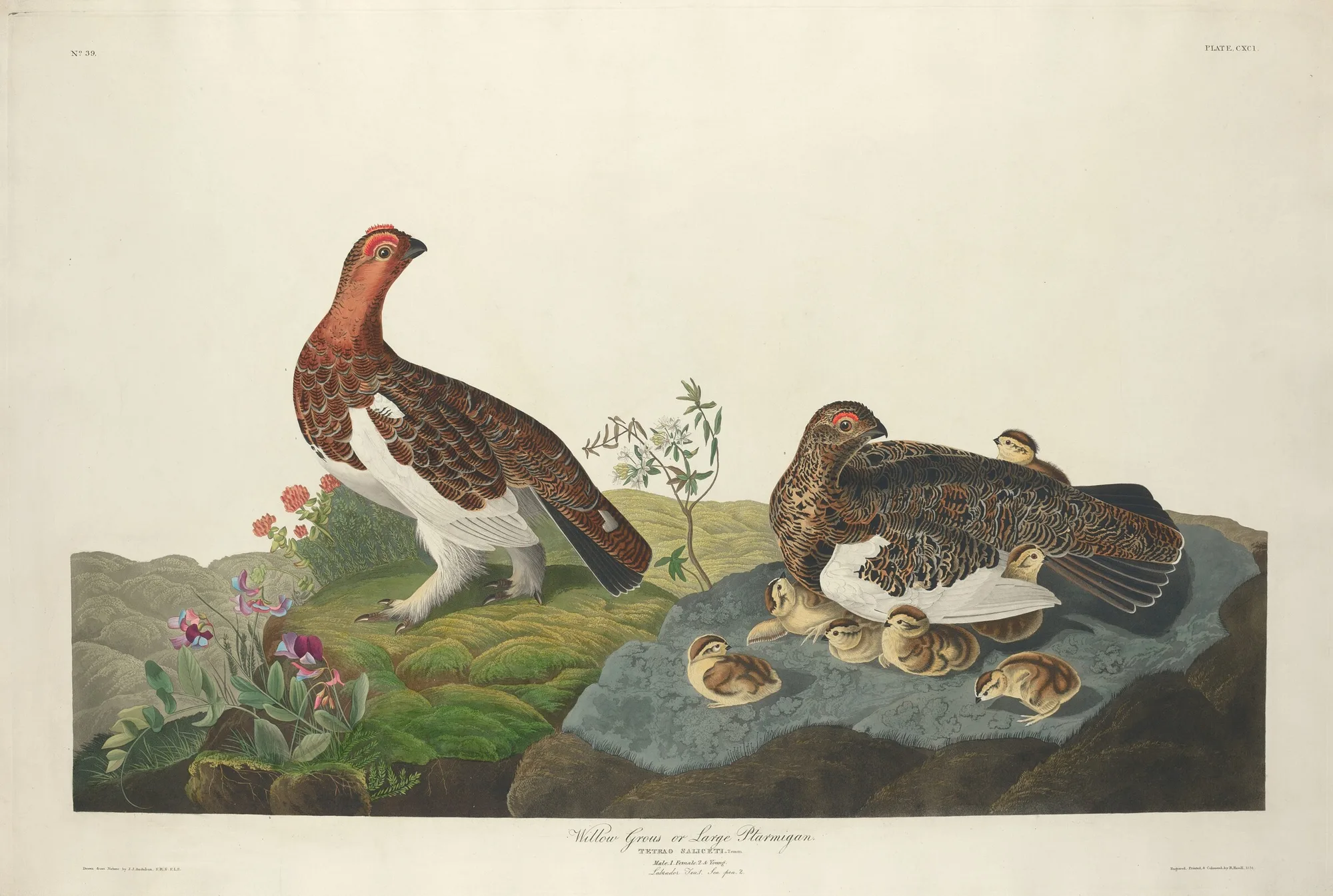
Click or press Enter to enlarge
Open the full-resolution image (4637 px, National Gallery of Art)
| Plate | 191 (CXCI) |
|---|---|
| Audubon's name | Willow Grous |
| Modern name | Willow Ptarmigan |
| Scientific name | Lagopus lagopus |
| Status | Least Concern |
| Engraved by | Robert Havell, after Audubon's watercolor |
| Date | 1834 |
| Medium | Hand-colored engraving and aquatint on Whatman wove paper |
| Collections | Turkeys, Grouse and Game Birds |
| This impression | National Gallery of Art, Washington, 1945.8.191; Gift of Mrs. Walter B. James |
About this plate
Plate 191 shows a family of Willow Ptarmigan, male, female and young, in summer plumage. The male has a chestnut head and neck and white wings, the female is mottled brown, and the chicks are downy. In winter both adults turn almost entirely white.
Audubon called it the Willow Grous, Tetrao saliceti. It is now the Willow Ptarmigan, Lagopus lagopus, the Willow Grouse of Europe. The Red Grouse of Britain is a subspecies. It lives in willow and birch scrub on tundra and the edges of boreal forest around the Arctic, and in North America from Alaska across northern Canada to Newfoundland. It is the state bird of Alaska. It is listed as Least Concern.
Audubon met it on the 1833 voyage to Labrador and Newfoundland. He was struck by a habit he knew in no other American grouse: the male stays with the female and young. When his party came upon a brood, the parents flew straight at the men so boldly that some were killed in the air with gun rods, while the chicks scattered and hid in the moss.
He believed the species also lived in Maine and near Lake Michigan, citing seven birds shot near Dennisville by Theodore Lincoln and skins from Lake Michigan. Neither is part of its known range today. The chapter also describes an outing from the schooner Ripley with Thomas Lincoln and his son John Woodhouse Audubon.
In Audubon's words
The males were always in the immediate vicinity of the nest while the females were sitting, and accompanied them and the young, from the time the latter were hatched until they were full-grown; and whenever we met with them, we observed that the males and the females manifested the strongest attachment towards each other, as well as towards their young. In fact, so much was this the case, that when a covey happened to come in our way, the parents would fly directly towards us with so much boldness, that some were actually killed on the wing with the rods of our guns, as they flew about in the agonies of rage and despair, with all their feathers raised and ruffled. In the mean time, the little ones dispersed and made off through the deep moss and tangled creeping plants with great rapidity, squatting and keeping close to the ground, when it became extremely difficult to find them.
John James Audubon, Ornithological Biography, vol. 2 (1834), “The Willow Grous”. Read the full chapter.