Northern Shrike (Plate 192)
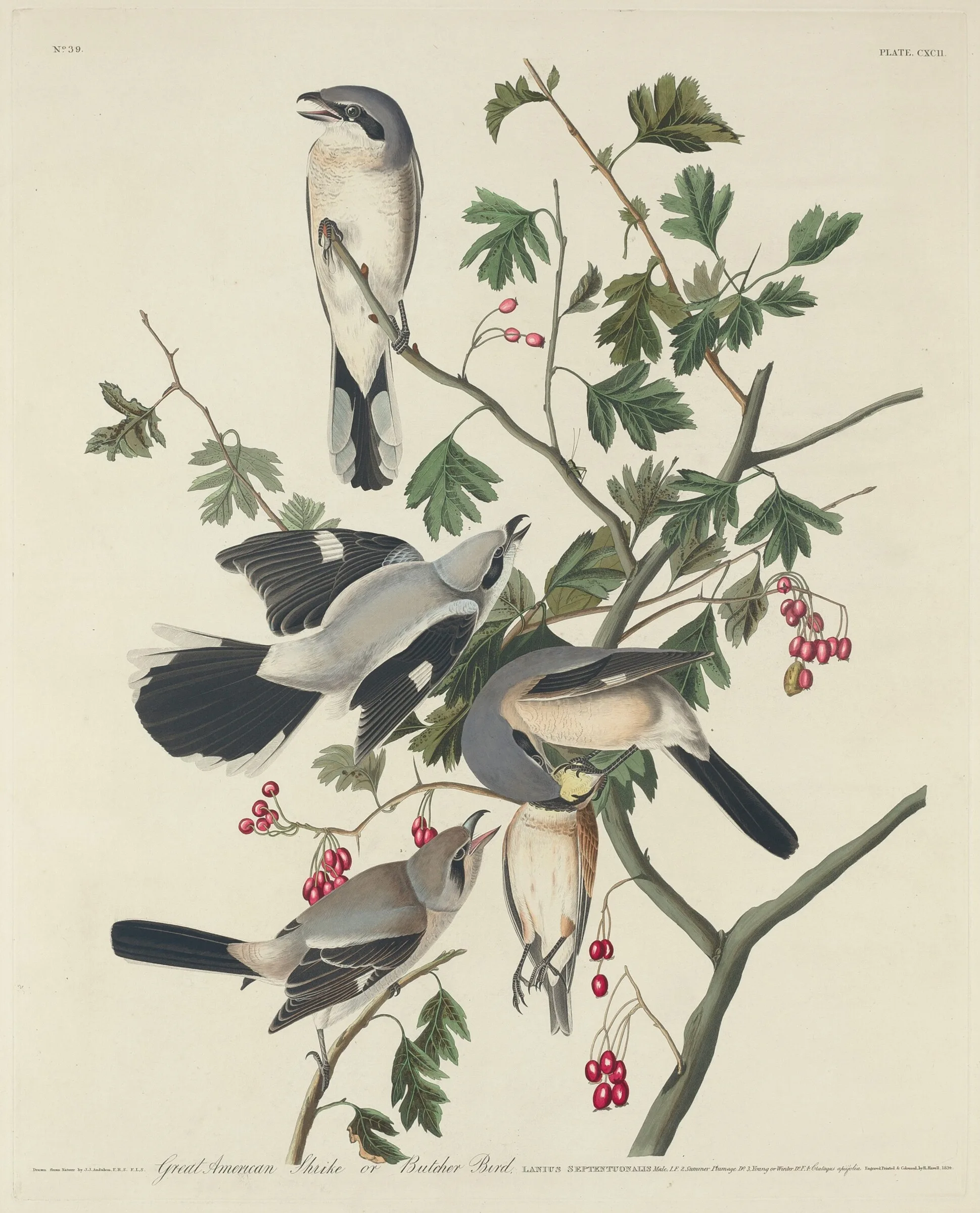
Audubon's “Great American Shrike or Butcher Bird”, The Birds of America, plate CXCII
Click or press Enter to enlarge
Open the full-resolution image (3182 px, National Gallery of Art)
| Plate | 192 (CXCII) |
|---|---|
| Audubon's name | Great American Shrike or Butcher Bird |
| Modern name | Northern Shrike |
| Scientific name | Lanius borealis |
| Status | Least Concern |
| Engraved by | Robert Havell, after Audubon's watercolor |
| Date | 1834 |
| Medium | Hand-colored engraving and aquatint on Whatman wove paper |
| Collections | Songbirds |
| This impression | National Gallery of Art, Washington, 1945.8.192; Gift of Mrs. Walter B. James |
About this plate
Plate 192 shows a male, female and young Northern Shrike. The adults are pale grey with a black mask, black wings and a hooked bill. The young bird is browner and finely barred below, and Audubon noted that young birds kept this plumage until late autumn and might be mistaken for another species.
Audubon called it the Great Cinereous Shrike, Lanius excubitor, and believed it was the same as the Great Grey Shrike of Europe. For a long time it was treated that way. In 2017 the American Ornithological Society split the American and eastern Siberian birds as the Northern Shrike, Lanius borealis. It breeds in open taiga and tundra edge across Alaska and northern Canada and winters across southern Canada and the northern United States. It is listed as Least Concern.
Shrikes are songbirds that hunt like small hawks. They catch insects, mice and small birds and store prey by impaling it on thorns or barbed wire, which gave rise to the name butcher bird. Audubon wrote that it could imitate the notes of other birds, especially cries of distress, to lure prey.
He reported that it bred in the mountains of the Middle States, building in bushes a nest lined with turkey and grouse feathers, and that in hard winters it reached Natchez and Kentucky. Northern Shrikes do not nest that far south. His nesting account is thought to be based on Loggerhead Shrikes.
In Audubon's words
On several occasions I have seen it in the act of screaming in this manner, when it would suddenly dart from its perch into a thicket, from which there would immediately issue the real cries of a bird on which it had seized. On the banks of the Mississippi, I saw one which for several days in succession had regularly taken its stand on the top of a tall tree, where it from time to time imitated the cries of the Swamp and Song Sparrows, and shortly afterwards would pitch downwards like a Hawk, with is wings close to its body, seldom failing in obtaining the object of its pursuit, which it would sometimes follow even through the briars and brambles among which it had sought refuge. When unable to secure the prey, it would reascend to its perch, and emit loud and discordant notes of anger.
John James Audubon, Ornithological Biography, vol. 2 (1834), “The Great Cinereous Shrike”. Read the full chapter.



