Canada Goose (Plate 201)
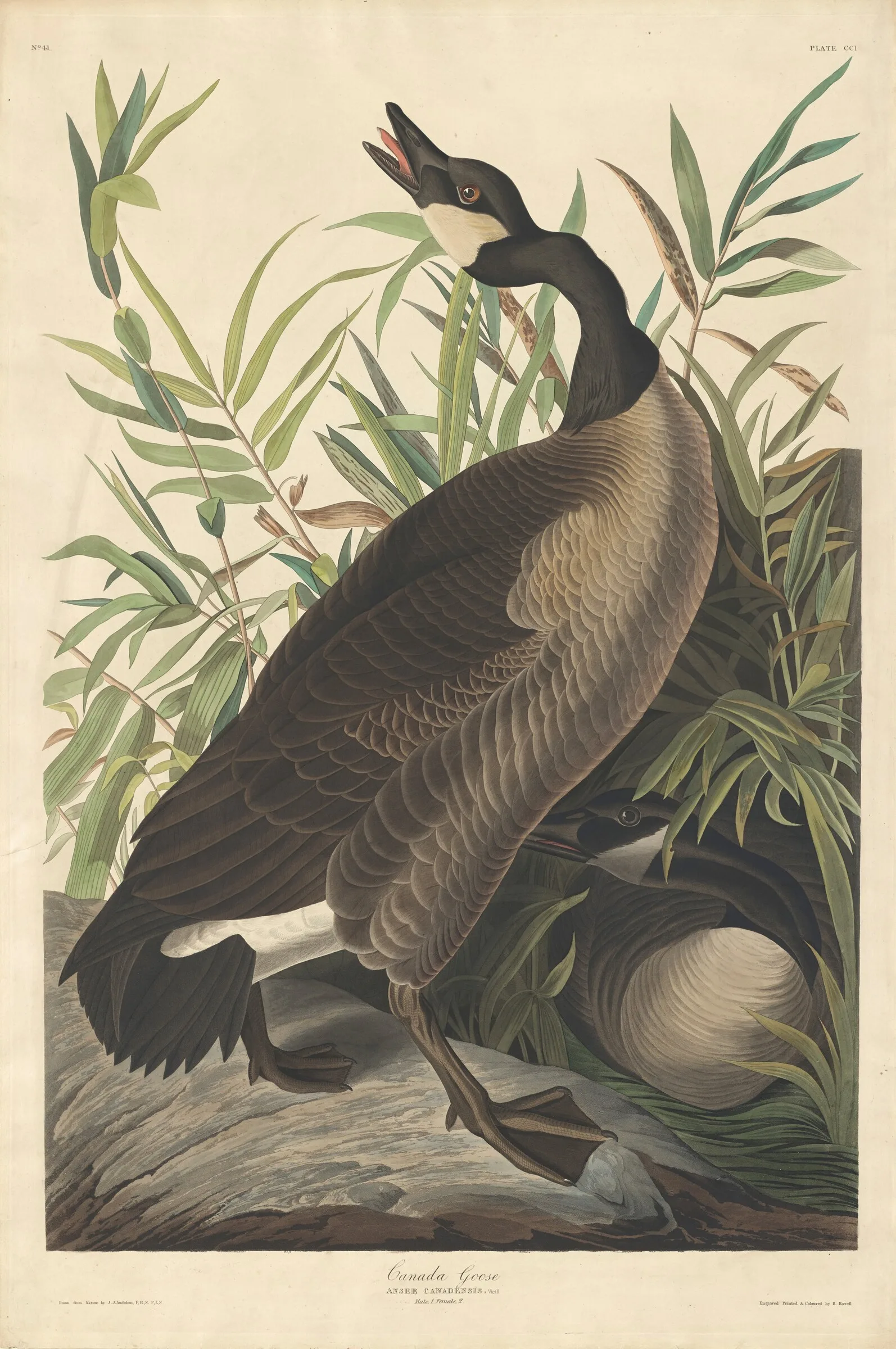
Audubon's “Canada Goose”, The Birds of America, plate CCI
Click or press Enter to enlarge
Open the full-resolution image (5865 px, National Gallery of Art)
| Plate | 201 (CCI) |
|---|---|
| Audubon's name | Canada Goose |
| Modern name | Canada Goose |
| Scientific name | Branta canadensis |
| Status | Least Concern |
| Engraved by | Robert Havell, after Audubon's watercolor |
| Date | 1834 |
| Medium | Hand-colored engraving and aquatint on Whatman wove paper |
| Size | plate: 98 x 65.5 cm (38 9/16 x 25 13/16 in.) sheet: 100.7 x 67.2 cm (39 5/8 x 26 7/16 in.) |
| Collections | Ducks, Geese and Swans |
| This impression | National Gallery of Art, Washington, 1945.8.201; Gift of Mrs. Walter B. James |
About this plate
Plate 201 shows a male and female Canada Goose, life size on the double elephant sheet. The birds have the black head and neck with a white chinstrap, brown back and pale breast familiar across North America. Audubon's text describes a gander's courtship of his mate and the fights between rival males, with hissing, wing blows and one male seizing the other's head in his bill.
Audubon called it Anser canadensis. It is now Branta canadensis. The small-bodied, short-necked northern birds that he would have known as variations were split off in 2004 as the Cackling Goose. Canada Geese breed across Canada and Alaska and, today, through most of the United States, where introduced and resident flocks live year-round on lawns, ponds and golf courses. It is listed as Least Concern.
In Audubon's day the bird was mainly a migrant in the East. He wrote that it bred only sparingly by lakes and rivers of the western districts, on Lake Erie and in a few pools in Massachusetts and Maine, and more commonly farther north and east. On the 1833 voyage he found geese sitting on eggs in the Magdalen Islands early in June, and in Labrador they bred on every suitable marshy plain.
He described spring flocks leaving the swampy prairies of Opelousas, the Arkansas River and the Florida Everglades from March to April, flying high, and smaller autumn flocks travelling lower.
In Audubon's words
I can imagine before me one who has just accomplished the defeat of another male after a struggle of half an hour or more. He advances gallantly towards the object of contention, his head scarcely raised an inch from the ground, his bill open to its full stretch, his fleshy tongue elevated, his eyes darting fiery glances, and as he moves he hisses loudly, while the emotion which he experiences, causes his quills to shake, and his feathers to rustle. Now he is close to her who in his eyes is all loveliness; his neck bending gracefully in all directions, passes all round her, and occasionally touches her body; and as she congratulates him on his victory, and acknowledges his affection, they move their necks in a hundred curious ways.
John James Audubon, Ornithological Biography, vol. 3 (1835), “The Canada Goose”. Read the full chapter.