Red-throated Loon (Plate 202)
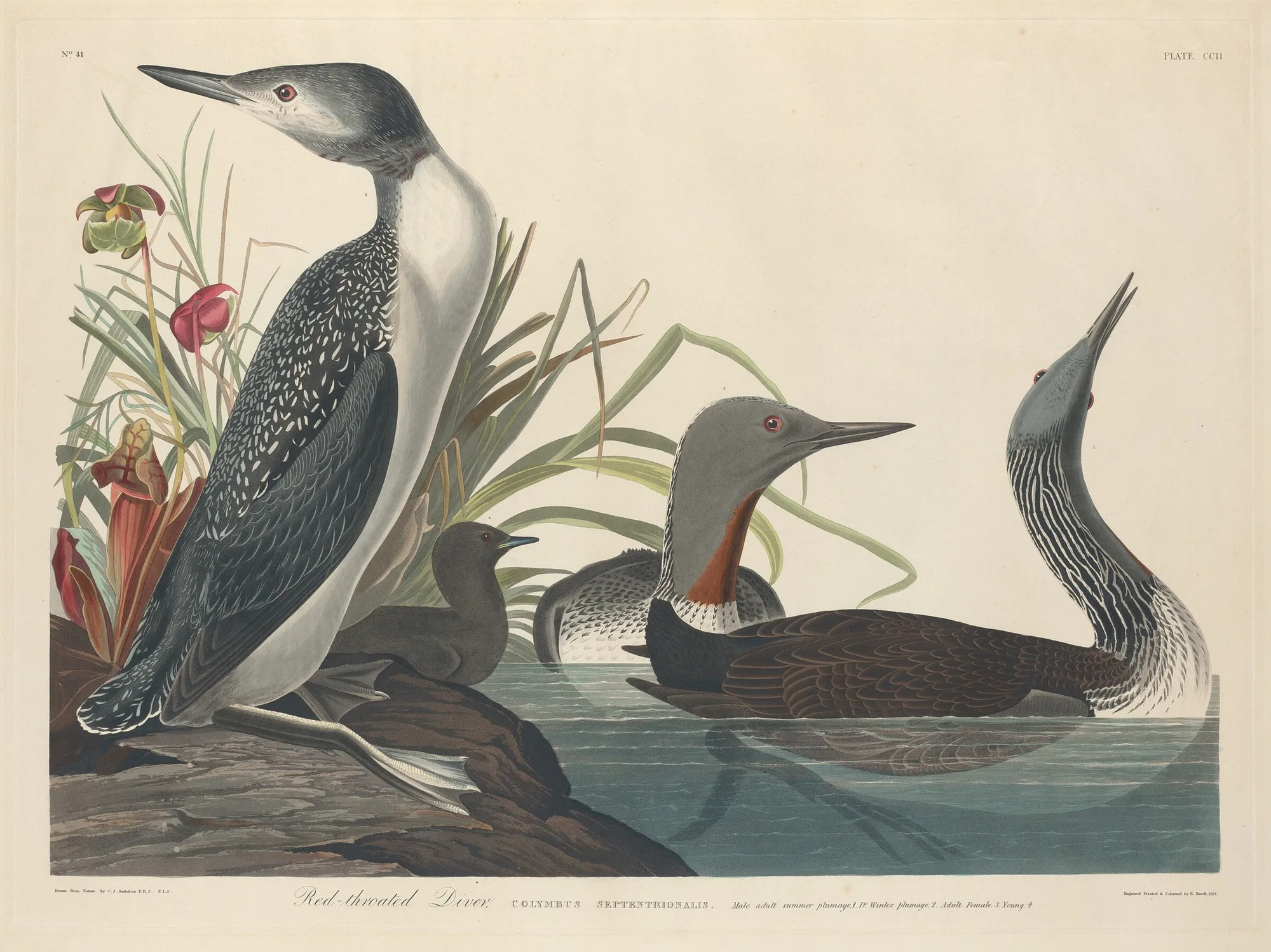
Audubon's “Red-throated Diver”, The Birds of America, plate CCII
Click or press Enter to enlarge
Open the full-resolution image (3551 px, National Gallery of Art)
| Plate | 202 (CCII) |
|---|---|
| Audubon's name | Red-throated Diver |
| Modern name | Red-throated Loon |
| Scientific name | Gavia stellata |
| Status | Least Concern |
| Engraved by | Robert Havell, after Audubon's watercolor |
| Date | 1834 |
| Medium | Hand-colored engraving and aquatint on Whatman wove paper |
| Collections | Seabirds |
| This impression | National Gallery of Art, Washington, 1945.8.202; Gift of Mrs. Walter B. James |
About this plate
Plate 202 shows Red-throated Loons in several plumages: an adult male in summer with a grey head and a dark red throat patch, a young male in winter, grey above with fine white speckling, a female, and a downy young bird. Audubon called it the Red-throated Diver, the name still used in Britain.
His Latin name was Colymbus septentrionalis. It is now Gavia stellata, the smallest and lightest of the loons. Unlike other loons it can take off from land or small ponds with a short run, and it often nests on tiny tundra pools and flies to the sea to feed. It breeds across the Arctic of North America, Europe and Asia and winters along both coasts of North America and in northern seas. It is listed as Least Concern.
The chapter opens with migrating pairs heading north in April, necks stretched and feet trailed behind, flying straight over sea and land. Audubon then follows them to the lakes of Labrador, describing the males' courtship flights and the pairs plunging and splashing together on the water.
He wrote that the birds began to breed in Labrador in early June and about two weeks earlier around the Bay of Fundy. All the nests his party found on the 1833 voyage were on small islands in freshwater lakes or ponds, rarely more than a mile from the sea. They were flat mats of grass close to the water, with no down and with beaten tracks leading to the water's edge.
In Audubon's words
Whilst the icicles are yet hanging from the rocks of our eastern shores, and the snows are gradually giving way under the influence of the April rains, the Bluebird is heard to sound the first notes of his love-song, and the Red-throated Diver is seen to commence his flight. Already paired, the male and female, side by side, move swiftly through the air, steering their course, at a great height, towards some far distant region of the dreary north. Pair after pair advance at intervals during the whole day, and perhaps continue their journey all night. Their long necks are extended, their feet stretched out rudder-like beyond the short tail, and onwards they speed, beating the air with great regularity. Now they traverse a great arm of the sea, now cross a peninsula; but let what may intervene, their undeviating course holds straight forwards, as the needle points to its pole.
John James Audubon, Ornithological Biography, vol. 3 (1835), “The Red-throated Diver”. Read the full chapter.