Horned Lark (Plate 200)
Audubon's “Shore Lark”, The Birds of America, plate CC
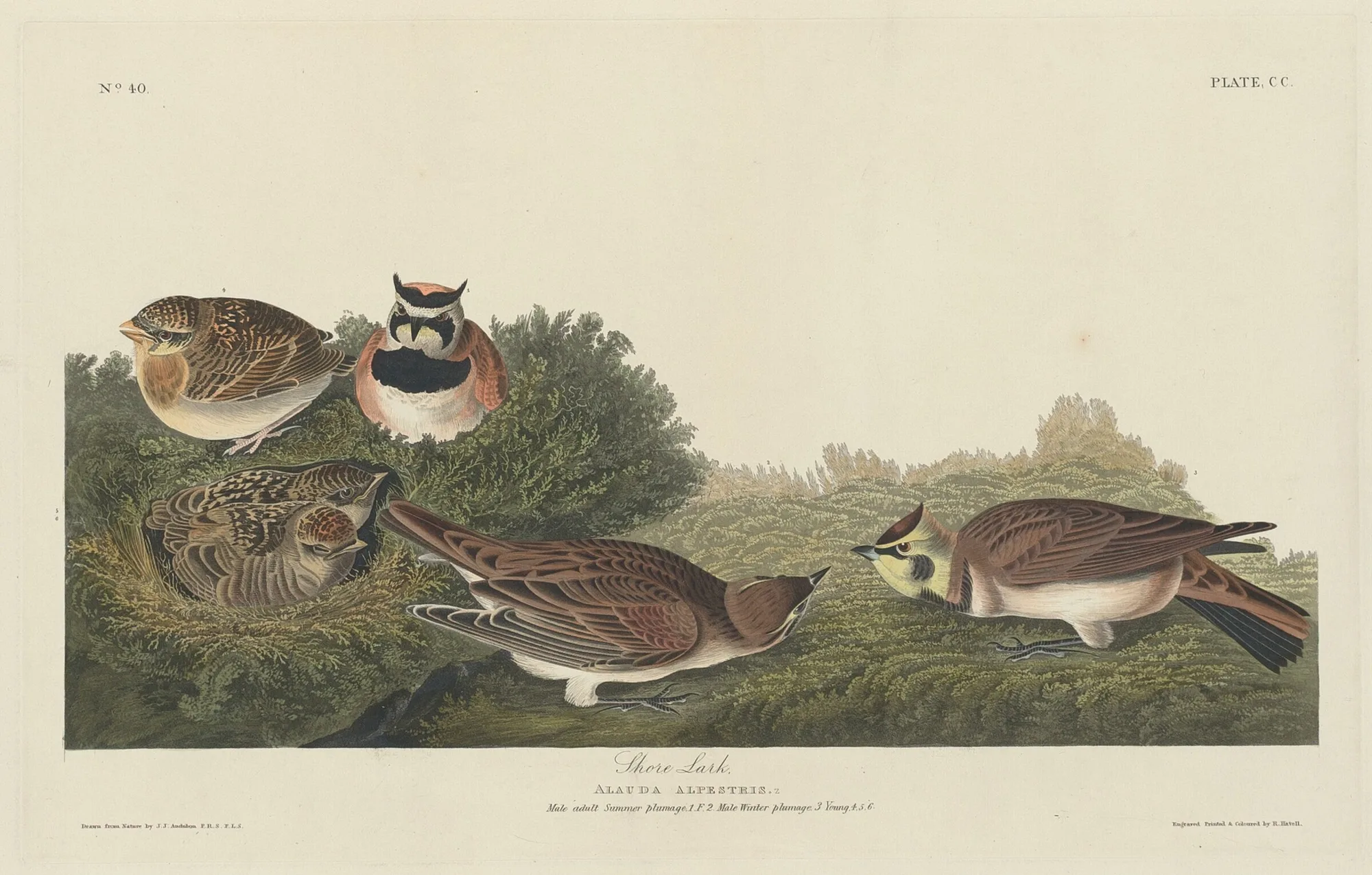
Click or press Enter to enlarge
Open the full-resolution image (2429 px, National Gallery of Art)
| Plate | 200 (CC) |
|---|---|
| Audubon's name | Shore Lark |
| Modern name | Horned Lark |
| Scientific name | Eremophila alpestris |
| Status | Least Concern |
| Engraved by | Robert Havell, after Audubon's watercolor |
| Date | 1834 |
| Medium | Hand-colored engraving and aquatint on Whatman wove paper |
| Collections | Songbirds |
| This impression | National Gallery of Art, Washington, 1945.8.200; Gift of Mrs. Walter B. James |
About this plate
Plate 200 shows a male, female and young Horned Lark, called the Shore Lark by Audubon and still by that name in Britain. The adults have a yellow and black face pattern, a black breast band and, in the male, two small black feather tufts on the crown. The young bird is speckled brown.
Audubon called it Alauda alpestris. It is now Eremophila alpestris, the only true lark native to the Americas. It breeds on tundra, prairies, deserts, beaches, airports and bare farm fields from the Arctic to Mexico, with an isolated population in Colombia, and across northern Eurasia. It is still widespread but North American numbers have dropped by more than half since 1970. It is listed as Least Concern.
Audubon studied it on the 1833 Labrador voyage. The chapter begins on 26 July, when the schooner Ripley groped through fog toward the harbour of Bras d'Or with a useless pilot, until the Eastport cod fisherman Billings guided them in through a narrow gap between rocks. Audubon described more than a hundred fishing vessels at anchor and the reek of split cod.
He then described the larks nesting in moss on the barrens in early July, the female feigning injury to lead intruders away, and the young running from the nest before they could fly. He wrote that adults followed his party almost to the boat, calling over their young.
In Audubon's words
The young leave the nest before they are able to fly, and follow their parents over the moss, where they are fed about a week. They run nimbly, emit a soft peep, and squat closely at the first appearance of danger. If observed and pursued, they open their wings to aid them in their escape, and separating, make off with great celerity. On such occasions it is difficult to secure more than one of them, unless several persons be present, when each can pursue a bird. The parents all this time are following the enemy overhead, lamenting the danger to which their young are exposed. In several instances, the old bird followed us almost to our boat, alighting occasionally on a projecting crag before us, and entreating us, as it were, to restore its offspring.
John James Audubon, Ornithological Biography, vol. 2 (1834), “The Shore Lark”. Read the full chapter.



