King Rail (Plate 203)
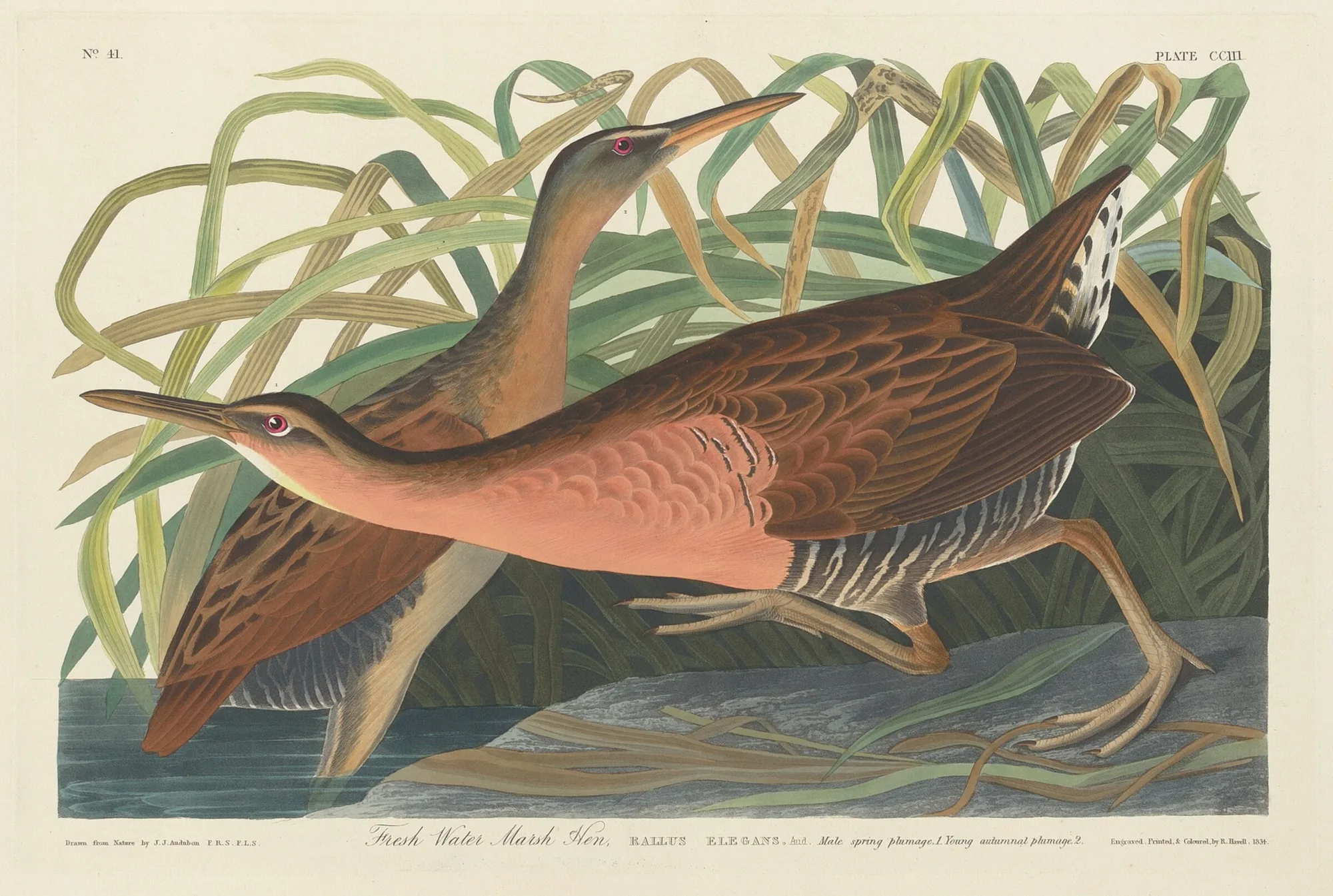
Audubon's “Fresh Water Marsh Hen”, The Birds of America, plate CCIII
Click or press Enter to enlarge
Open the full-resolution image (2421 px, National Gallery of Art)
| Plate | 203 (CCIII) |
|---|---|
| Audubon's name | Fresh Water Marsh Hen |
| Modern name | King Rail |
| Scientific name | Rallus elegans |
| Status | Near Threatened |
| Engraved by | Robert Havell, after Audubon's watercolor |
| Date | 1834 |
| Medium | Hand-colored engraving and aquatint on Whatman wove paper |
| Collections | Shorebirds, Rails and Cranes |
| This impression | National Gallery of Art, Washington, 1945.8.203; Gift of Mrs. Walter B. James |
About this plate
Plate 203 shows an adult King Rail and a young bird. Audubon engraved it as the Fresh Water Marsh Hen and in his text also called it the Great Red-breasted Rail. The adult has a long, slightly curved bill, a rich cinnamon breast, and black and white barring on the flanks. The young bird is darker and sooty.
Audubon used this chapter to correct Alexander Wilson, who had treated the King Rail as the adult of the Clapper Rail. Audubon and John Bachman studied both birds and showed they were distinct: the King Rail is larger and lives in fresh water, while the Clapper Rail never leaves the salt marshes. He named it Rallus elegans, and the name stands. The two species are close relatives and occasionally hybridise in brackish marshes.
The King Rail breeds in freshwater and brackish marshes of the eastern United States, most commonly along the Gulf and southern Atlantic coasts and in Florida, with scattered populations in the Midwest. It has declined sharply as wetlands were drained, and IUCN lists it as Near Threatened.
Audubon's first record was a female he caught at Henderson, Kentucky, on 29 May 1810. He noted then that it was very shy, ran fast and cried like a common fowl when caught. In July 1832 he killed another near Camden, New Jersey, with Edward Harris and Mr Ogden. He also recorded a bird found inside a moccasin snake that Bachman had killed.
In Audubon's words
No doubt exists in my mind that Wilson considered this beautiful bird as merely the adult of Rallus crepitans, the manners of which he described, as studied at Great Egg Harbour in New Jersey, while he gave in his works the figure and colouring of the present species. My friend Thomas Nuttall has done the same, without, I apprehend, having seen the two birds together. Always unwilling to find faults in so ardent a student of nature as Wilson, I felt almost mortified when, after having, in the company of my worthy and learned friend, the Reverend John Bachman, carefully examined the habits of both species, which, in form and general appearance, are closely allied, I discovered the error which he had in this instance committed.
John James Audubon, Ornithological Biography, vol. 3 (1835), “The Great Red-breasted Rail, or Fresh-water Marsh-hen”. Read the full chapter.