Wood Duck (Plate 206)
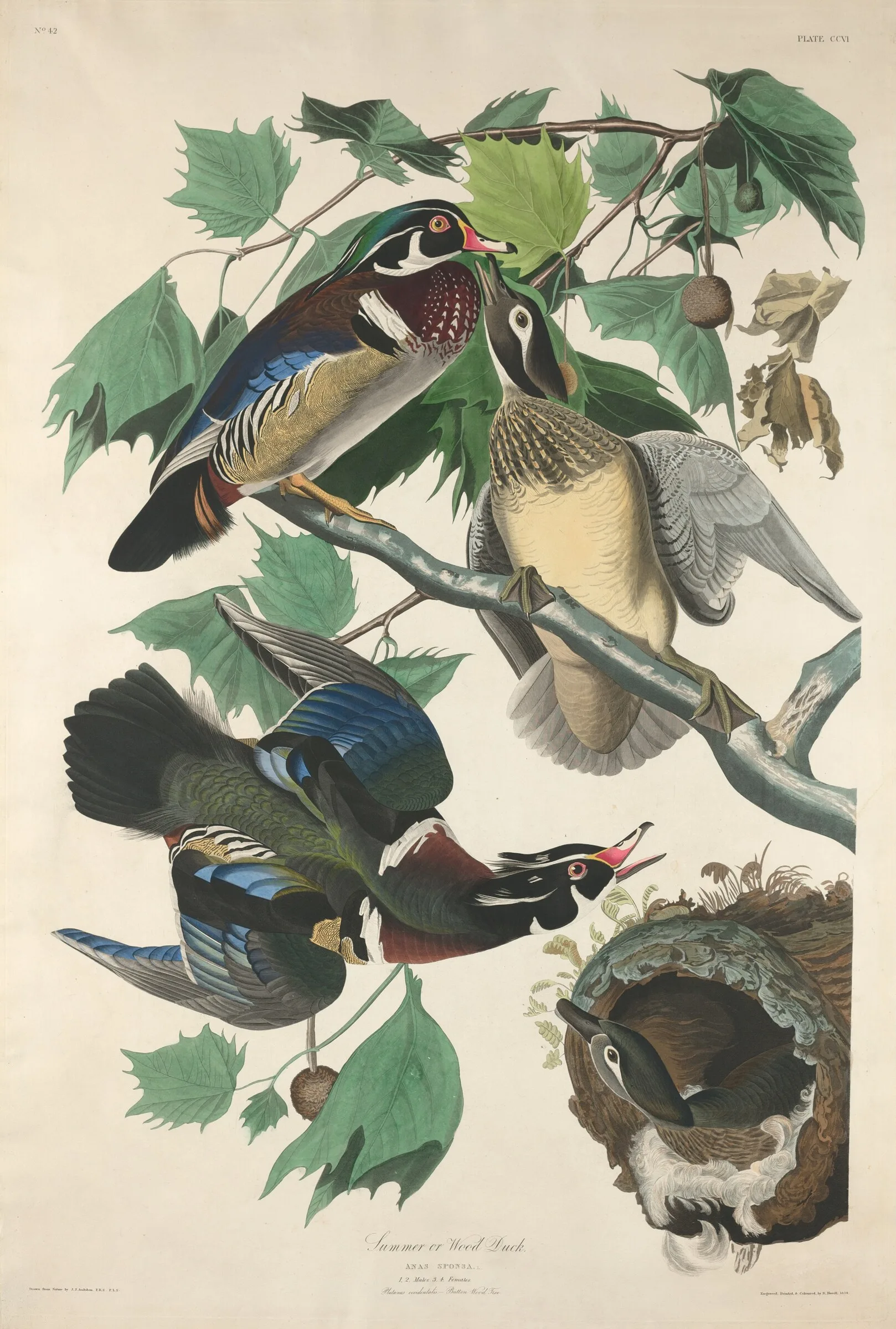
Audubon's “Summer or Wood Duck”, The Birds of America, plate CCVI
Click or press Enter to enlarge
Open the full-resolution image (4705 px, National Gallery of Art)
| Plate | 206 (CCVI) |
|---|---|
| Audubon's name | Summer or Wood Duck |
| Modern name | Wood Duck |
| Scientific name | Aix sponsa |
| Status | Least Concern |
| Engraved by | Robert Havell, after Audubon's watercolor |
| Date | 1834 |
| Medium | Hand-colored engraving and aquatint on Whatman wove paper |
| Size | plate: 97.2 x 65.4 cm (38 1/4 x 25 3/4 in.) sheet: 101 x 67.6 cm (39 3/4 x 26 5/8 in.) |
| Collections | Ducks, Geese and Swans |
| This impression | National Gallery of Art, Washington, 1945.8.206; Gift of Mrs. Walter B. James |
About this plate
Plate 206 shows two pairs of Wood Ducks around a tree, with the nest site Audubon listed among the figures. The males have the glossy green and purple crested head with white face lines, a chestnut breast and buff flanks. The females are grey-brown with a white teardrop around the eye. It is one of the most colourful plates in the duck series.
Audubon engraved it as the Summer or Wood Duck and called it Anas sponsa, meaning bride. It is now Aix sponsa, which it shares with the Mandarin Duck of eastern Asia. It nests in tree cavities, often well above the ground, and the ducklings jump to the ground a day after hatching. By about 1900 hunting and the felling of swamp forest had made it rare. Hunting limits and nest box programmes brought it back, and it is now common across eastern North America and the Pacific coast. It is listed as Least Concern.
The chapter opens with Audubon sitting by a huge sycamore over a dark bayou with canes along its bank, describing mosquitoes, ticks, a lizard, an otter with a fish, and then a flock of Wood Ducks sweeping in and settling on the water.
For three years running he found a pair near Henderson, Kentucky, nesting in an old Ivory-billed Woodpecker hole. He wrote that the eggs, six to fifteen, were laid on dry plants, feathers and a little down plucked from the female's breast, and that the male left as soon as the set was complete, joining flocks of other males until the young could fly.
In Audubon's words
A squirrel spread flat against a tree, with its head directed downwards, is watching me; the warblers, too, are peeping from among the twigs. On the water, the large bull-frogs are endeavouring to obtain a peep of the sun; suddenly there emerges the head of an otter, with a fish in its jaws, and in an instant my faithful dog plunges after him, but is speedily recalled. At this moment, when my heart is filled with delight, the rustling of wings comes sweeping through the woods, and anon there shoots overhead a flock of Wood Ducks. Once, twice, three times, have they rapidly swept over the stream, and now, having failed to discover any object of alarm, they all alight on its bosom, and sound a note of invitation to others yet distant.
John James Audubon, Ornithological Biography, vol. 3 (1835), “The Wood Duck”. Read the full chapter.