Virginia Rail (Plate 205)
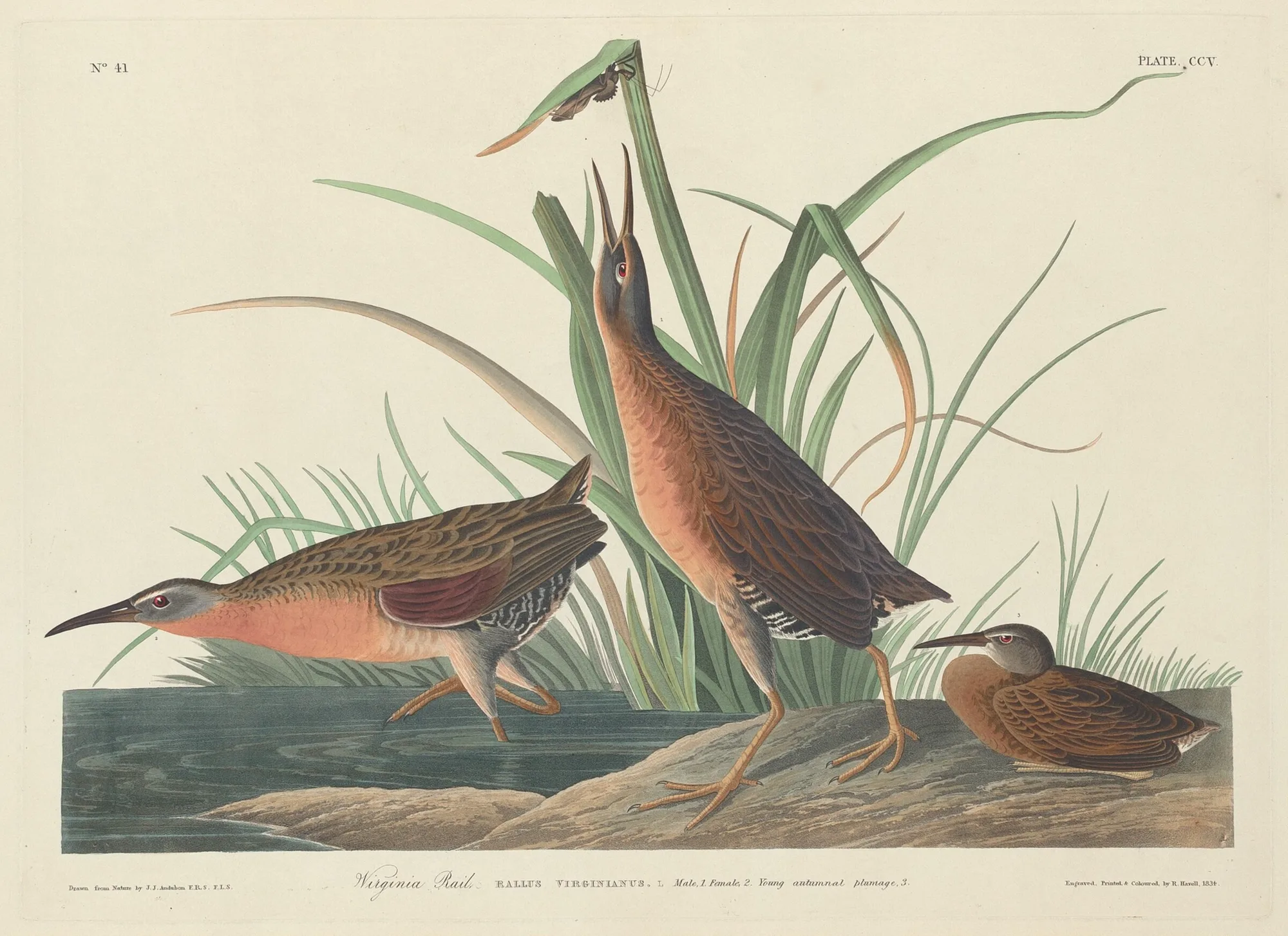
Audubon's “Virginia Rail”, The Birds of America, plate CCV
Click or press Enter to enlarge
Open the full-resolution image (2573 px, National Gallery of Art)
| Plate | 205 (CCV) |
|---|---|
| Audubon's name | Virginia Rail |
| Modern name | Virginia Rail |
| Scientific name | Rallus limicola |
| Status | Least Concern |
| Engraved by | Robert Havell, after Audubon's watercolor |
| Date | 1834 |
| Medium | Hand-colored engraving and aquatint on Whatman wove paper |
| Collections | Shorebirds, Rails and Cranes |
| This impression | National Gallery of Art, Washington, 1945.8.205; Gift of Mrs. Walter B. James |
About this plate
Plate 205 shows a male, female and young Virginia Rail. The adults are a smaller version of the King Rail, with a long, slightly drooping reddish bill, grey cheeks, a rusty breast and barred flanks. Audubon described the newly hatched young as covered in jet black down.
Audubon called it the Virginian Rail, Rallus virginianus. The species is now Rallus limicola. It breeds in freshwater and brackish marshes across southern Canada and much of the United States, and winters along the coasts and in the southern states and Mexico. It is secretive and far more often heard, giving grunting and ticking calls, than seen. It is listed as Least Concern.
Audubon wrote that in habits it fell between the Clapper Rail of salt marshes and the Sora of fresh meadows, and fed in both. He had found it from the Wabash River in Illinois to the St John River in New Brunswick, where people brought him birds as curiosities, and on the shores of Lakes Erie and Michigan, where it bred commonly.
He traced the breeding season by latitude: females on eggs near New Orleans in early March, near Henderson, Kentucky, in early April, about two weeks later near Vincennes, and from May to June in the Middle and Eastern States. He also saw them migrating by night, flying low and straight over rivers in bright moonlight.
In Audubon's words
The males usually arrive at the breeding-places a week or ten days before the females. They travel silently and by night, as I have ascertained by observing them proceed singly and in a direct course, at a height of only a few feet, over our broad rivers, or over level land, when their speed is such as is never manifested by them under ordinary circumstances. Their movements can be easily traced for fifty yards or so during nights of brilliant moonshine, when you see them passing with a constant beat of the wings, in the manner of a Green-winged Teal.
John James Audubon, Ornithological Biography, vol. 3 (1835), “The Virginian Rail”. Read the full chapter.



