Brown Booby (Plate 207)
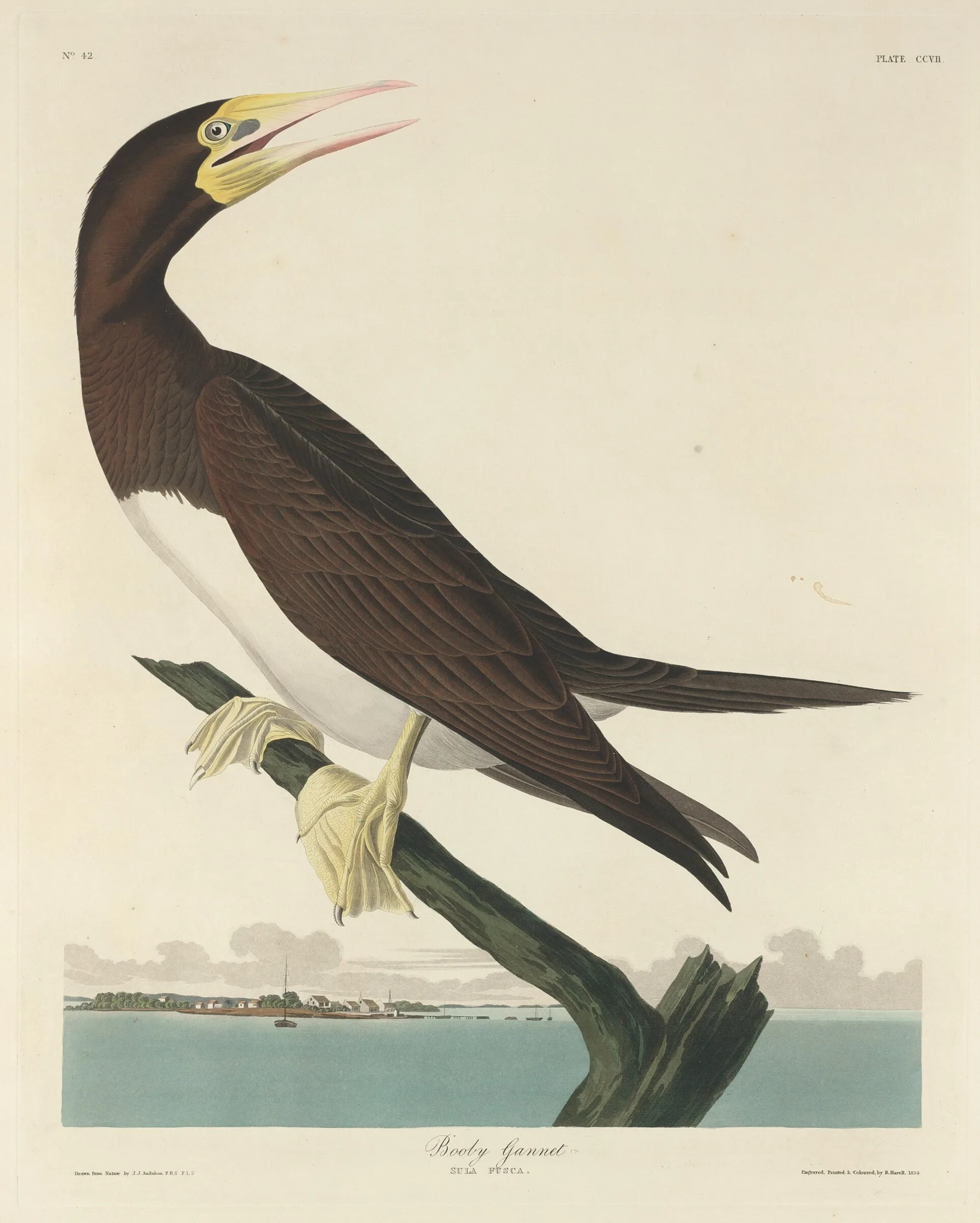
Audubon's “Booby Gannet”, The Birds of America, plate CCVII
Click or press Enter to enlarge
Open the full-resolution image (3240 px, National Gallery of Art)
| Plate | 207 (CCVII) |
|---|---|
| Audubon's name | Booby Gannet |
| Modern name | Brown Booby |
| Scientific name | Sula leucogaster |
| Status | Least Concern |
| Engraved by | Robert Havell, after Audubon's watercolor |
| Date | 1834 |
| Medium | Hand-colored engraving and aquatint on Whatman wove paper |
| Collections | Seabirds, Florida and Wading Birds |
| This impression | National Gallery of Art, Washington, 1945.8.207; Gift of Mrs. Walter B. James |
About this plate
Plate 207 shows a single male Brown Booby, which Audubon engraved as the Booby Gannet. The bird is chocolate brown on the head, neck and back, with a sharply divided white belly, a long pointed yellowish bill and pale feet.
Audubon called it Sula fusca. It is now Sula leucogaster. Boobies are tropical relatives of the gannets that dive from the air for fish and squid. The Brown Booby breeds on islands throughout the tropical Atlantic, Pacific and Indian Oceans and is seen regularly off southern Florida and the Dry Tortugas, where small numbers roost on channel markers and on the lighthouse at Fort Jefferson. It is listed as Least Concern.
Audubon met the bird in May 1832, as the revenue cutter Marion approached the Dry Tortugas. Boobies landed on the ship's top-yard at nightfall, and he noted their habit of roosting as high as possible, on bushes or upright poles. To reach the first one, perched on a snag fixed to a shallow reef, he and the pilot waded about a hundred yards through rough water known to hold sharks. The pilot fired, broke the bird's leg, and it flew off.
The party then sailed to Booby Island, a low sandbar about eight miles northeast of the Tortugas lighthouse, but the birds rose and scattered before the boat could land. Audubon also described boobies fishing far out at sea, plunging headlong to seize fish.
In Audubon's words
The first that was shot at, was approached with considerable difficulty: it had alighted on the prong of a tree which had floated and been fastened to the bottom of a rocky shallow at some distance from shore; the water was about four feet deep and quite rough; sharks we well knew were abundant around us; but the desire to procure the bird was too strong to be overcome by such obstacles. In an instant, the pilot and myself were over the sides of the boat, and onward we proceeded with our guns cocked and ready. The yawl was well manned, and its crew awaiting the result. After we had struggled through the turbulent waters about a hundred yards, my companion raised his gun and fired; but away flew the bird with a broken leg, and we saw no more of it that day.
John James Audubon, Ornithological Biography, vol. 3 (1835), “The Booby Gannet”. Read the full chapter.