Ring-billed Gull (Plate 212)
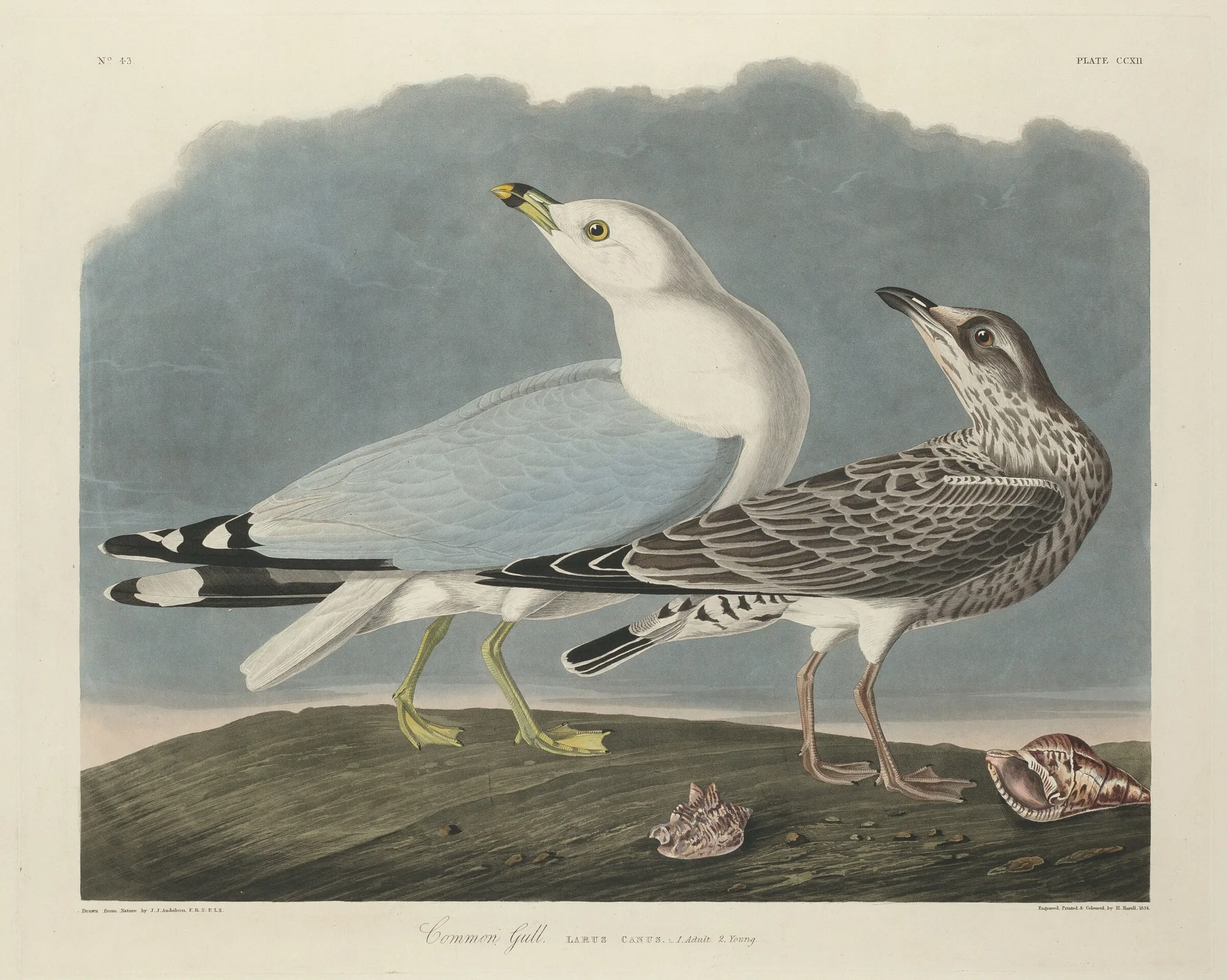
Audubon's “Common Gull”, The Birds of America, plate CCXII
Click or press Enter to enlarge
Open the full-resolution image (3218 px, National Gallery of Art)
| Plate | 212 (CCXII) |
|---|---|
| Audubon's name | Common Gull |
| Modern name | Ring-billed Gull |
| Scientific name | Larus delawarensis |
| Status | Least Concern |
| Engraved by | Robert Havell, after Audubon's watercolor |
| Date | 1834 |
| Medium | Hand-colored engraving and aquatint on Whatman wove paper |
| Collections | Seabirds |
| This impression | National Gallery of Art, Washington, 1945.8.212; Gift of Mrs. Walter B. James |
About this plate
Plate 212 shows an adult male Ring-billed Gull and a young bird, both in winter plumage. The adult is pale grey above with black wingtips, yellow legs and a yellow bill with a black ring near the tip. The young bird is mottled brown and grey with a dark-tipped pink bill.
Audubon engraved it as the Common Gull and called it the Common American Gull, using Richardson's name Larus zonorhynchus, meaning band-billed. It is now Larus delawarensis, the Ring-billed Gull. It is not the Common Gull of Europe, which is a different species, Larus canus. The Ring-billed Gull breeds on islands in lakes across the northern United States and Canada and winters south to Mexico and the Caribbean. It recovered from heavy declines in the early 1900s and is now one of the most numerous gulls in North America, common in parking lots, fields and city waterfronts. It is listed as Least Concern.
Audubon's chapter is mostly about inland migration. He described gulls and terns travelling from Labrador up the St Lawrence to the Great Lakes and then down the Ohio and Mississippi to the Gulf of Mexico. He saw them gather at the Falls of the Ohio and around shipping on the big rivers, picking up garbage thrown overboard.
He also wrote of birds of this species appearing far out at sea beside his ship, taking bread from the passengers, then flying off suddenly toward land.
In Audubon's words
No country can afford greater facilities for the migration of water-birds than the United States of America. Even the Gulls are enabled to traverse their whole extent from north to south, and in the contrary direction, without suffering from want of food or of proper resting places. The Gull that has been bred in Labrador, or still farther north, can reach the Gulf of Mexico without being seriously incommoded by the storms that now and then rage along the Atlantic coast. The broad waters of the St Lawrence leads it to our great lakes, from which hundreds of streams conduct it to the head waters of the Ohio or the Mississippi, by following the windings of which it at length arrives in the warm regions of the Mexican Gulf, on whose waters the traveller can spend the winter.
John James Audubon, Ornithological Biography, vol. 3 (1835), “The Common American Gull”. Read the full chapter.



