Great Blue Heron (Plate 211)
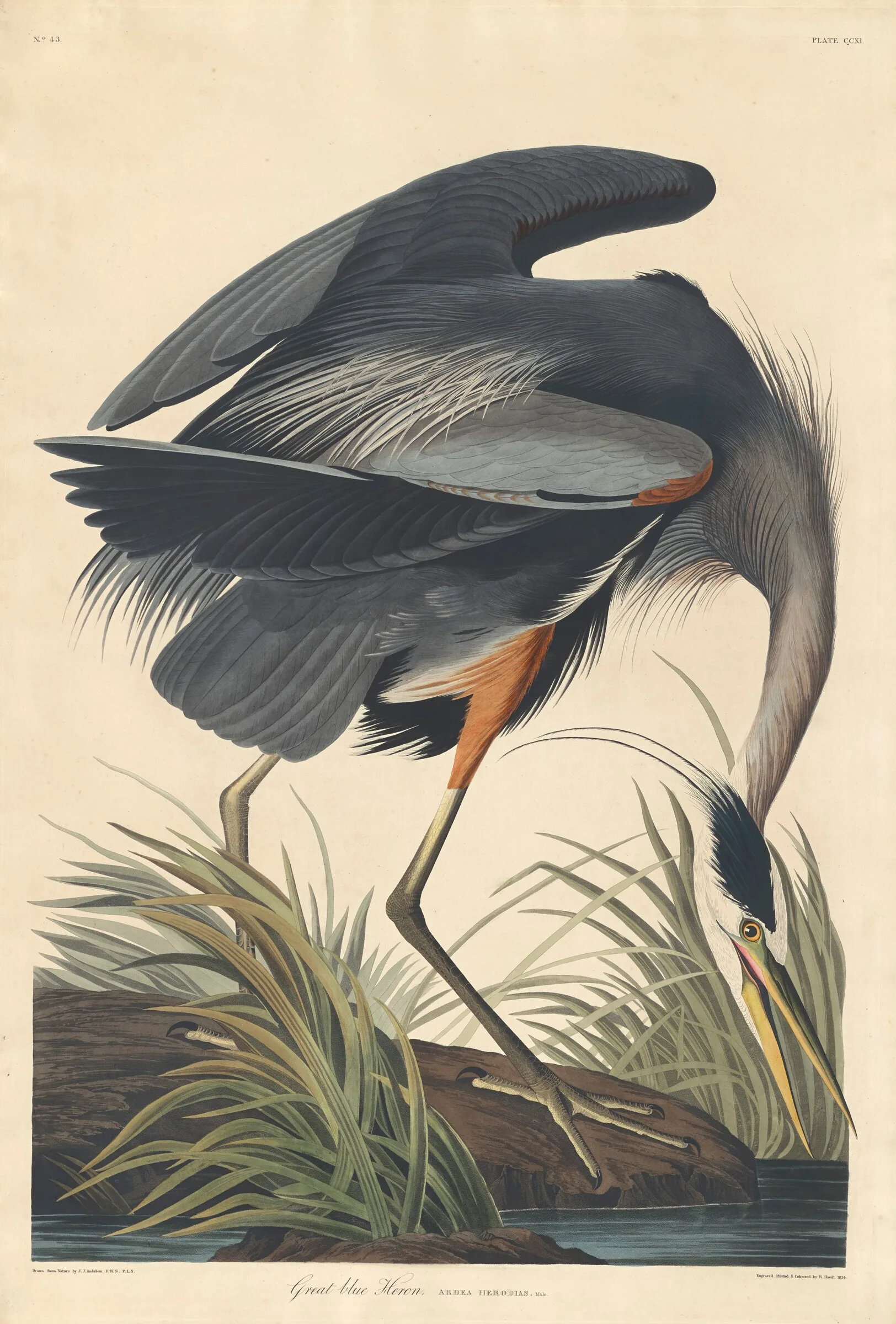
Audubon's “Great blue Heron”, The Birds of America, plate CCXI
Click or press Enter to enlarge
Open the full-resolution image (5737 px, National Gallery of Art)
| Plate | 211 (CCXI) |
|---|---|
| Audubon's name | Great blue Heron |
| Modern name | Great Blue Heron |
| Scientific name | Ardea herodias |
| Status | Least Concern |
| Engraved by | Robert Havell, after Audubon's watercolor |
| Date | 1834 |
| Medium | Hand-colored engraving and aquatint on Whatman wove paper |
| Size | plate: 97.2 x 65.8 cm (38 1/4 x 25 7/8 in.) sheet: 101 x 68.5 cm (39 3/4 x 26 15/16 in.) |
| Collections | Herons and Egrets, Florida and Wading Birds |
| This impression | National Gallery of Art, Washington, 1945.8.211; Gift of Mrs. Walter B. James |
About this plate
Plate 211 shows a single adult male Great Blue Heron, life size, in profile at the water's edge. The bird has the black plume over the eye, the grey-blue body and chestnut thighs of breeding plumage, and the neck is stretched forward in a hunting stance.
Audubon called it Ardea herodias, the name it still carries. It is the largest heron in North America, found from southern Canada through the United States to Mexico, the Caribbean and the Galapagos. It hunts fish, frogs, rodents and other small animals in almost any shallow water and nests in colonies in tall trees. It is listed as Least Concern.
The chapter begins on the banks of the Ohio, where Audubon invites the reader to watch a heron stand like a statue, strike a perch, beat it to death on the ground and swallow it. He wrote that the bird was known across the United States as the Blue Crane, that he had seen it in every state and territory he visited, and that he found no herons at all in Newfoundland or Labrador.
He also described breeding season combat, with males fighting with open bills and wings like expert swordsmen. He watched such fights for half an hour at a time and never saw a bird killed, though he often saw one felled and trampled.
In Audubon's words
Look on the one that stands near the margin of the pure stream:—see his reflection dipping as it were into the smooth water, the bottom of which it might reach had it not to contend with the numerous boughs of those magnificent trees. How calm, how silent, how grand is the scene! The tread of the tall bird himself no one hears, so carefully does he place his foot on the moist ground, cautiously suspending it for a while at each step of his progress. Now his golden eye glances over the surrounding objects, in surveying which he takes advantage of the full stretch of his graceful neck. Satisfied that no danger is near, he lays his head on his shoulders, allows the feathers of his breast to droop, and patiently awaits the approach of his finned prey. You might imagine what you see to be the statue of a bird, so motionless is it.
John James Audubon, Ornithological Biography, vol. 3 (1835), “The Great Blue Heron”. Read the full chapter.
Great Blue Heron (Plate 211): the story behind one of the most famous plates in the collection →