Atlantic Puffin (Plate 213)
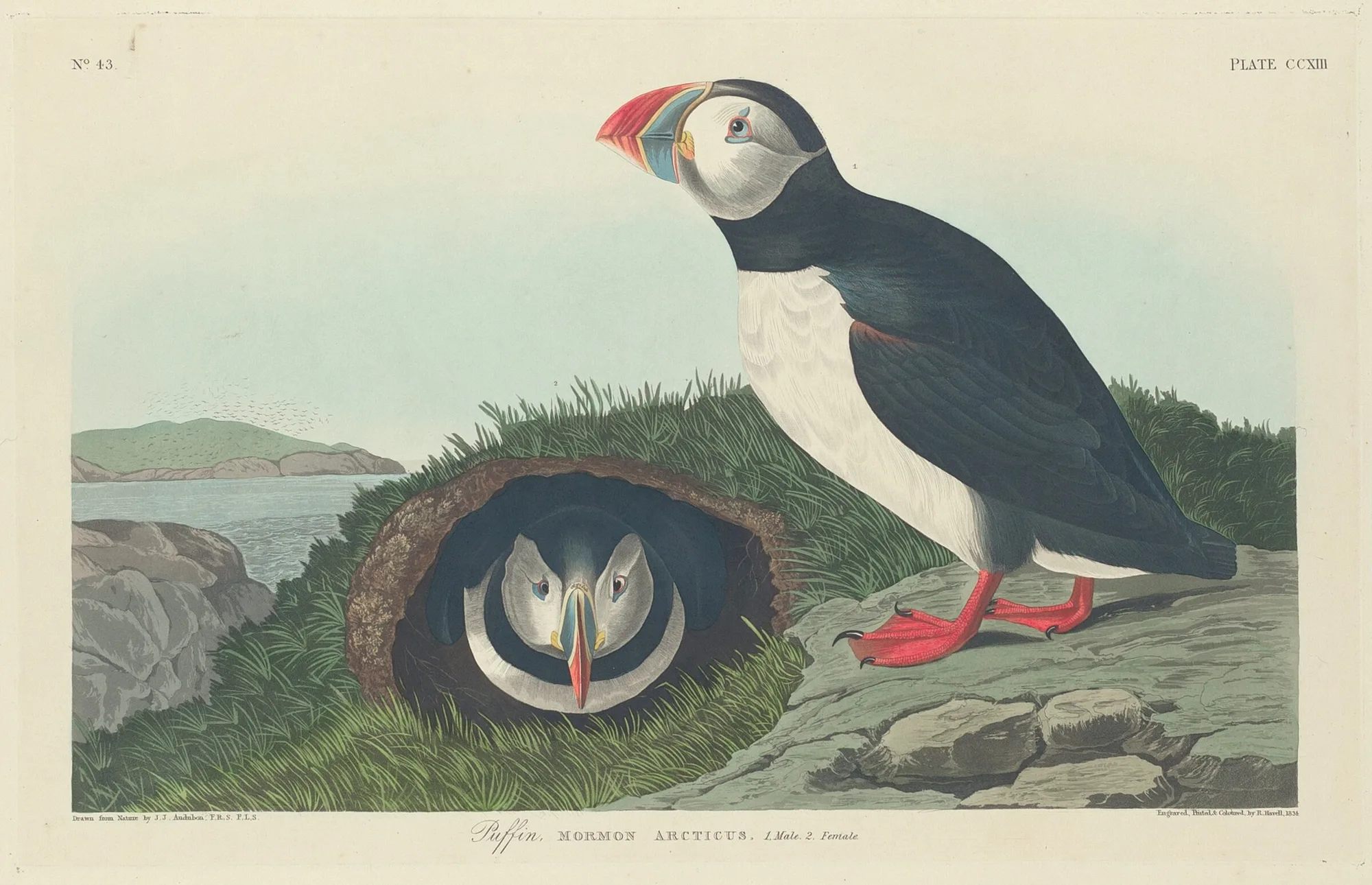
Audubon's “Puffin”, The Birds of America, plate CCXIII
Click or press Enter to enlarge
Open the full-resolution image (2405 px, National Gallery of Art)
| Plate | 213 (CCXIII) |
|---|---|
| Audubon's name | Puffin |
| Modern name | Atlantic Puffin |
| Scientific name | Fratercula arctica |
| Status | Vulnerable |
| Engraved by | Robert Havell, after Audubon's watercolor |
| Date | 1834 |
| Medium | Hand-colored engraving and aquatint on Whatman wove paper |
| Size | plate: 31.8 x 49.9 cm (12 1/2 x 19 5/8 in.) sheet: 68.3 x 99.1 cm (26 7/8 x 39 in.) |
| Collections | Seabirds |
| This impression | National Gallery of Art, Washington, 1945.8.213; Gift of Mrs. Walter B. James |
About this plate
Plate 213 shows a male and female Atlantic Puffin on a rocky coast. The birds are in breeding plumage, with black backs, white faces and the tall red, blue and yellow bill plates that grow each spring and are shed after the season. Audubon wrote that the bird was known on the American coast and in Newfoundland and Labrador as the Sea Parrot.
Audubon called it Mormon arcticus. It is now Fratercula arctica, the only puffin of the Atlantic. It breeds in burrows on grassy islands and cliffs from Maine and Newfoundland to Greenland, Iceland, Britain and Norway, and spends the winter at sea. Its global status is Vulnerable because of large declines in Europe linked to food shortages. In Maine, puffins were wiped out on most islands by the late 1800s and were brought back by a reintroduction project beginning in 1973.
Audubon saw that decline beginning. He wrote that many still bred on islands at the entrance to the Bay of Fundy, but perhaps not one for every hundred that had nested there twenty years before. He also saw a good number at the mouth of the Savannah River in Georgia in the winter of 1831 to 1832, which he thought unusual.
On the 1833 Labrador voyage he saw puffins daily, sometimes covering half an acre of sea. He described landing on a grassy island so honeycombed with burrows that men fell through at every step, where the birds bit and scratched hard when handled.
In Audubon's words
Those which happened to be caught alive in the hand bit most severely, and scratched with their claws at such a rate that we were glad to let them escape. The burrows here communicated in various ways with each other, so that the whole island was perforated as if by a multitude of subterranean labyrinths, over which one could not run without the risk of falling at almost every step. The voices of the young sounded beneath our feet like voices from the grave, and the stench was extremely disagreeable, so that as soon as our boats were filled with birds we were glad to get away.
John James Audubon, Ornithological Biography, vol. 3 (1835), “The Puffin”. Read the full chapter.