Razorbill (Plate 214)
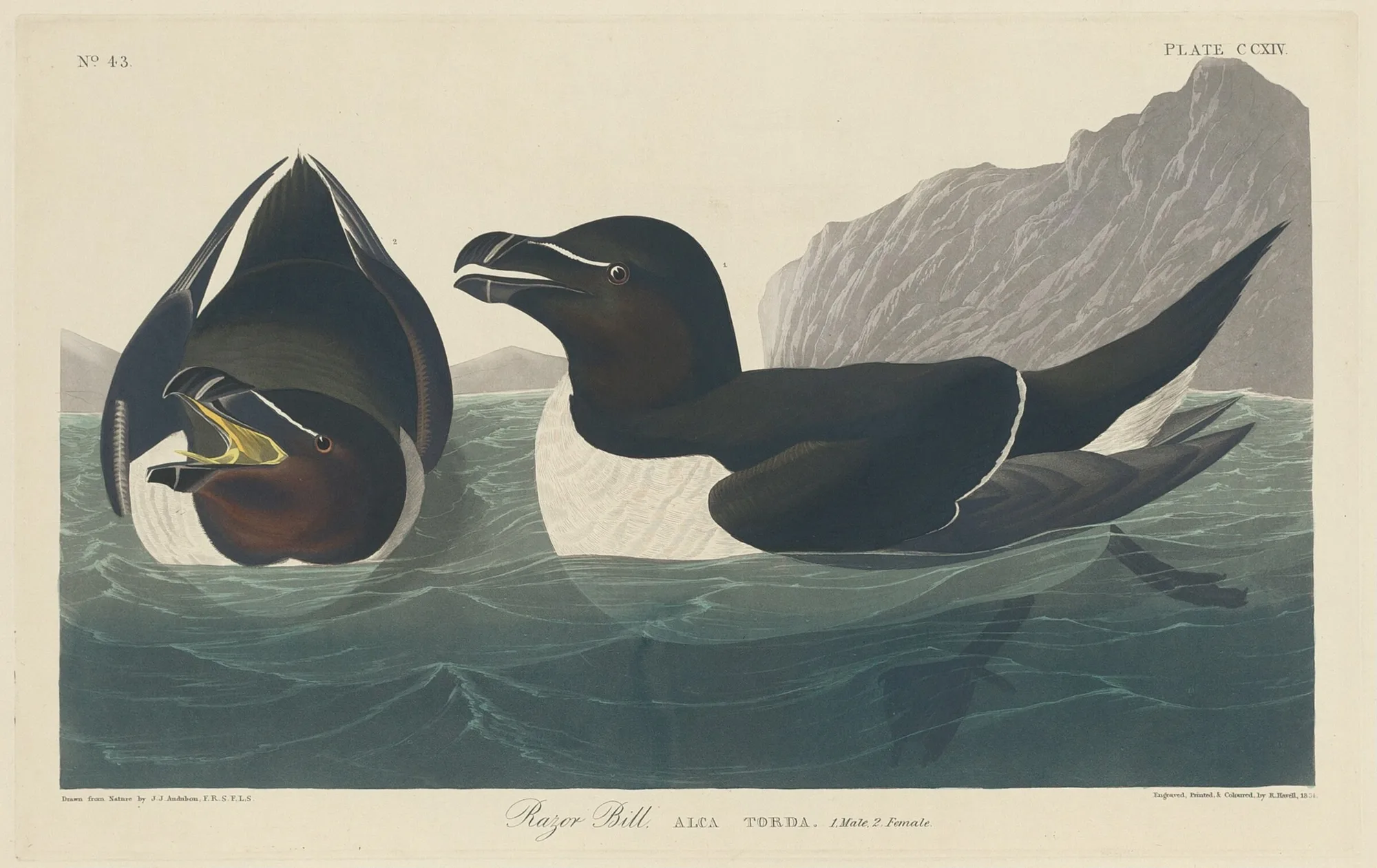
Audubon's “Razor Bill”, The Birds of America, plate CCXIV
Click or press Enter to enlarge
Open the full-resolution image (2415 px, National Gallery of Art)
| Plate | 214 (CCXIV) |
|---|---|
| Audubon's name | Razor Bill |
| Modern name | Razorbill |
| Scientific name | Alca torda |
| Status | Least Concern |
| Engraved by | Robert Havell, after Audubon's watercolor |
| Date | 1834 |
| Medium | Hand-colored engraving and aquatint on Whatman wove paper |
| Collections | Seabirds |
| This impression | National Gallery of Art, Washington, 1945.8.214; Gift of Mrs. Walter B. James |
About this plate
Plate 214 shows a male and female Razorbill, which Audubon called the Razor-billed Auk. The birds are black above and white below, with a thick, flattened black bill crossed by a white line and a thin white line from the bill to the eye. The Razorbill is the closest living relative of the extinct Great Auk.
Audubon called it Alca torda, the name still in use. It breeds on rocky islands and cliffs in the North Atlantic, from the Gulf of Maine and the Gulf of St Lawrence to Labrador, Greenland, Iceland and northern Europe, laying a single egg in a crevice or on a ledge. It winters at sea, south along the Atlantic coast. It is listed as Least Concern.
Audubon wrote that a few came as far south as New York in winter and that some bred on the Seal Islands off the Bay of Fundy. He watched them fish on banks fifteen to eighteen fathoms deep and believed they dived to the bottom. On the 1833 voyage, inhabitants of the Magdalen Islands told him the birds arrived in mid-April while the Gulf was still covered with ice.
Approaching Labrador, he watched long files of Razorbills pass close to the Ripley, turning white and black in turn. He found them the shyest of the seabirds, and described a visit to their breeding fissures near the harbour he called Whapati Guan, where sailors shot many.
In Audubon's words
As we proceeded towards Labrador, they passed us every now and then in long files, flying at the height of a few yards from the water, in a rather undulating manner, with a constant beat of the wings, often within musket-shot of our vessel, and sometimes moving round us and coming so close as to induce us to believe that they had a wish to alight. The thermometer indicated 44°. The sight of these files of birds passing swiftly by was extremely pleasing; each bird would alternately turn towards us the pure white of its lower parts, and again the jetty black of the upper. As I expected ere many days should pass to have the gratification of inspecting their breeding grounds, I experienced great delight in observing them as they sped their flight toward the north.
John James Audubon, Ornithological Biography, vol. 3 (1835), “The Razor-billed Auk”. Read the full chapter.



