Red-necked Phalarope (Plate 215)
Audubon's “Hyperborean Phalarope”, The Birds of America, plate CCXV
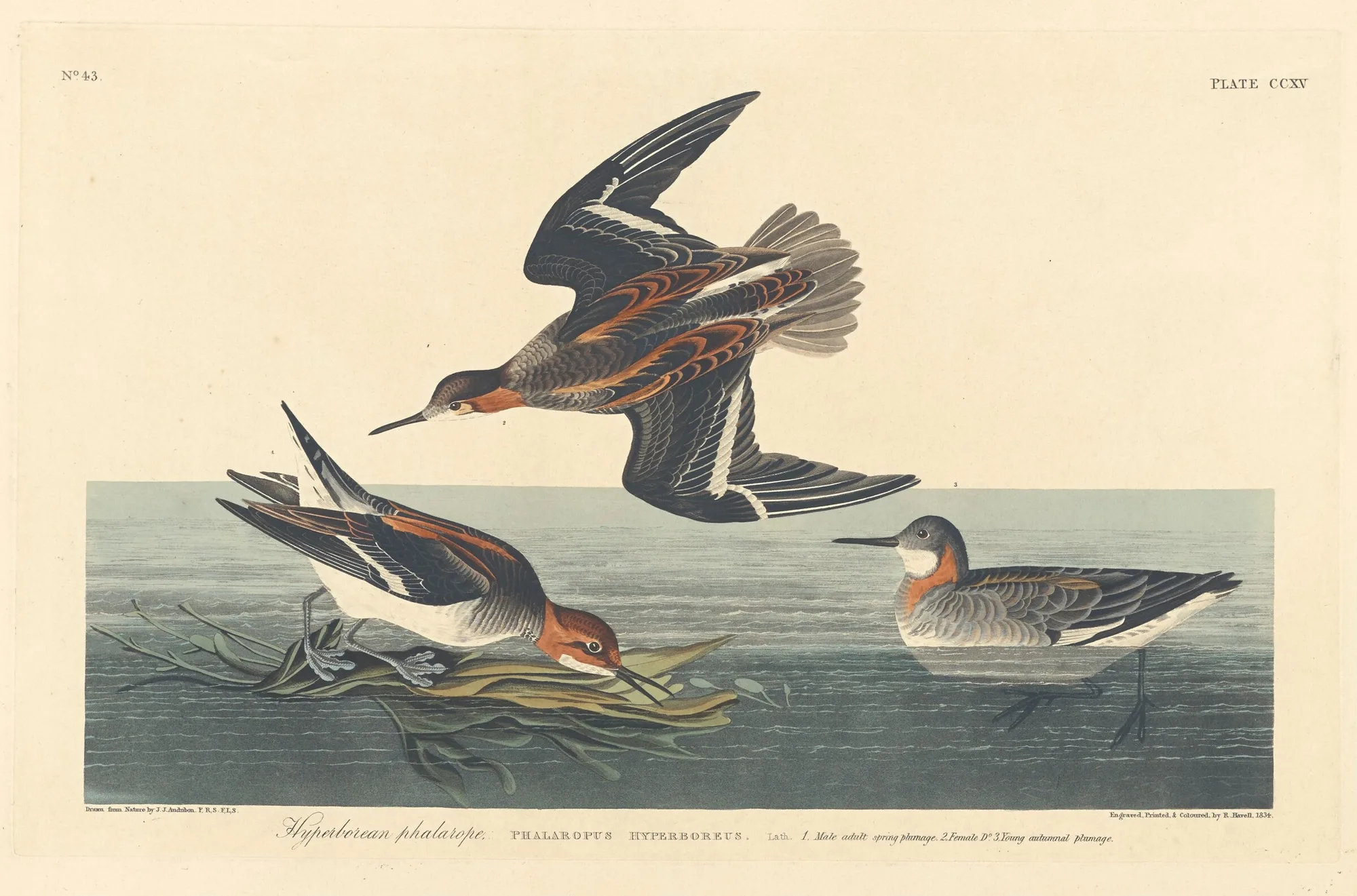
Click or press Enter to enlarge
Open the full-resolution image (2977 px, National Gallery of Art)
| Plate | 215 (CCXV) |
|---|---|
| Audubon's name | Hyperborean Phalarope |
| Modern name | Red-necked Phalarope |
| Scientific name | Phalaropus lobatus |
| Status | Least Concern |
| Engraved by | Robert Havell, after Audubon's watercolor |
| Date | 1834 |
| Medium | Hand-colored engraving and aquatint on Whatman wove paper |
| Collections | Shorebirds, Rails and Cranes |
| This impression | National Gallery of Art, Washington, 1945.8.215; Gift of Mrs. Walter B. James |
About this plate
Plate 215 shows a male, female and young Red-necked Phalarope, which Audubon called the Hyperborean Phalarope. As in all phalaropes, the female is the brighter bird, with a slate-grey head, a white throat and a rich chestnut band on the neck. The male is duller and takes on incubation and care of the young.
Audubon called it Phalaropus hyperboreus. It is now Phalaropus lobatus. It breeds on tundra ponds and bogs around the Arctic and spends the winter far out at sea, mainly off western South America, in the Arabian Sea and in parts of Southeast Asia. Flocks spin in tight circles on the water to stir up small prey. It is listed as Least Concern, though the huge flocks that once gathered in the Bay of Fundy have largely disappeared.
Audubon described flocks of sixty to more than a hundred in May around Eastport, Maine, and in the Bay of Fundy, where his son John shot several. Local gunners called them Sea Geese. He noted that they swam like ducks, floated as lightly as gulls, walked over floating seaweed and garbage, and bunched together when threatened. He also met flocks more than a hundred miles offshore, sometimes with Red Phalaropes.
In Labrador in 1833 he found them in small parties at freshwater ponds, nesting in a hollow in the herbage lined with grass and moss, with four eggs.
In Audubon's words
They procure their food principally upon the water, on which they alight like Ducks, float as light as Gulls, and move about in search of food with much nimbleness. The sight of a bank of floating sea-weeds or garbage of any kind induces them at once to alight upon it, when they walk about as unconcernedly as if on land. Their notes, which resemble the syllables tweet, tweet, tweet, are sharp and clear, and in their flight they resemble our common American Snipe. At the approach of an enemy, they immediately close their ranks, until they almost touch each other, when great havock is made among them; but if not immediately shot at, they rise all at once and fly swiftly off emitting their shrill cries, and remove to a great distance.
John James Audubon, Ornithological Biography, vol. 3 (1835), “Hyperborean Phalarope”. Read the full chapter.



