Common Murre (Plate 218)
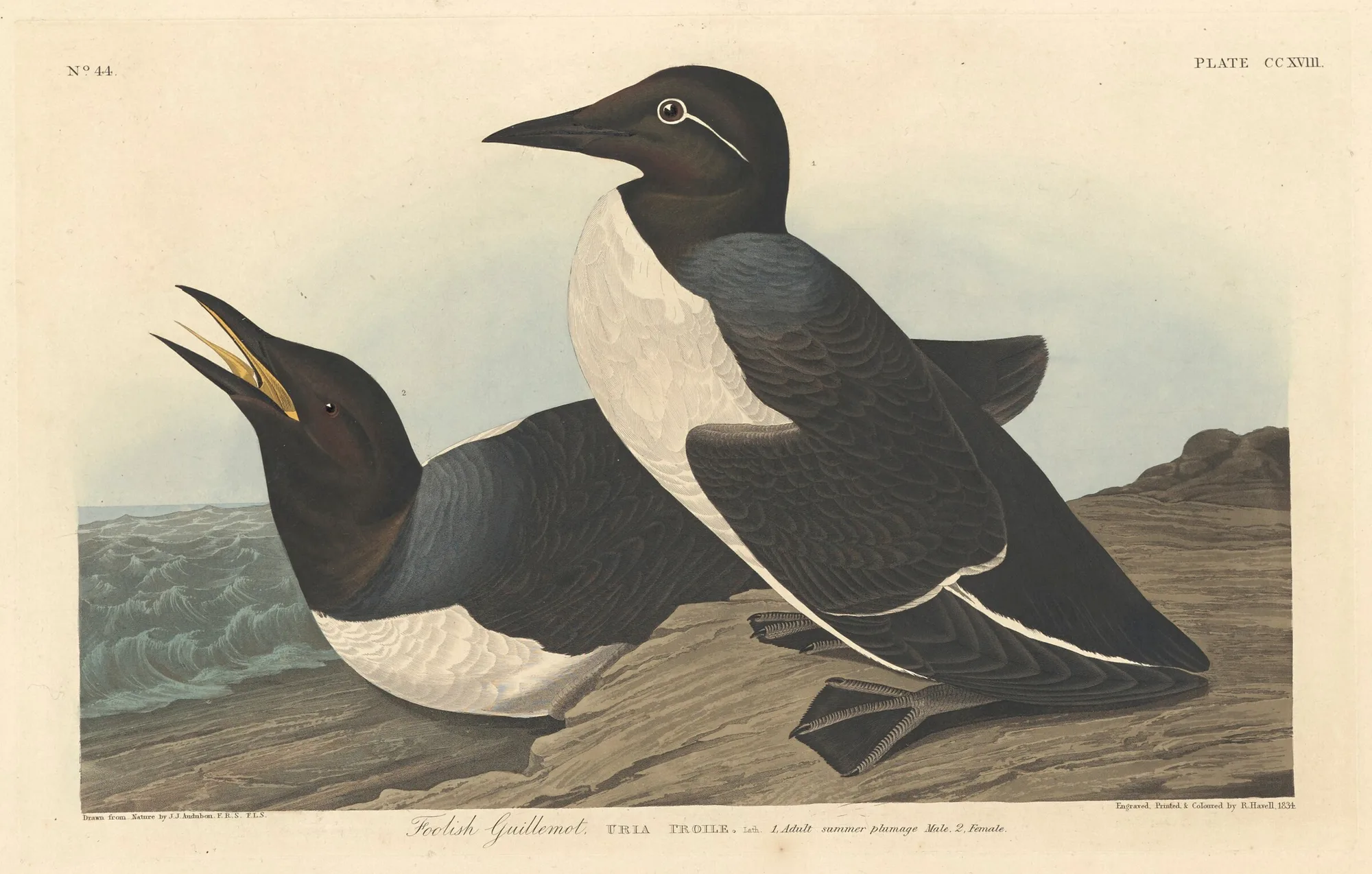
Audubon's “Foolish Guillemot”, The Birds of America, plate CCXVIII
Click or press Enter to enlarge
Open the full-resolution image (3000 px, National Gallery of Art)
| Plate | 218 (CCXVIII) |
|---|---|
| Audubon's name | Foolish Guillemot |
| Modern name | Common Murre |
| Scientific name | Uria aalge |
| Status | Least Concern |
| Engraved by | Robert Havell, after Audubon's watercolor |
| Date | 1834 |
| Medium | Hand-colored engraving and aquatint on Whatman wove paper |
| Collections | Seabirds |
| This impression | National Gallery of Art, Washington, 1945.8.218; Gift of Mrs. Walter B. James |
About this plate
Plate 218 shows a male and female Common Murre, which Audubon called the Foolish Guillemot. The birds are dark brown above and white below, with a long, slender, pointed bill. Murres stand upright on cliff ledges like small penguins.
Audubon called it Uria troile. It is now Uria aalge, the Common Murre in North America and the Common Guillemot in Britain. It breeds in dense colonies on cliff ledges in the North Atlantic and North Pacific, laying a single pear-shaped egg on bare rock. The eggs vary greatly in colour and pattern, and Audubon wrote that they were white when first laid. The species is listed as Least Concern, though a heat wave in the northeast Pacific in 2015 and 2016 killed millions of birds.
Audubon reported that an old gunner he employed in Boston in the winter of 1832 to 1833 remembered murres breeding on rocky islands at the mouth of the bay, but said none had stayed past early April for about twenty years. In the Bay of Fundy, Newfoundland and Labrador the bird was called the Murre and bred in myriads.
He described murres riding storm waves unconcerned at the bow of the Ripley while the crew struggled. He also described the eggers who took eggs in huge numbers for distant markets, where they sold for one to three cents each. Egging and shooting greatly reduced the Labrador colonies later in the century.
In Audubon's words
A very old gunner whom I employed while at Boston, during the winter of 1832-3, assured me, that when he was a young man, this species bred on many of the rocky islands about the mouth of the bay there; but that for about twenty years back none remained after the first days of April, when they departed for the north in company with the Thick-billed Guillemot, the Common Auk, the Puffin, and the Eider and King Ducks, all of which visit these bays in hard weather. In the Bay of Fundy, the Foolish Guillemot is very numerous, and is known by the name of Murre, which it retains among all the eggers and fishermen of Newfoundland and Labrador, where it breeds in myriads.
John James Audubon, Ornithological Biography, vol. 3 (1835), “The Foolish Guillemot”. Read the full chapter.