Tricolored Heron (Plate 217)
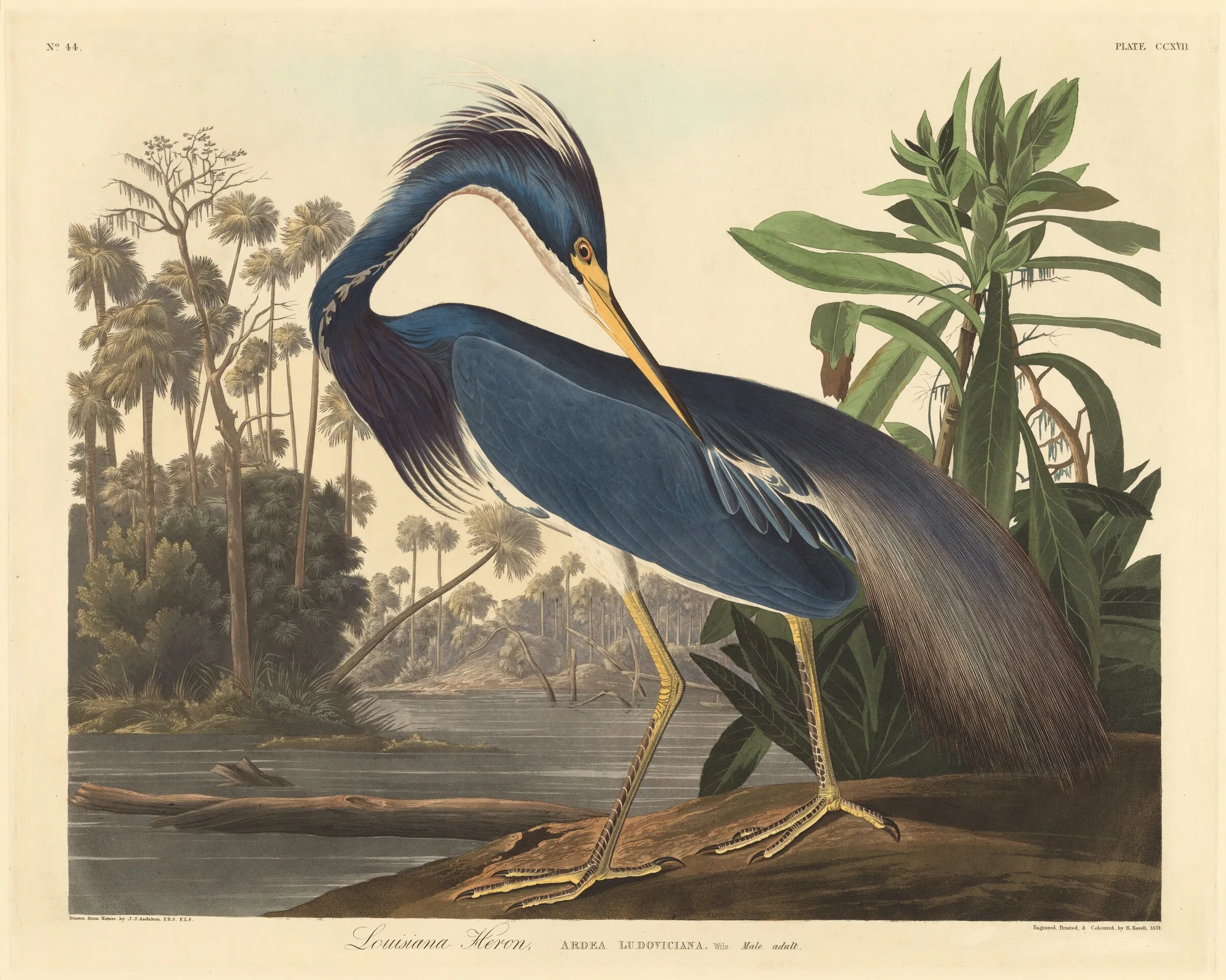
Audubon's “Louisiana Heron”, The Birds of America, plate CCXVII
Click or press Enter to enlarge
Open the full-resolution image (7069 px, National Gallery of Art)
| Plate | 217 (CCXVII) |
|---|---|
| Audubon's name | Louisiana Heron |
| Modern name | Tricolored Heron |
| Scientific name | Egretta tricolor |
| Status | Least Concern |
| Engraved by | Robert Havell, after Audubon's watercolor |
| Date | 1834 |
| Medium | Hand-colored engraving and aquatint on Whatman wove paper |
| Size | plate: 52.8 x 66 cm (20 13/16 x 26 in.) sheet: 68.5 x 101.2 cm (26 15/16 x 39 13/16 in.) |
| Collections | Herons and Egrets, Florida and Wading Birds |
| This impression | National Gallery of Art, Washington, 1945.8.217; Gift of Mrs. Walter B. James |
About this plate
Plate 217 shows a single male Tricolored Heron in breeding plumage, which Audubon called the Louisiana Heron. The bird is slender, slate blue above with a white belly and white line down the front of the neck, a maroon and white throat, a long crest and buff plumes over the back. A version of this plate appears on the cover image used for many editions of The Birds of America.
Audubon used Wilson's name Ardea ludoviciana. The species is now Egretta tricolor. It lives in salt marshes, mangroves and coastal mudflats from the Gulf and southern Atlantic coasts of the United States through the Caribbean and Central America to Brazil and Peru. It often runs after small fish in shallow water. It is listed as Least Concern.
Audubon called it the Lady of the Waters and opened his chapter with a day in its life on the sand beaches of Florida: catching a fly on a blade of grass, swallowing a stranded minnow alive, searching wet herbage for snails and lizards, resting in the shade at midday, and flying to its roost at dusk.
He wrote that it was resident in southern Florida, rarely seen in winter east of Savannah, and abundant in the Carolinas in spring. He never found it more than about forty miles inland. He believed that all American herons except the Green Heron laid exactly three eggs, pale blue tinged with green, and raised a single brood.
In Audubon's words
Delicate in form, beautiful in plumage, and graceful in its movements, I never see this interesting Heron, without calling it the Lady of the Waters. Watch its motions, as it leisurely walks over the pure sand beaches of the coast of Florida, arrayed in the full beauty of its spring plumage. Its pendent crest exhibits its glossy tints, its train falls gracefully over a well defined tail, and the tempered hues of its back and wings contrast with those of its lower parts. Its measured steps are so light that they leave no impression on the sand, and with its keen eye it views every object around with the most perfect accuracy. See, it has spied a small fly lurking on a blade of grass, it silently runs a few steps, and with the sharp point of its bill it has already secured the prey.
John James Audubon, Ornithological Biography, vol. 3 (1835), “Louisiana Heron”. Read the full chapter.