Black Guillemot (Plate 219)
Audubon's “Black Guillemot”, The Birds of America, plate CCXIX
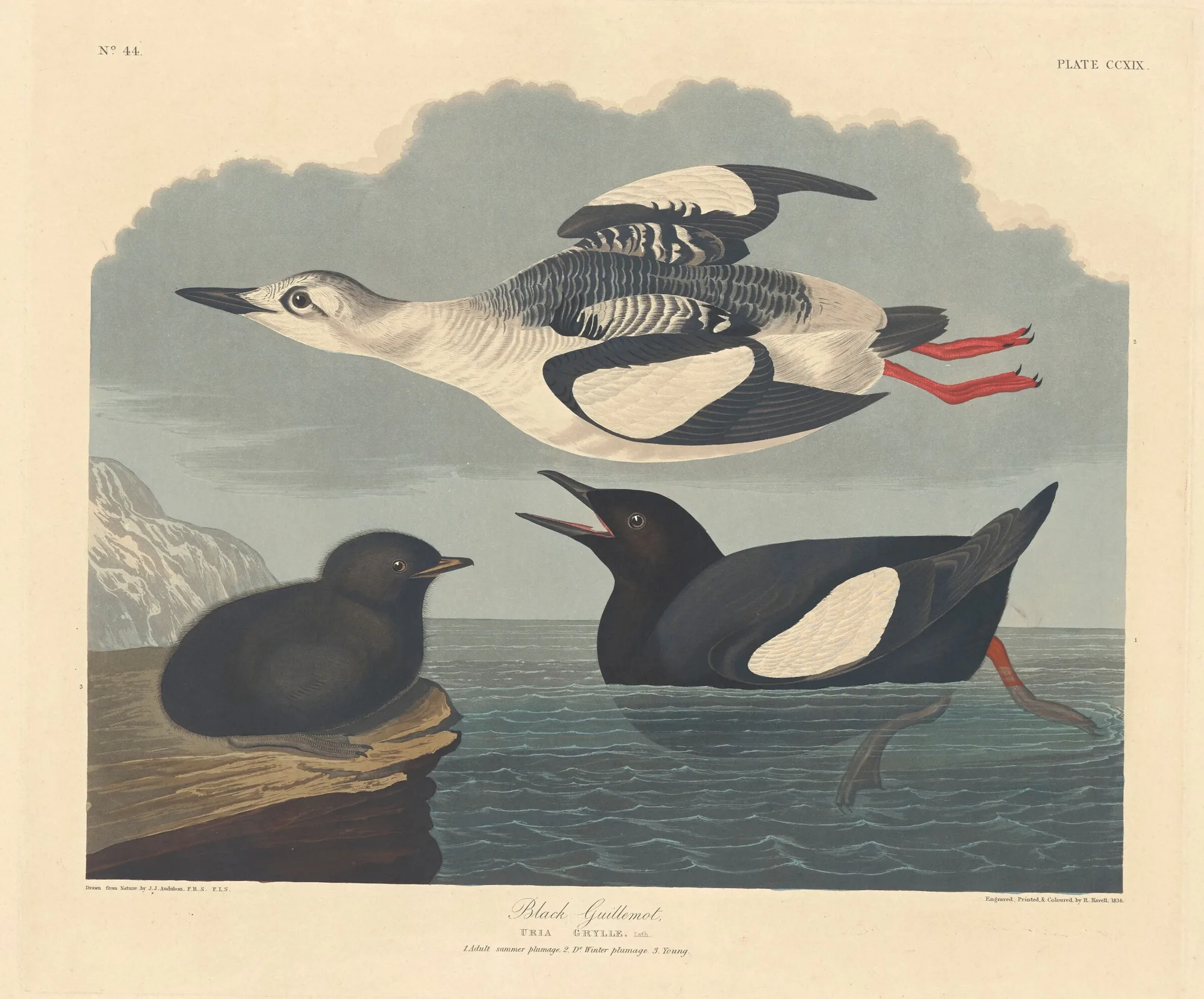
Click or press Enter to enlarge
Open the full-resolution image (3142 px, National Gallery of Art)
| Plate | 219 (CCXIX) |
|---|---|
| Audubon's name | Black Guillemot |
| Modern name | Black Guillemot |
| Scientific name | Cepphus grylle |
| Status | Least Concern |
| Engraved by | Robert Havell, after Audubon's watercolor |
| Date | 1834 |
| Medium | Hand-colored engraving and aquatint on Whatman wove paper |
| Collections | Seabirds |
| This impression | National Gallery of Art, Washington, 1945.8.219; Gift of Mrs. Walter B. James |
About this plate
Plate 219 shows Black Guillemots in three plumages: an adult in summer, all sooty black with a large white wing patch and bright red feet; an adult in winter, mostly white with a mottled grey back; and a young bird, greyer and barred. The contrast between the seasonal plumages is the point of the plate.
Audubon called it Uria grylle. It is now Cepphus grylle. Unlike murres and Razorbills, it does not nest in dense colonies on open ledges, but in crevices, under boulders and in rock piles, laying usually two eggs. It stays close to shore year-round, feeding on fish and crustaceans near the bottom. It breeds around the Arctic and North Atlantic, south to Maine and the British Isles. It is listed as Least Concern.
The chapter opens on the Magdalen Islands in the Gulf of St Lawrence during the 1833 voyage. Audubon watched Captain Henry Emery of the Ripley hang on a rope several hundred feet down a crumbling cliff, held by four or five sailors, dodging falling rocks and probing crevices for eggs with his arm and a boat-hook. Birds shot out of the cracks into his face. He collected only a few eggs because the season was early.
Audubon noted that the species was resident around the Bay of Fundy, nested on Grand Manan and wherever he landed on the way to Labrador, and that in hard winters he had seen it as far south as Maryland.
In Audubon's words
It was a frightful thing to see my good Captain, Henry Emery, swinging on a long rope upon the face of a rocky and crumbling eminence, at a height of several hundred feet from the water, in search of the eggs of the Black Guillemot, with four or five sailors holding the rope above, and walking along the edge of the precipice. I stood watching the motions of the adventurous sailor. When the friction of the rope by which he was suspended loosened a block, which with awful crash came tumbling down from above him, he, with a promptness and dexterity that appeared to me quite marvellous, would, by a sudden jerk, throw himself aside to the right or left, and escape the danger. Now he would run his arm into a fissure, which, if he found it too deep, he would probe with a boat-hook.
John James Audubon, Ornithological Biography, vol. 3 (1835), “The Black Guillemot”. Read the full chapter.



