Piping Plover (Plate 220)
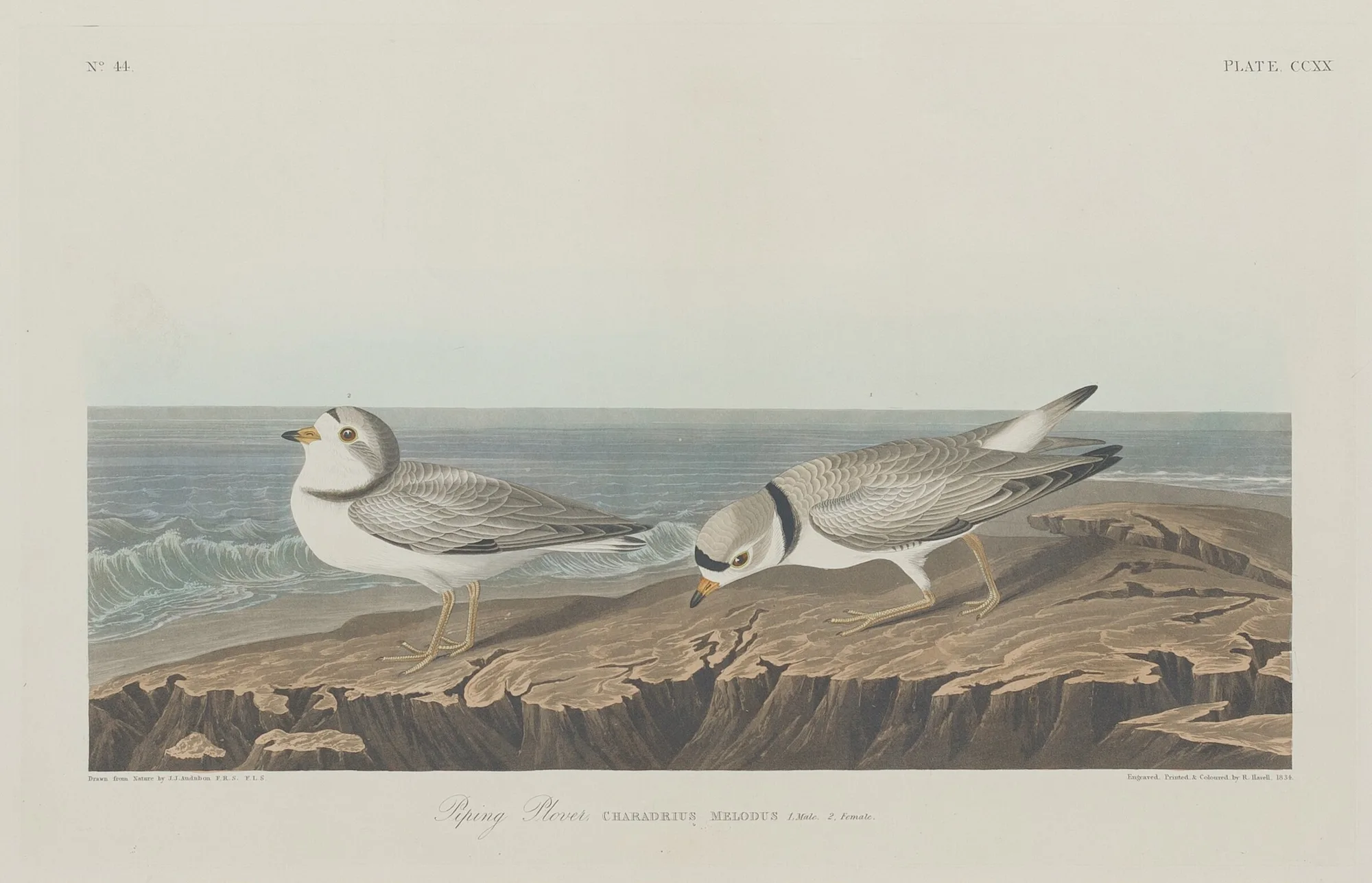
Audubon's “Piping Plover”, The Birds of America, plate CCXX
Click or press Enter to enlarge
Open the full-resolution image (2372 px, National Gallery of Art)
| Plate | 220 (CCXX) |
|---|---|
| Audubon's name | Piping Plover |
| Modern name | Piping Plover |
| Scientific name | Charadrius melodus |
| Status | Near Threatened |
| Engraved by | Robert Havell, after Audubon's watercolor |
| Date | 1834 |
| Medium | Hand-colored engraving and aquatint on Whatman wove paper |
| Collections | Shorebirds, Rails and Cranes |
| This impression | National Gallery of Art, Washington, 1945.8.220; Gift of Mrs. Walter B. James |
About this plate
Plate 220 shows a male and female Piping Plover. They are small, pale sand-coloured plovers with orange legs, a short orange bill tipped with black, and a narrow black band across the breast and forehead in breeding plumage. Their colour makes them almost invisible on dry sand.
Audubon used George Ord's name Charadrius melodus, which is still current. The species breeds on open sandy beaches of the Atlantic coast from Newfoundland to North Carolina, on the shores of the Great Lakes, and on sandbars and alkali lakes of the northern Great Plains. It winters on the coasts of the southeastern United States, the Gulf of Mexico and the Bahamas. Beach development and human disturbance caused steep declines. It is federally protected in the United States, with the Great Lakes population listed as endangered, and IUCN lists it as Near Threatened.
Audubon found it nesting on sandy beaches along the whole Atlantic coast and saw many paired with eggs on the Magdalen Islands on 11 June 1833. He also reported eggs found on the Florida Keys on 3 May, which does not match the species' known breeding range and may refer to another small plover.
He described nests as bare scrapes in the sand, sometimes at the foot of a grass tuft, with four eggs, spaced thirty or forty yards apart on low sandy islands. He wrote that the sun's heat did much of the incubating by day, while the female sat in rough weather and at night.
In Audubon's words
The favourite breeding stations of this species are low islands, mostly covered with drifting sand, having a scanty vegetation, and not liable to inundation. In such a place many pairs may be found, with nests thirty or forty yards apart. The nest is sometimes placed at the foot of a tuft of withered grass, at other times in an exposed situation. A cavity is merely scooped out in the soil, and there are deposited in it four eggs, which are in a great measure hatched by the heat which the sand acquires under the influence of a summer sun; but in rough weather, and always by night, the female is careful to sit upon them. Her mate is extremely attentive to her during the period of incubation, and should you happen to stroll near the nest, you are sure to meet him at his station.
John James Audubon, Ornithological Biography, vol. 3 (1835), “The Piping Plover”. Read the full chapter.



