Mallard (Plate 221)
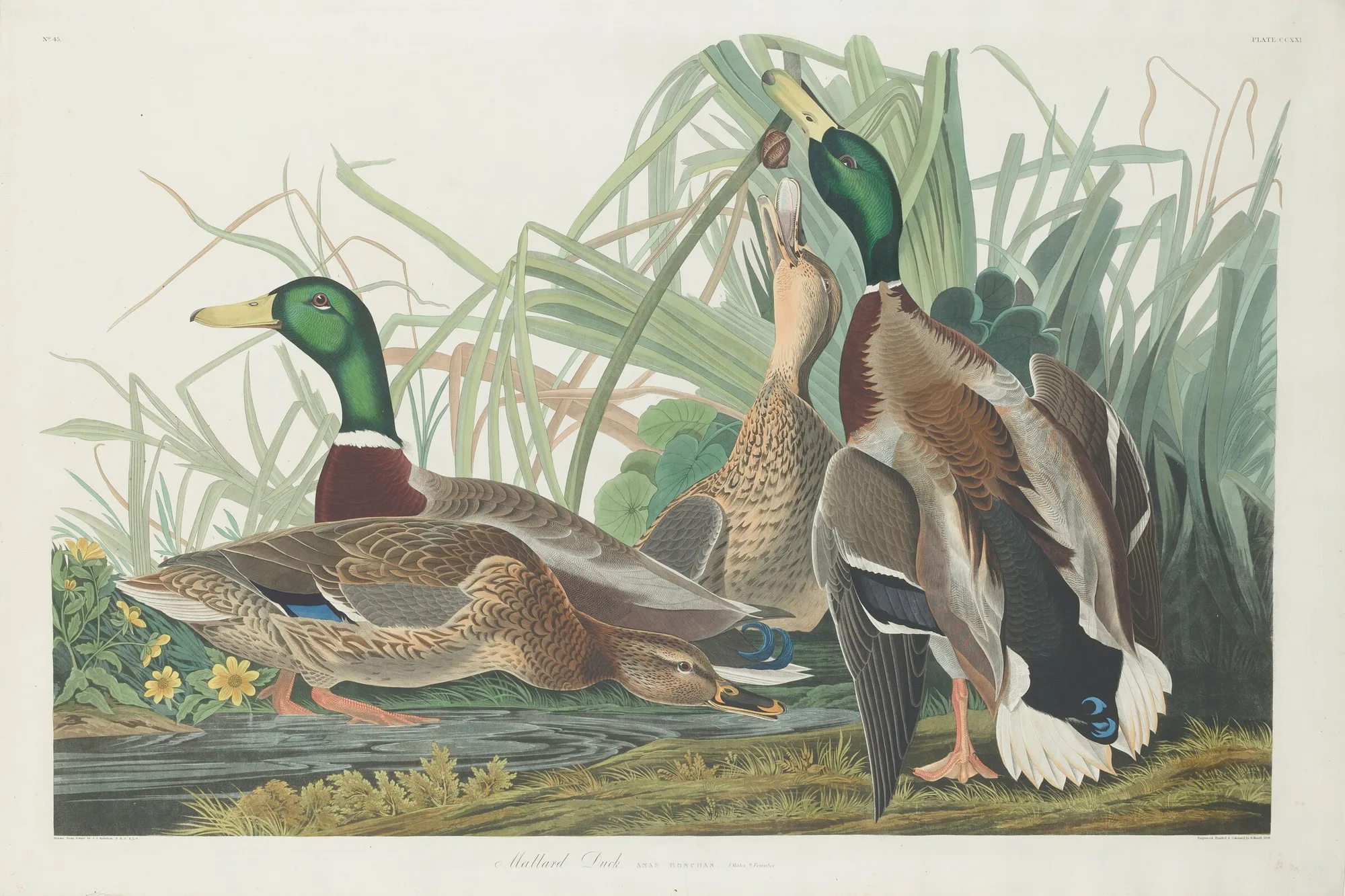
Audubon's “Mallard Duck”, The Birds of America, plate CCXXI
Click or press Enter to enlarge
Open the full-resolution image (4625 px, National Gallery of Art)
| Plate | 221 (CCXXI) |
|---|---|
| Audubon's name | Mallard Duck |
| Modern name | Mallard |
| Scientific name | Anas platyrhynchos |
| Status | Least Concern |
| Engraved by | Robert Havell, after Audubon's watercolor |
| Date | 1834 |
| Medium | Hand-colored engraving and aquatint on Whatman wove paper |
| Size | plate: 65.4 x 97.2 cm (25 3/4 x 38 1/4 in.) sheet: 68.3 x 68 cm (26 7/8 x 26 3/4 in.) |
| Collections | Ducks, Geese and Swans |
| This impression | National Gallery of Art, Washington, 1945.8.221; Gift of Mrs. Walter B. James |
About this plate
Plate 221 shows Mallards of both sexes. The drakes carry the green head, white neck ring and chestnut breast of breeding plumage, and the hens are mottled brown. Audubon's chapter is less about the figures than about the wild bird as he knew it in the Ohio and Mississippi valleys.
He wrote that the Mallard was far from common everywhere, as earlier authors had claimed. He and Thomas Nuttall found it rare in the wild near Boston, his party saw none beyond Portland in Maine, and nobody in Labrador or Newfoundland knew it. There the American Black Duck took its place. Inland it was abundant. Flocks reached Kentucky between mid-September and early October, when the acorns and beech-nuts ripened, and he found hens nesting by ponds in Kentucky, Indiana and Illinois.
Audubon called it Anas boschas. The current name is Anas platyrhynchos. It is the most widespread duck of the Northern Hemisphere and the ancestor of nearly all domestic ducks, a point Audubon made when he called the farmyard duck the descendant of a race of slaves. The picture he gave of the Northeast has since changed: Mallards spread east through the twentieth century, helped by released birds, and now breed commonly in New England, where they hybridize with Black Ducks.
The species is listed as Least Concern. It thrives in city parks, farm ponds and marshes alike, and it is among the most heavily hunted ducks in North America.
In Audubon's words
Look at that Mallard as he floats on the lake; see his elevated head glittering with emerald-green, his amber eyes glancing in the light! Even at this distance, he has marked you, and suspects that you bear no good will towards him, for he sees that you have a gun, and he has many a time been frightened by its report, or that of some other. The wary bird draws his feet under his body, springs upon them, opens his wings, and with loud quacks bids you farewell. Now another is before you, on the margin of that purling streamlet. How brisk are all his motions compared with those of his brethren that waddle across your poultry-yard! how much more graceful in form and neat in apparel!
John James Audubon, Ornithological Biography, vol. 3 (1835), “The Mallard”. Read the full chapter.