White Ibis (Plate 222)
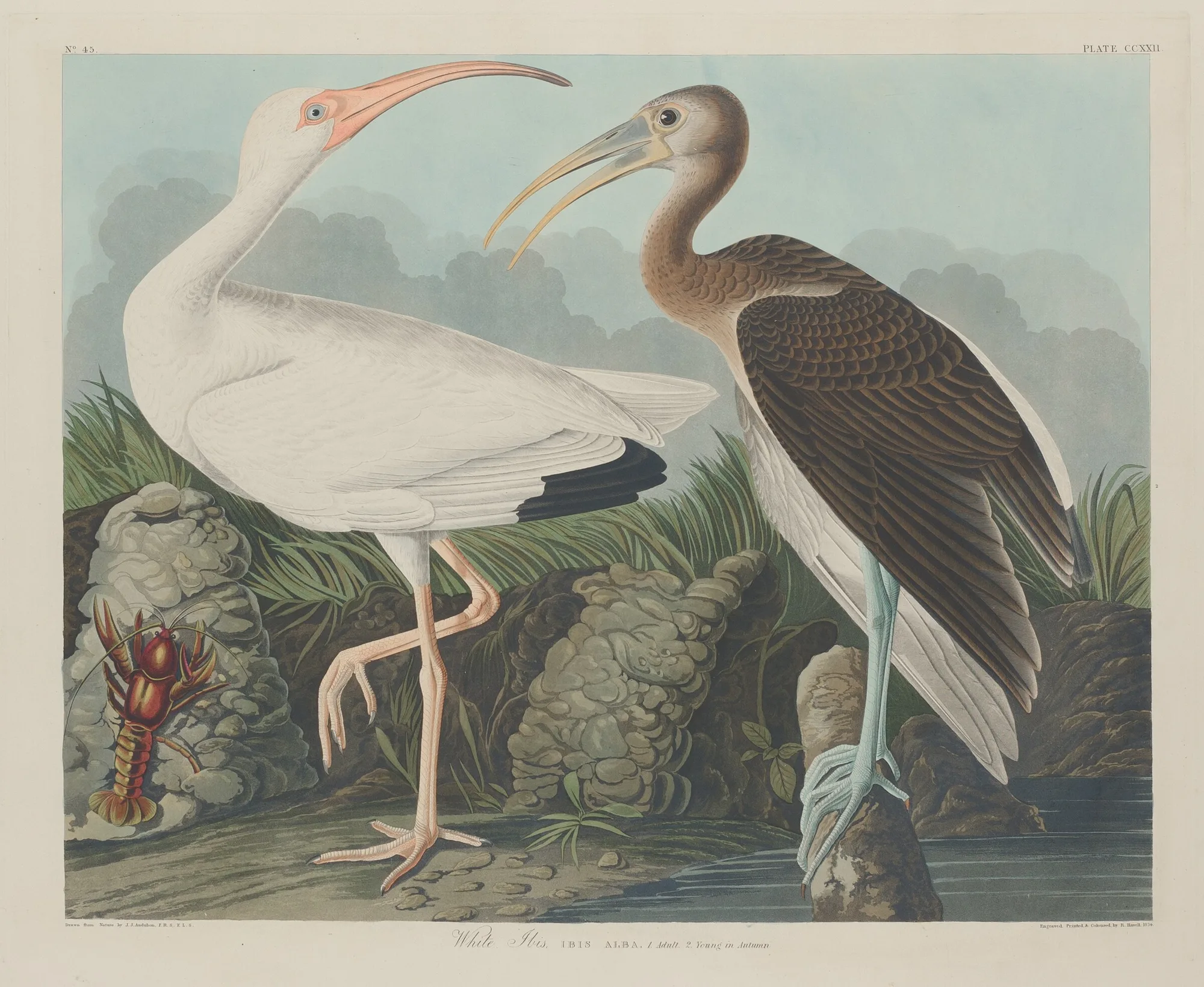
Audubon's “White Ibis”, The Birds of America, plate CCXXII
Click or press Enter to enlarge
Open the full-resolution image (3108 px, National Gallery of Art)
| Plate | 222 (CCXXII) |
|---|---|
| Audubon's name | White Ibis |
| Modern name | White Ibis |
| Scientific name | Eudocimus albus |
| Status | Least Concern |
| Engraved by | Robert Havell, after Audubon's watercolor |
| Date | 1834 |
| Medium | Hand-colored engraving and aquatint on Whatman wove paper |
| Collections | Florida and Wading Birds |
| This impression | National Gallery of Art, Washington, 1945.8.222; Gift of Mrs. Walter B. James |
About this plate
Plate 222 pairs an adult male White Ibis, white with black wing tips and a red decurved bill, with a young bird in brown first plumage. Audubon noted that the young take on full adult dress during their first winter.
His account centres on Sandy Island, a horseshoe-shaped key about six miles off Cape Sable, which he visited during his 1832 voyage along the Florida coast. Thousands of ibises nested there among mangroves, wild plums, giant cactus and nettles. He counted forty-seven nests in a single plum tree, and he described the stench of the colony and the scratches the cactus left on his legs. He also recorded that adults flew twenty or thirty miles to the mudflats to feed at low tide, by night as well as by day, and that the bill, legs and throat pouch of breeding birds turned a deep red.
Audubon used the name Ibis alba. The species is now Eudocimus albus. It breeds along the coasts of the southeastern United States and the Gulf, through the Caribbean and into northern South America, and it feeds mainly on crayfish, fiddler crabs and other small prey probed from mud and shallow water.
The White Ibis is listed as Least Concern. Florida remains a stronghold, though colonies shift from year to year with rainfall and water levels, and the species has also taken to feeding on city lawns and in parks.
In Audubon's words
As we entered that well-known place, we saw nests on every bush, cactus, or tree. Whether the number was one thousand or ten I cannot say, but this I well know:—I counted forty-seven on a single plum-tree. These nests of the White Ibis measure about fifteen inches in their greatest diameter, and are formed of dry twigs intermixed with fibrous roots and green branches of the trees growing on the island, which this bird easily breaks with its bill; the interior, which is flat, being finished with leaves of the cane and some other plants. The bird breeds only once in the year, and the full number of its eggs is three.
John James Audubon, Ornithological Biography, vol. 3 (1835), “The White Ibis”. Read the full chapter.