Black-legged Kittiwake (Plate 224)
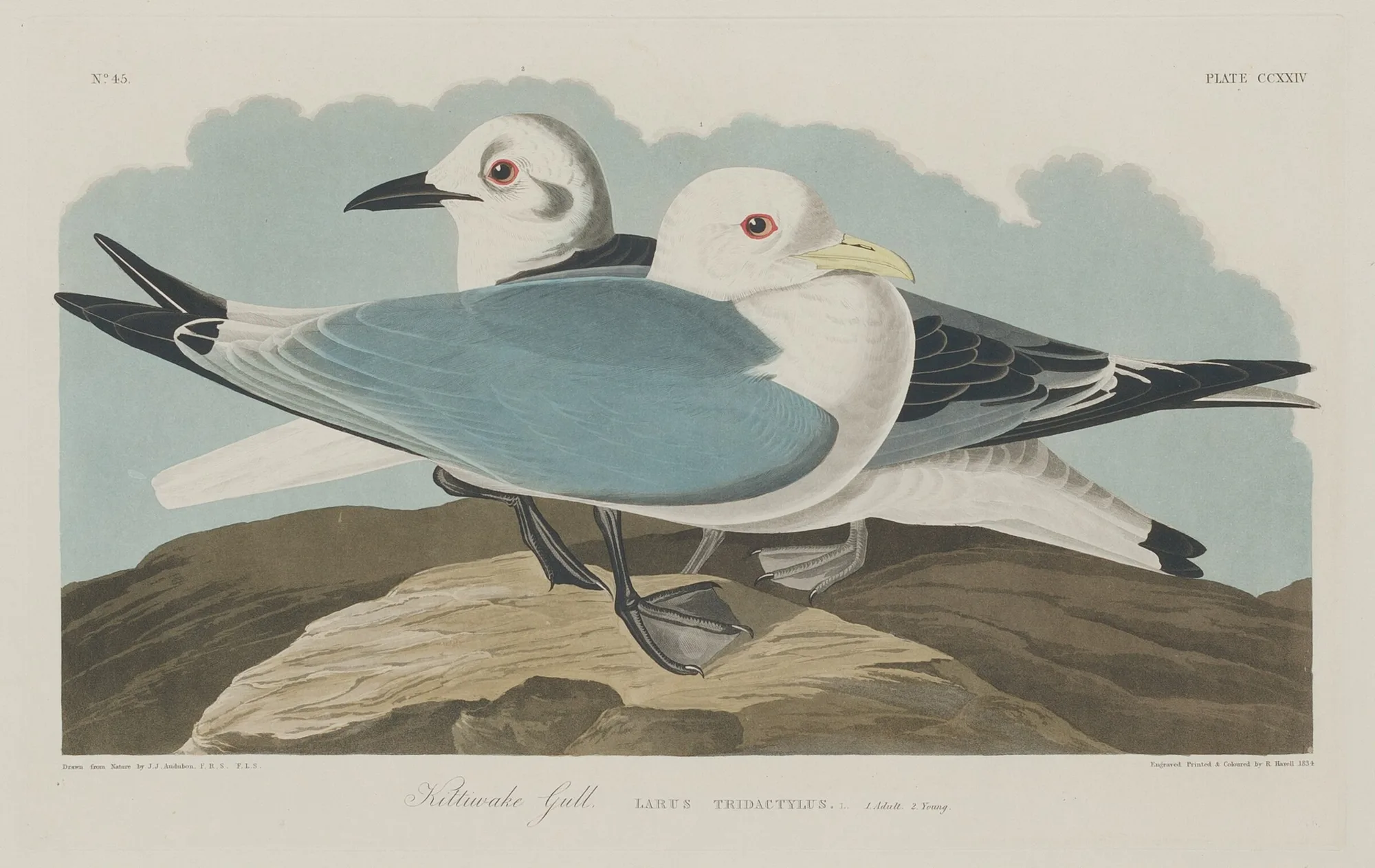
Audubon's “Kittiwake Gull”, The Birds of America, plate CCXXIV
Click or press Enter to enlarge
Open the full-resolution image (2399 px, National Gallery of Art)
| Plate | 224 (CCXXIV) |
|---|---|
| Audubon's name | Kittiwake Gull |
| Modern name | Black-legged Kittiwake |
| Scientific name | Rissa tridactyla |
| Status | Vulnerable |
| Engraved by | Robert Havell, after Audubon's watercolor |
| Date | 1834 |
| Medium | Hand-colored engraving and aquatint on Whatman wove paper |
| Collections | Seabirds |
| This impression | National Gallery of Art, Washington, 1945.8.224; Gift of Mrs. Walter B. James |
About this plate
Plate 224 shows an adult Black-legged Kittiwake in summer plumage, white-headed with a yellow bill and black wing tips, and a young bird in its first winter. Audubon wrote that the two birds were drawn at Boston as spring approached, when the adults had already regained their white heads.
The chapter draws on his 1833 voyage to Labrador. He described nests built of eel-grass and coarse grass on rock ledges barely a foot wide, where no other bird but the guillemot would venture, and sitting birds that only stepped aside when the party approached. He noted that the young keep black bills and feet until their second spring, and he heard from a settler at Bras d'Or that young kittiwakes were salted down for winter food. On land he thought it the most awkward of gulls, but on the water and in the air among the most buoyant.
Audubon's Larus tridactylus is now Rissa tridactyla. It is the most oceanic of the common gulls, nesting on sea cliffs around the North Atlantic and North Pacific and spending the winter far offshore. Young birds show a black collar and a black zigzag across the wings.
The Black-legged Kittiwake was uplisted to Vulnerable after steep declines in its North Atlantic colonies, linked to changes in the small fish it feeds on.
In Audubon's words
The Kittiwake is on land the most awkward of its tribe; and, although it walks often on the rocks, its gait manifests a waddling gaucherie; but on the water, or in the air, few birds surpass it in buoyancy, grace, and ease of motion. Bearing up against the heaviest gale, it passes from one trough of the sea to another, as if anxious to rest for an instant under the lee of the billows; yet as these are seen to rear their curling crests, the Gull is already several feet above them, and preparing to plunge into the next hollow. While in our harbour, and during fine weather, they seemed to play with their companions of other species.
John James Audubon, Ornithological Biography, vol. 3 (1835), “The Kittiwake Gull”. Read the full chapter.



