Killdeer (Plate 225)
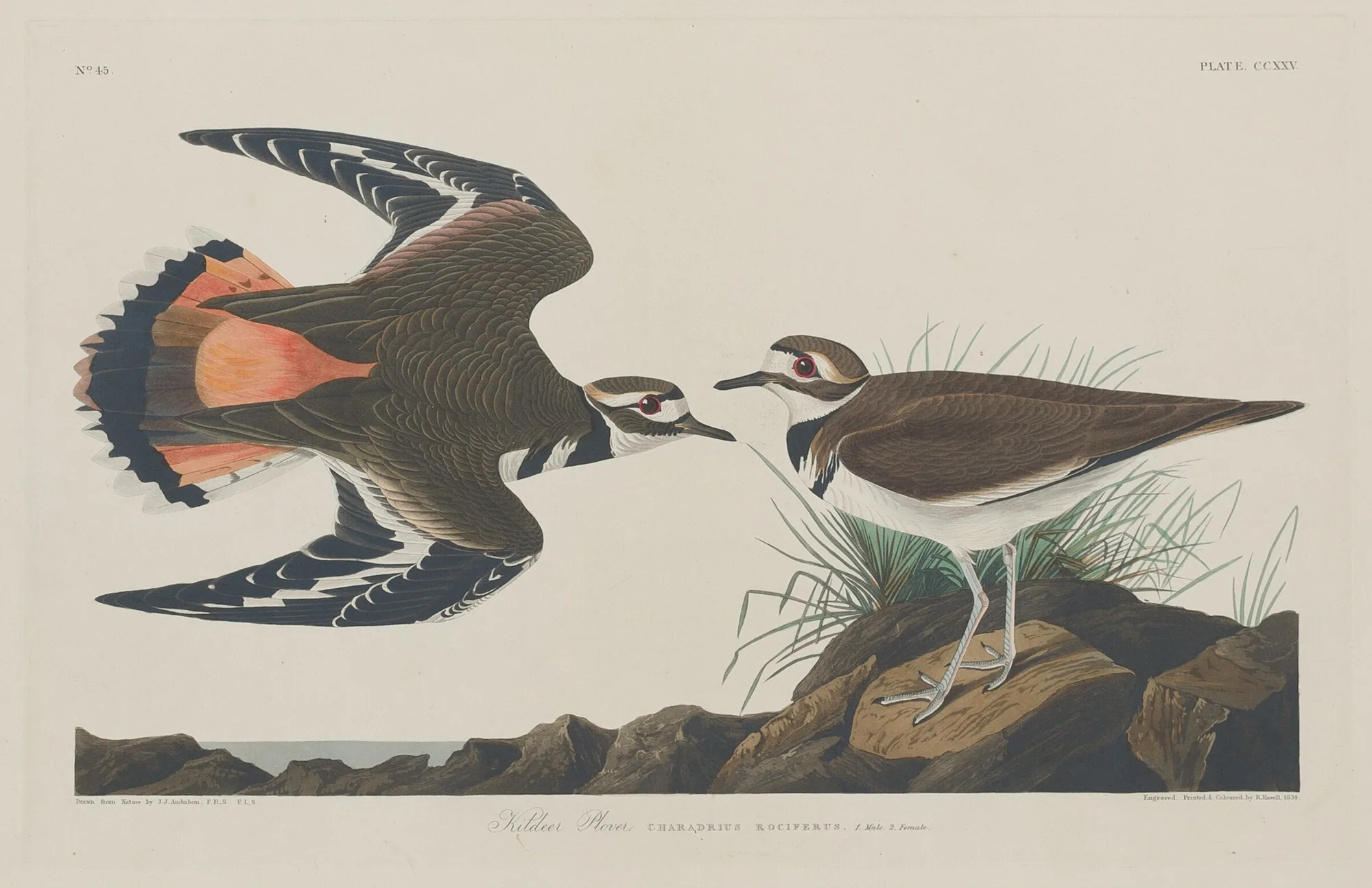
Audubon's “Kildeer Plover”, The Birds of America, plate CCXXV
Click or press Enter to enlarge
Open the full-resolution image (2380 px, National Gallery of Art)
| Plate | 225 (CCXXV) |
|---|---|
| Audubon's name | Kildeer Plover |
| Modern name | Killdeer |
| Scientific name | Charadrius vociferus |
| Status | Least Concern |
| Engraved by | Robert Havell, after Audubon's watercolor |
| Date | 1834 |
| Medium | Hand-colored engraving and aquatint on Whatman wove paper |
| Collections | Shorebirds, Rails and Cranes |
| This impression | National Gallery of Art, Washington, 1945.8.225; Gift of Mrs. Walter B. James |
About this plate
Plate 225 is Audubon's Kildeer Plover, the bird now called the Killdeer. Both sexes look alike: brown above, white below, with two black bands across the breast, a white forehead and a long tail that shows orange-rufous at the base in flight. The engraved spelling, Kildeer, was usual in his day.
The name imitates its loud, repeated call, which carries over farms, pastures and shorelines. Unlike most plovers, the Killdeer often lives far from water. It nests in a bare scrape on open ground, including gravel roads, parking lots and flat gravel roofs, and lays four speckled eggs that blend with the stones.
It is best known for its broken-wing display. When a person or predator nears the nest, the adult drags a wing, fans its tail and calls in apparent distress, leading the intruder away before flying off. Chicks leave the nest within hours of hatching and feed themselves.
The Killdeer breeds across most of North America and south into Mexico, with resident populations in the West Indies and Peru. Northern birds move south in winter. It is listed as Least Concern, although breeding bird surveys show a long-term decline.



