American Oystercatcher (Plate 223)
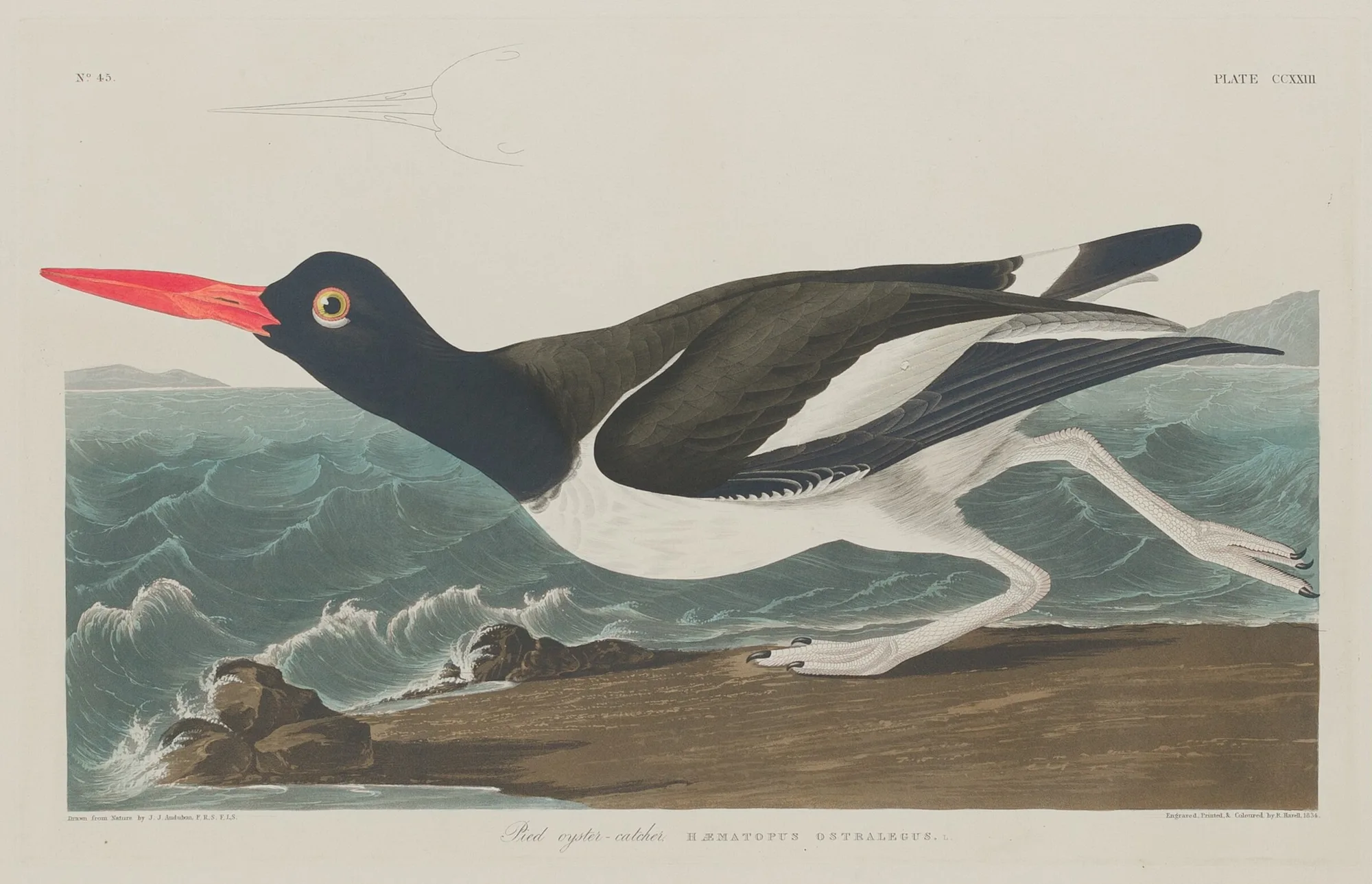
Audubon's “Pied Oyster-Catcher”, The Birds of America, plate CCXXIII
Click or press Enter to enlarge
Open the full-resolution image (2358 px, National Gallery of Art)
| Plate | 223 (CCXXIII) |
|---|---|
| Audubon's name | Pied Oyster-Catcher |
| Modern name | American Oystercatcher |
| Scientific name | Haematopus palliatus |
| Status | Least Concern |
| Engraved by | Robert Havell, after Audubon's watercolor |
| Date | 1834 |
| Medium | Hand-colored engraving and aquatint on Whatman wove paper |
| Collections | Shorebirds, Rails and Cranes |
| This impression | National Gallery of Art, Washington, 1945.8.223; Gift of Mrs. Walter B. James |
About this plate
Plate 223 shows a single male American Oystercatcher, black-headed and brown-backed, with a white belly and a long, flattened red bill. The engraved title uses the name of the European Pied Oyster-catcher. In the Ornithological Biography Audubon called his bird the American Oyster-Catcher and used Temminck's name Haematopus palliatus, which is still its scientific name.
Audubon found the species hard to approach and studied it through a telescope from a quarter of a mile away. He watched birds probe sand, knock limpets off rocks with sideways blows of the bill, open gaping oysters on the raccoon-oyster beds of the South, and beat razor clams against the sand until the shells broke. He described scrapes in sand above the high-water mark in the Middle States and eggs laid on bare rock in Labrador and the Bay of Fundy.
Today the American Oystercatcher breeds on Atlantic and Gulf beaches and salt marshes from New England south, and along the Pacific coast of Mexico and South America. It does not nest in Labrador, so his northern breeding birds may have been misidentified. Market hunting in the nineteenth century removed it from much of the Northeast, and it returned after legal protection.
The species is listed as Least Concern, but beach development and disturbance keep numbers low, and it is a conservation priority along the Atlantic coast.
In Audubon's words
Shy, vigilant, and ever on the alert, the Oyster-Catcher walks with a certain appearance of dignity, greatly enhanced by its handsome plumage and remarkable bill. If you stop to watch it, that instant it sounds a loud shrill note of alarm; and should you advance farther towards it, when it has neither nest nor young, off it flies quite out of sight. Few birds, indeed, are more difficult to be approached, and the only means of studying its habits I found to be the use of an excellent telescope, with which I could trace its motions when at the distance of a quarter of a mile, and pursuing its avocations without apprehension of danger.
John James Audubon, Ornithological Biography, vol. 3 (1835), “The American Oyster-Catcher”. Read the full chapter.



