Northern Pintail (Plate 227)
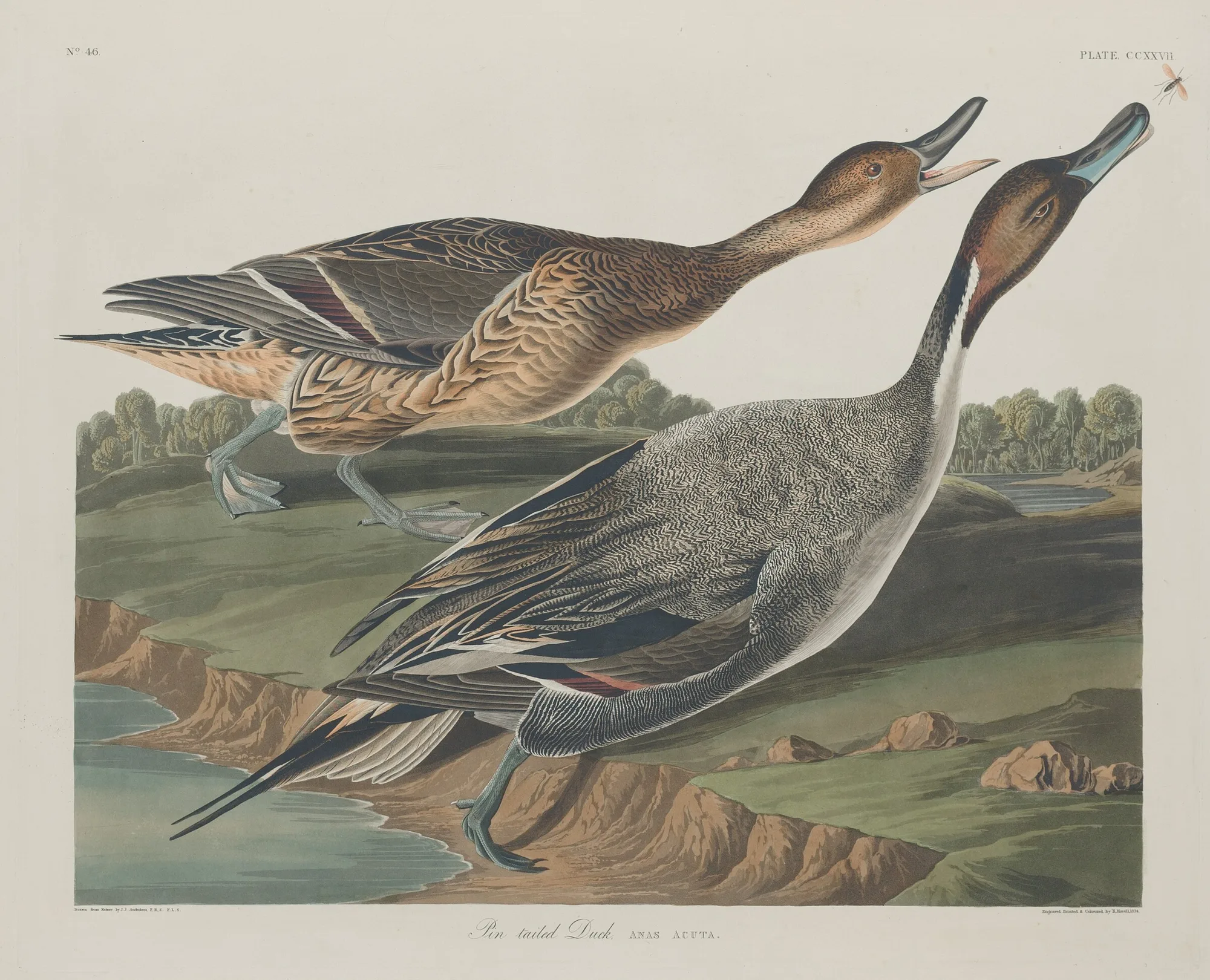
Audubon's “Pin-Tailed Duck”, The Birds of America, plate CCXXVII
Click or press Enter to enlarge
Open the full-resolution image (3124 px, National Gallery of Art)
| Plate | 227 (CCXXVII) |
|---|---|
| Audubon's name | Pin-Tailed Duck |
| Modern name | Northern Pintail |
| Scientific name | Anas acuta |
| Status | Least Concern |
| Engraved by | Robert Havell, after Audubon's watercolor |
| Date | 1834 |
| Medium | Hand-colored engraving and aquatint on Whatman wove paper |
| Collections | Ducks, Geese and Swans |
| This impression | National Gallery of Art, Washington, 1945.8.227; Gift of Mrs. Walter B. James |
About this plate
Plate 227 shows a male and female Northern Pintail. The drake has a chocolate-brown head, a white stripe running up the side of the neck and long, needle-pointed central tail feathers. The female is mottled brown with a shorter pointed tail.
Audubon admired the bird's slender neck and raised tail on the water and found its notes soft and pleasant, so unlike a Mallard's that he suspected writers who compared them had confused the two. He wrote that it was better known in the United States as the Sprigtail. In Kentucky and the West it was abundant from September until late spring, often with wigeon, Blue-winged Teal and Mallards on ponds. It ate beech-nuts in the woods, tadpoles in spring, leeches in autumn and even a dead mouse in winter. He saw none in Labrador, Newfoundland or Nova Scotia.
The species is Anas acuta, as in Audubon's day. It breeds across northern North America, Europe and Asia, mostly on open prairie and tundra wetlands, and winters south to Central America, Africa and southern Asia.
The Northern Pintail is listed as Least Concern worldwide, but the North American population is well below its levels of the 1950s and 1970s. Biologists link the decline to the ploughing of prairie nesting grounds, where the hens nest early in fields that are then cultivated.
In Audubon's words
On the water, few birds exhibit more graceful motions than the Pintail Duck. Its delicately slender neck, the beautiful form of its body, and its pointed tail, which it always carries highly raised, distinguish it from the other species with which it may associate. There seems also a kind of natural modesty in it which you do not find in other ducks, and its notes, which are often heard, are soft and pleasant. That these notes should ever have been compared to those of the Mallard, appears to me very strange;—so strange that I am tempted to believe that they who say so must have mistaken Mallards for Pintails.
John James Audubon, Ornithological Biography, vol. 3 (1835), “The Pintail Duck”. Read the full chapter.