Green-winged Teal (Plate 228)
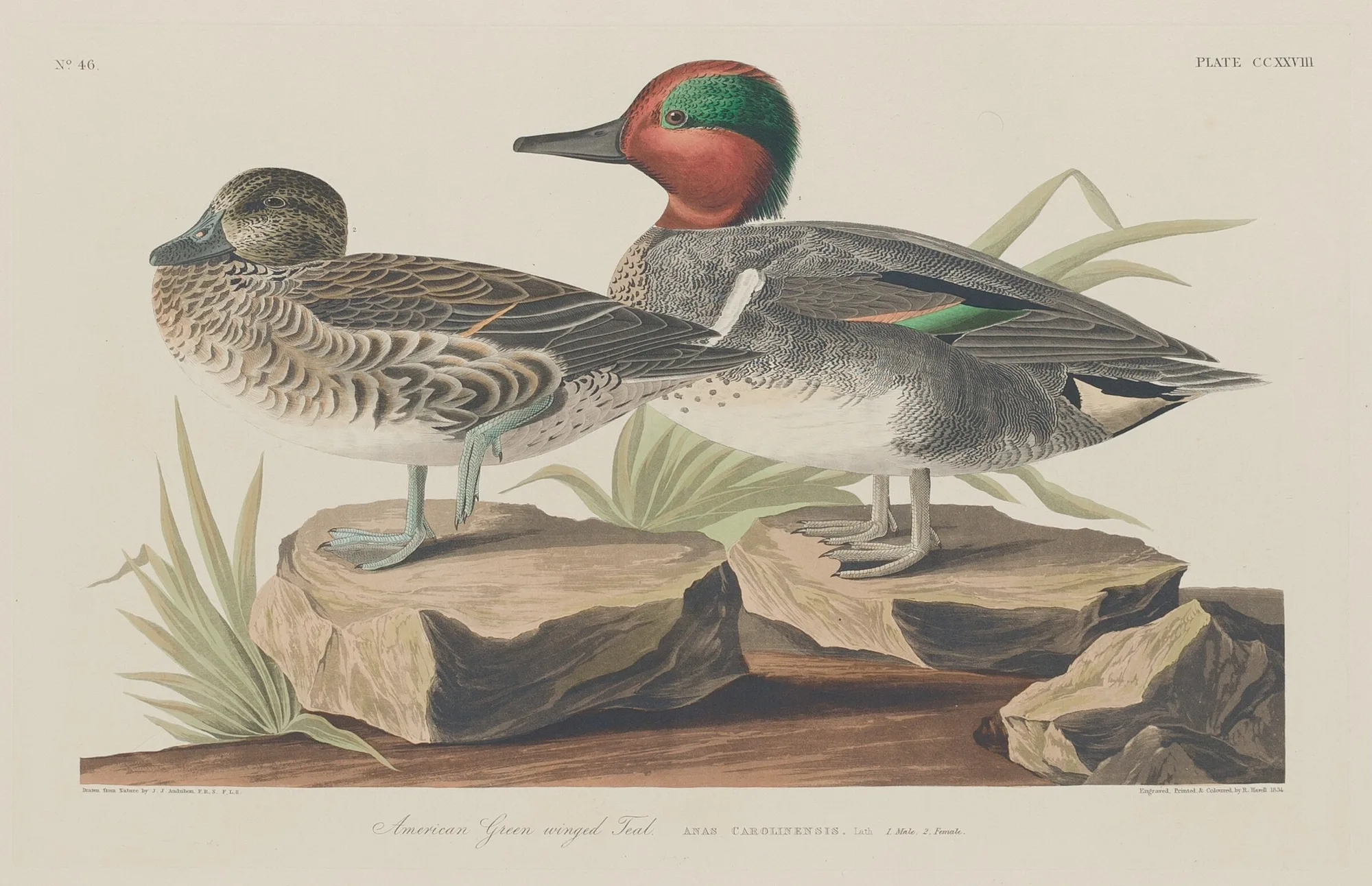
Audubon's “American Green-Winged Teal”, The Birds of America, plate CCXXVIII
Click or press Enter to enlarge
Open the full-resolution image (2357 px, National Gallery of Art)
| Plate | 228 (CCXXVIII) |
|---|---|
| Audubon's name | American Green-Winged Teal |
| Modern name | Green-winged Teal |
| Scientific name | Anas crecca |
| Status | Least Concern |
| Engraved by | Robert Havell, after Audubon's watercolor |
| Date | 1834 |
| Medium | Hand-colored engraving and aquatint on Whatman wove paperr |
| Size | plate: 31.1 x 49.2 cm (12 1/4 x 19 3/8 in.) sheet: 66.8 x 99.9 cm (26 5/16 x 39 5/16 in.) |
| Collections | Ducks, Geese and Swans |
| This impression | National Gallery of Art, Washington, 1945.8.228; Gift of Mrs. Walter B. James |
About this plate
Plate 228 shows a pair of Green-winged Teal. The male has a chestnut head with a broad green band from the eye to the nape and a vertical white bar on the side of the breast. The female is mottled brown, and both show the green speculum that gives the bird its name.
Audubon wrote the chapter as a sportsman's evening. In September the hunter waits on the bank of a rice field in Carolina or a strip of land between two ponds in Kentucky, a small dark cloud of teal sweeps over, and two shots break the flock. He wrote that he had seen more than six dozen shot by one gunner in a day when the birds first arrived in the West. He also suggested that migrating flocks return to places where they have rested and fed before.
This is the smallest dabbling duck in North America. The American bird is listed by the American Ornithological Society as a subspecies of Anas crecca, the Eurasian Teal, while some other lists treat it as a separate species, Anas carolinensis. The male's vertical white breast bar is the quickest way to tell it from the Eurasian form, which has a horizontal white stripe instead.
It breeds across Alaska, Canada and the northern United States and winters south to Mexico and the Caribbean. It is listed as Least Concern and is common.
In Audubon's words
Now he squats on his haunches; his dog lies close; and ere another minute has elapsed, right over his head, but too high to be shot at, pass the winged travellers. Some of them remember the place well, for there they have reposed and fed before. Now they wheel, dash irregularly through the air, sweep in a close body over the watery fields, and in their course pass near the fatal spot where the gunner anxiously awaits. Hark, two shots in rapid succession! The troop is in disorder, and the dog dashes through the water. Here and there lies a Teal, with its legs quivering; there, one is whirling round in the agonies of death; some, which are only winged, quickly and in silence make their way towards a hiding-place, while one, with a single pellet in his head, rises perpendicularly with uncertain beats, and falls with a splash on the water.
John James Audubon, Ornithological Biography, vol. 3 (1835), “The Green-Winged Teal”. Read the full chapter.