Whooping Crane (Plate 226)
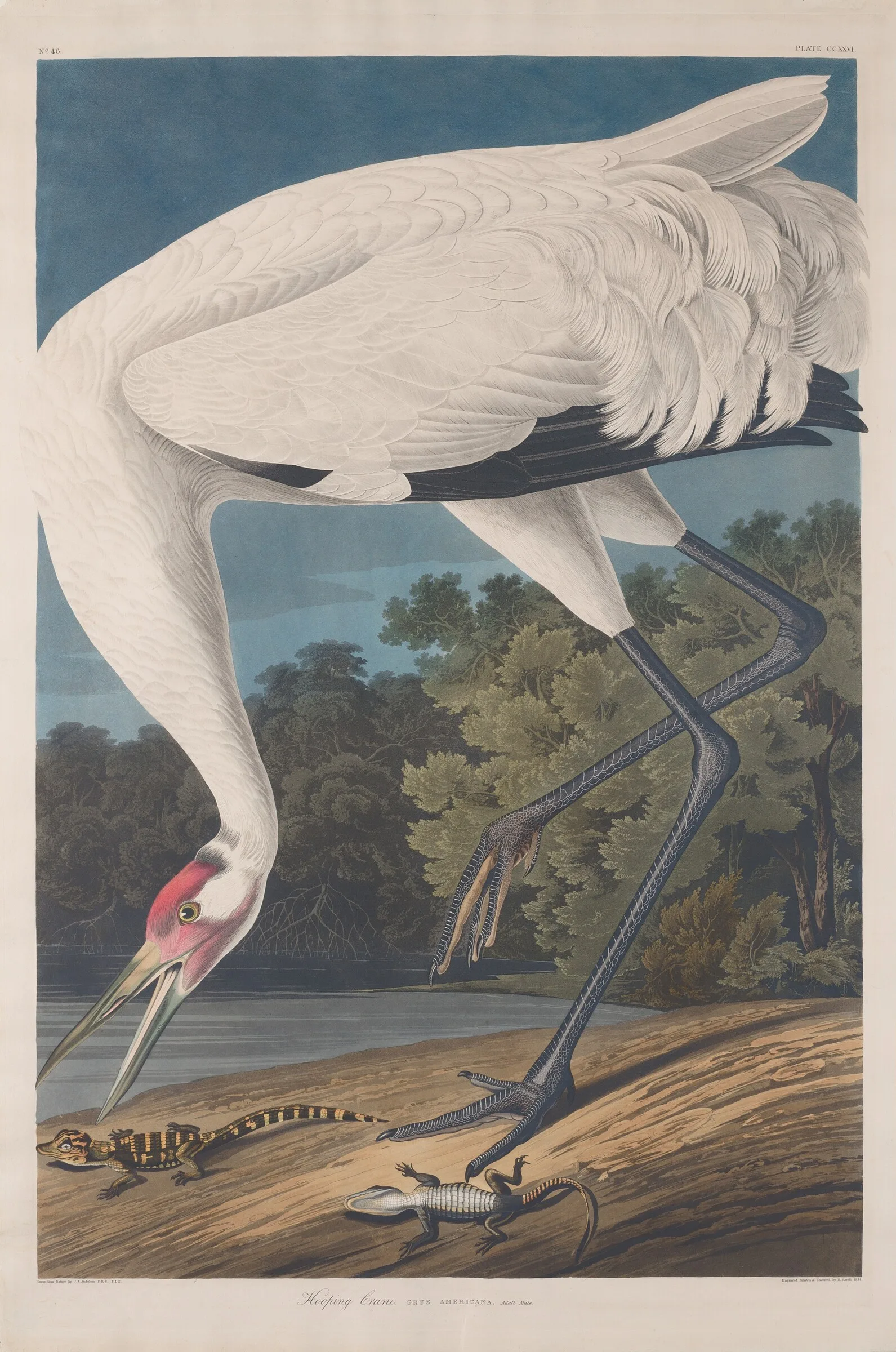
Audubon's “Hooping Crane”, The Birds of America, plate CCXXVI
Click or press Enter to enlarge
Open the full-resolution image (4624 px, National Gallery of Art)
| Plate | 226 (CCXXVI) |
|---|---|
| Audubon's name | Hooping Crane |
| Modern name | Whooping Crane |
| Scientific name | Grus americana |
| Status | Endangered |
| Engraved by | Robert Havell, after Audubon's watercolor |
| Date | 1834 |
| Medium | Hand-colored engraving and aquatint on Whatman wove paper |
| Size | plate: 97 x 65.5 cm (38 3/16 x 25 13/16 in.) sheet: 100.3 x 67.7 cm (39 1/2 x 26 5/8 in.) |
| Plants and setting | Marsh ground with newly hatched alligators |
| Collections | Shorebirds, Rails and Cranes, Florida and Wading Birds |
| This impression | National Gallery of Art, Washington, 1945.8.226; Gift of Mrs. Walter B. James |
About this plate
Plate 226 shows an adult male Whooping Crane, white with black primaries, a red crown and dark facial skin, bending low toward the ground. In the Havell plate the bird reaches toward newly hatched alligators at its feet.
Audubon opened the chapter with a scene of late October, when the cranes come down out of the clouds onto the western savannahs. He wrote that they reached the Western Country in October or November in flocks of twenty to thirty, and spread from Illinois and Kentucky to the Carolinas, Florida, Louisiana and the lands toward Mexico, returning north in April or May. They migrated inland, he said, and were almost unknown in the Middle and Eastern States.
Audubon made one notable error. He believed that the brown Sandhill Crane was the young of the Whooping Crane, and he engraved a Sandhill as the young bird in plate 261. The two are distinct species: young Whooping Cranes are rusty and white, not grey.
Grus americana is the tallest bird in North America and one of the rarest. Hunting and the drainage of prairie wetlands cut the only surviving migratory flock to about fifteen birds in 1941. That flock nests in Wood Buffalo National Park in Canada and winters at Aransas on the Texas coast, and it now numbers more than 500. The species is listed as Endangered.
In Audubon's words
Suddenly the turbid atmosphere clears, and now he can perceive the passing birds. Gradually they descend, dress their extended lines, and prepare to alight on the earth. With necks outstretched, and long bony legs extended behind, they proceed supported by wings white as the snow but tipped with jet, until arriving over the great savannah they wheel their circling flight, and slowly approach the ground, on which with half-closed wings, and outstretched feet they alight, running along for a few steps to break the force of their descent. Reader, see the majestic bird shake its feathers, and again arrange them in order. Proud of its beautiful form, and prouder still of its power of flight, it stalks over the withering grasses with all the majesty of a gallant chief. With long and measured steps he moves along, his head erect, his eye glistening with delight. His great journey is accomplished, and being well acquainted with a country which has often been visited by him, he at once commences his winter avocations.
John James Audubon, Ornithological Biography, vol. 3 (1835), “The Whooping Crane”. Read the full chapter.