Greater Scaup (Plate 229)
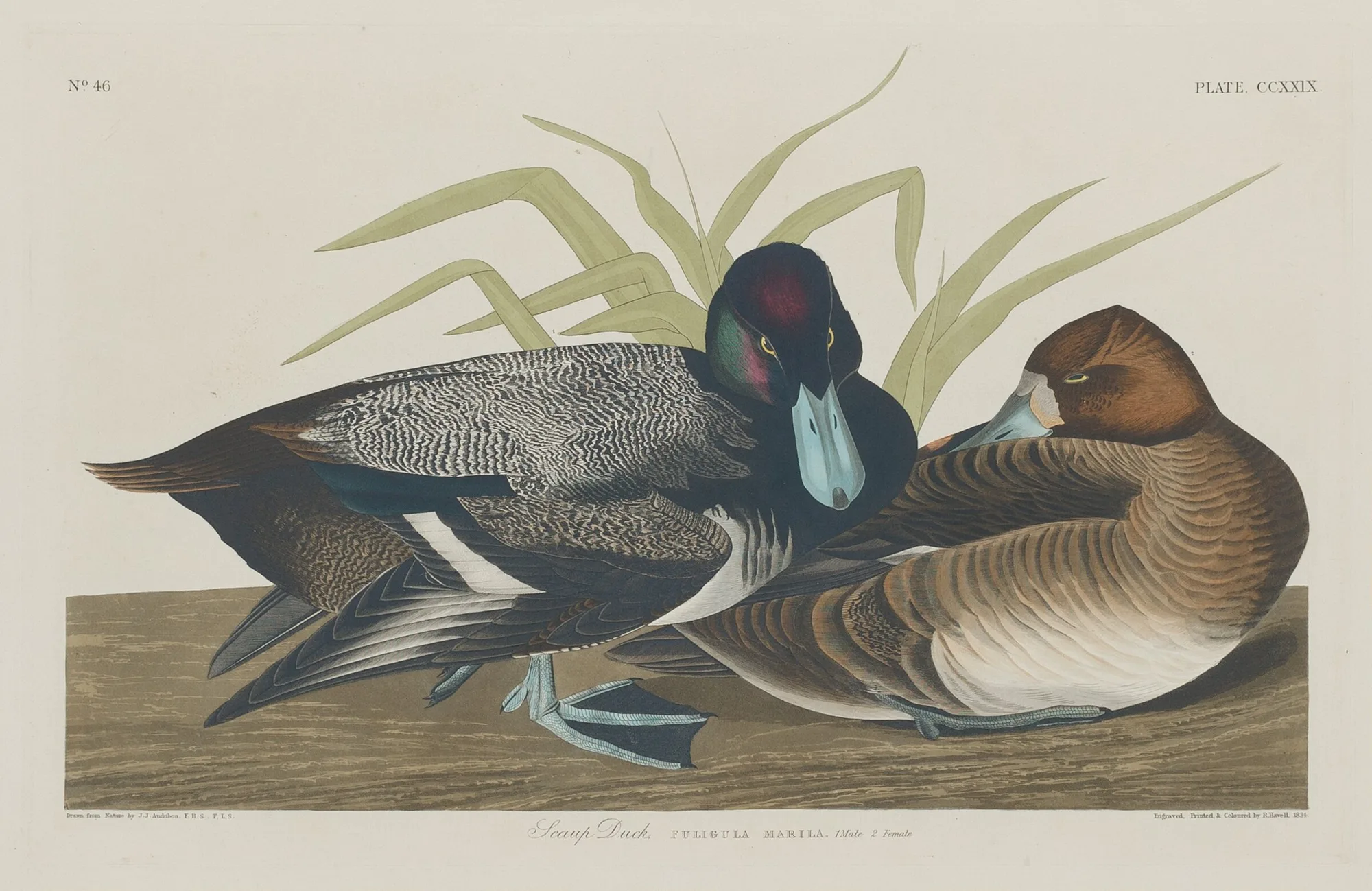
Audubon's “Scaup Duck”, The Birds of America, plate CCXXIX
Click or press Enter to enlarge
Open the full-resolution image (2379 px, National Gallery of Art)
| Plate | 229 (CCXXIX) |
|---|---|
| Audubon's name | Scaup Duck |
| Modern name | Greater Scaup |
| Scientific name | Aythya marila |
| Status | Least Concern |
| Engraved by | Robert Havell, after Audubon's watercolor |
| Date | 1834 |
| Medium | Hand-colored engraving and aquatint on Whatman wove paper |
| Collections | Ducks, Geese and Swans |
| This impression | National Gallery of Art, Washington, 1945.8.229; Gift of Mrs. Walter B. James |
About this plate
Plate 229 shows a male and female scaup. The male has a dark, glossy head, black breast, grey back and white flanks. The female is brown with a white band around the base of the bill.
Audubon wrote to correct Alexander Wilson, who believed the Scaup Duck kept to the coast. He had shot many on the Ohio, Missouri and Mississippi between Pittsburgh and New Orleans, where they arrived in October and left between March and mid-April. In Kentucky, he said, the birds were called the Flocking Fowl because small flocks joined into larger ones. He watched them dive in the eddies below points of land, especially along the steep Kentucky bank between Louisville and Shippingport. He thought the flesh tough and fishy.
Audubon's name was Fuligula marila, now Aythya marila, the Greater Scaup. The Lesser Scaup, Aythya affinis, was not separated as a species until 1838, after this volume appeared. Lesser Scaup are the common scaup on inland rivers and lakes, so many of the flocks Audubon saw on the western rivers were probably that species.
The Greater Scaup breeds on tundra and northern lakes around the Arctic and winters mainly on coastal bays. It is listed as Least Concern, though North American scaup numbers have fallen since the 1980s.
In Audubon's words
The Scaup Duck seems to float less lightly than it really does, its body being comparatively flat. It moves fast, frequently sipping the water, as if to ascertain whether its favourite food be in it. Then turning its head and glancing on either side to assure itself of security, down it dives with all the agility of a Merganser, and remains a considerable time below. On emerging, it shakes its head, raises the hind part of its body, opens its short and rather curved wings, after a few flaps replaces them, and again dives in search of food. Should any person appear when it emerges, it swims off to a considerable distance, watches every movement of the intruder, and finally either returns to its former place, or flies away.
John James Audubon, Ornithological Biography, vol. 3 (1835), “The Scaup Duck”. Read the full chapter.