Sanderling (Plate 230)
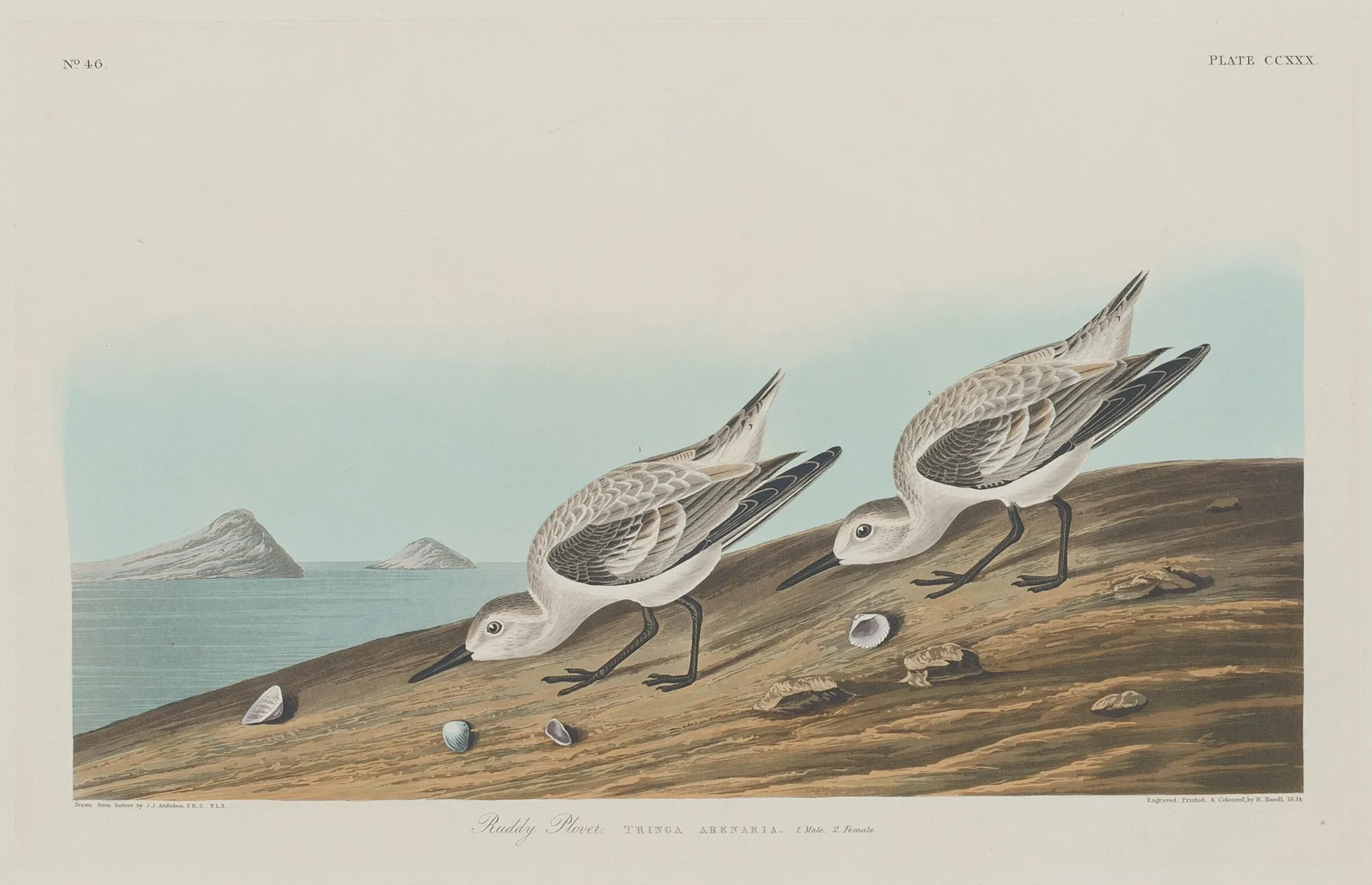
Audubon's “Ruddy Plover”, The Birds of America, plate CCXXX
Click or press Enter to enlarge
Open the full-resolution image (2337 px, National Gallery of Art)
| Plate | 230 (CCXXX) |
|---|---|
| Audubon's name | Ruddy Plover |
| Modern name | Sanderling |
| Scientific name | Calidris alba |
| Status | Least Concern |
| Engraved by | Robert Havell, after Audubon's watercolor |
| Date | 1834 |
| Medium | Hand-colored engraving and aquatint on Whatman wove paper |
| Collections | Shorebirds, Rails and Cranes |
| This impression | National Gallery of Art, Washington, 1945.8.230; Gift of Mrs. Walter B. James |
About this plate
Plate 230 is engraved with the title Ruddy Plover, but the chapter in the Ornithological Biography treats the bird as the Sanderling. The Ruddy Plover of earlier American writers was the Sanderling in its rusty breeding dress, while the pale winter bird was known by another name. Audubon showed a male and female, and he wrote that the figure of a fine male, drawn on another sheet and overlooked in London while he was away, appeared later as plate 285.
He found it along the Atlantic coast from Maine to the Florida Keys only as an autumn and winter visitor, arriving in New England about the first of August and in East Florida by November. He described birds probing wet sand at every step and leaving rows of twenty or thirty holes along the tide line, and following the retreating waves for small shrimps. He hoped to find nests in Labrador in 1833 but did not, though he saw young birds at Bras d'Or.
Audubon's Tringa arenaria is now Calidris alba. The Sanderling nests on the high Arctic tundra of Canada, Greenland and Siberia and winters on sandy beaches on nearly every coast of the world, some reaching Chile, South Africa and Australia.
It is listed as Least Concern. Its habit of running back and forth with the waves makes it one of the most familiar beach birds.
In Audubon's words
The Sanderling obtains its food principally by probing the moist sands of the sea-shores with its bill held in an oblique position. At every step it inserts this instrument with surprising quickness, to a greater or less depth, according to the softness of the sand, sometimes introducing it a quarter of an inch, sometimes to the base. The holes thus made may be seen on the borders of beaches, when the tide is fast receding, in rows of twenty, thirty, or more; in certain spots less numerous; for it appears that when a place proves unproductive of the food for which they are searching, they very soon take to their wings and remove to another, now and then in so hurried a manner that one might suppose they had been suddenly frightened.
John James Audubon, Ornithological Biography, vol. 3 (1835), “The Sanderling”. Read the full chapter.



