Hooded Merganser (Plate 232)
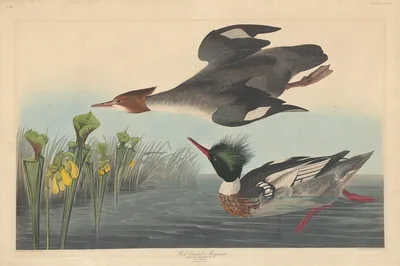
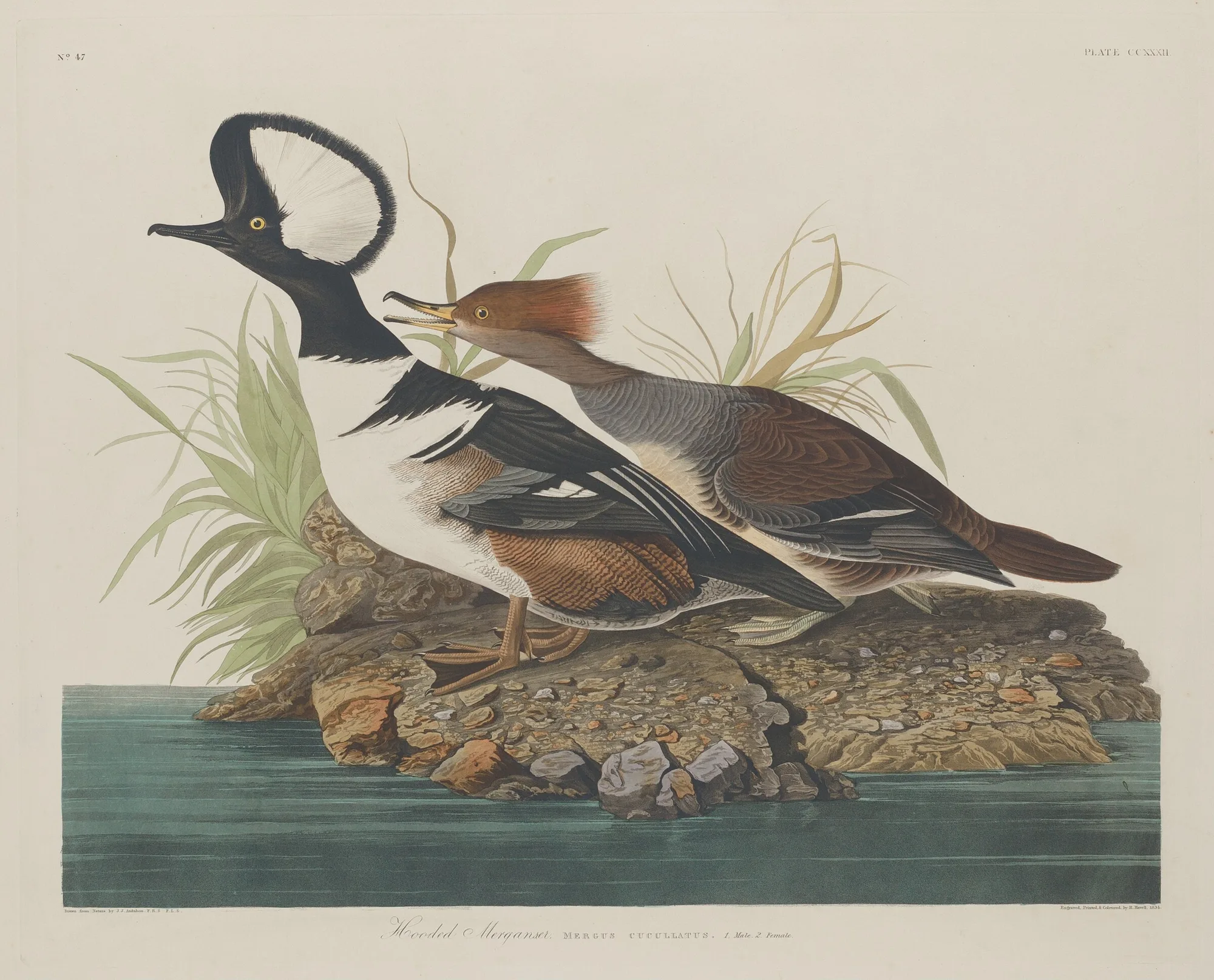
Audubon's “Hooded Merganser”, The Birds of America, plate CCXXXII
Click or press Enter to enlarge
Open the full-resolution image (3126 px, National Gallery of Art)
| Plate | 232 (CCXXXII) |
|---|---|
| Audubon's name | Hooded Merganser |
| Modern name | Hooded Merganser |
| Scientific name | Lophodytes cucullatus |
| Status | Least Concern |
| Engraved by | Robert Havell, after Audubon's watercolor |
| Date | 1834 |
| Medium | Hand-colored engraving and aquatint on Whatman wove paper |
| Collections | Ducks, Geese and Swans |
| This impression | National Gallery of Art, Washington, 1945.8.232; Gift of Mrs. Walter B. James |
About this plate
Plate 232 shows a male and female Hooded Merganser. The male's fan-shaped crest is white edged with black, and he can raise or flatten it at will. The female is grey-brown with a loose cinnamon crest. Audubon thought it the handsomest of its family after the Smew.
Much of the chapter is set on the Ohio, which he called la belle rivière. He described standing on the bank on moonlit evenings and hearing the whistle of wings as small parties of five to ten swept low over the river and shot into a creek mouth, where they bathed, preened and dived for minnows before roosting on a clean sand beach. He wrote that the species preferred fresh water, creeks and small ponds to the sea coast, that a wounded bird would swim with only its bill above the surface to hide among the plants, and that the flesh tasted of fish.
Audubon's Mergus cucullatus is now Lophodytes cucullatus, the only member of its genus. It is the smallest North American merganser and nests in tree cavities near wooded ponds and rivers, readily using nest boxes put up for Wood Ducks. The female lays eggs in other mergansers' and Wood Ducks' nests as well as her own.
The species breeds across the eastern United States and southern Canada and in the Pacific Northwest. It is listed as Least Concern, and its numbers have grown as beaver ponds and nest boxes have spread.
In Audubon's words
At the approach of night, a person standing still on the banks of such a river as the Ohio, first hears the well-known sound of wings whistling through the air, presently after, a different noise, as if produced by an eagle stooping on her prey, when gliding downwards with the rapidity of an arrow, he dimly perceives the Hooded Mergansers sweeping past. Five or six, perhaps ten, there are; with quick beats of their pinions, they fly low over the waters in wide circles. Now they have spied the entrance of a creek; there they shoot into it, and in a few seconds you hear the rushing noise which they make as they alight on the bosom of the still pool. How often have I enjoyed such scenes, when enticed abroad by the clear light of the silvery moon, I have wandered on the shores of la belle rivière, to indulge in the contemplation of nature!
John James Audubon, Ornithological Biography, vol. 3 (1835), “The Hooded Merganser”. Read the full chapter.