Long-billed Curlew (Plate 231)
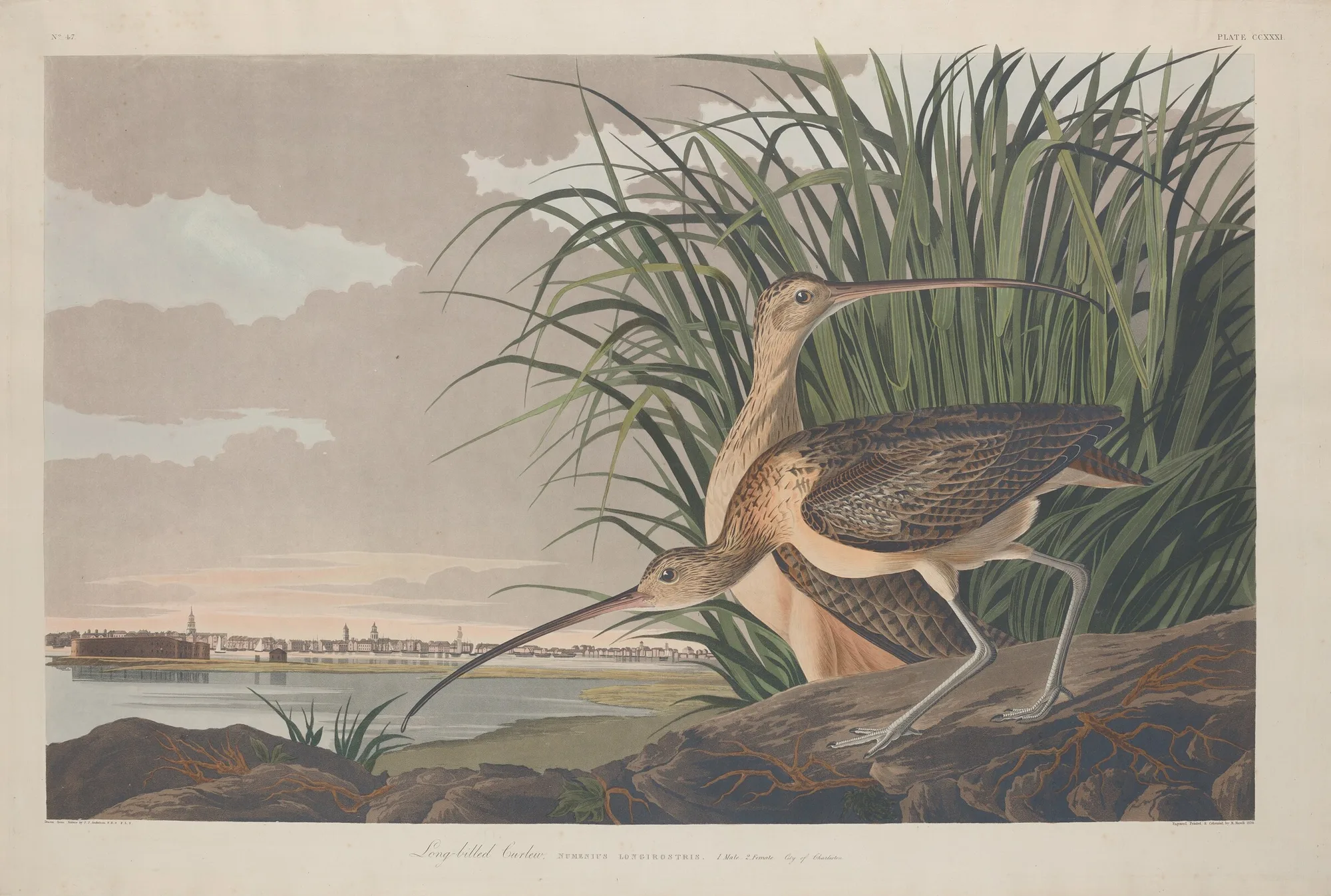
Audubon's “Long-billed Curlew”, The Birds of America, plate CCXXXI
Click or press Enter to enlarge
Open the full-resolution image (4586 px, National Gallery of Art)
| Plate | 231 (CCXXXI) |
|---|---|
| Audubon's name | Long-billed Curlew |
| Modern name | Long-billed Curlew |
| Scientific name | Numenius americanus |
| Status | Least Concern |
| Engraved by | Robert Havell, after Audubon's watercolor |
| Date | 1834 |
| Medium | Hand-colored engraving and aquatint on Whatman wove paper |
| Size | plate: 64.1 x 96.5 cm (25 1/4 x 38 in.) sheet: 67.3 x 100.3 cm (26 1/2 x 39 1/2 in.) |
| Plants and setting | Background view of Charleston harbour |
| Collections | Shorebirds, Rails and Cranes |
| This impression | National Gallery of Art, Washington, 1945.8.231; Gift of Mrs. Walter B. James |
About this plate
Plate 231 shows a male and female Long-billed Curlew, cinnamon-buff birds with bills that curve down for up to eight inches. The background is a distant view of Charleston, South Carolina, across the water.
Audubon studied the species near Charleston with his friend John Bachman. On 10 November 1831 their party sailed about twenty miles to Cole's Island to watch the curlews come in at dusk. He wrote that the birds fed in the salt marshes by day and gathered on the beaches at night, small parties joining until several thousand had collected. He believed the species lived in the South all year and bred on the islands of the Carolina coast, as Bachman had reported, and he doubted reports that it nested in the far north.
Audubon's Numenius longirostris is now Numenius americanus, the largest sandpiper in North America. It breeds not on the Atlantic coast but in the dry grasslands of the Great Plains and Great Basin, and winters from California and the Gulf coast into Mexico, with smaller numbers on the Southeast coast. He was right that it does not nest in the Arctic.
It is listed as Least Concern, but loss of native grassland to ploughing has made it a species of conservation concern in the United States and Canada.
In Audubon's words
The Long-billed Curlew spends the day in the sea-marshes, from which it returns at the approach of night, to the sandy beaches of the sea-shores, where it rests until dawn. As the sun sinks beneath the horizon, the Curlews rise from their feeding-grounds in small parties, seldom exceeding fifteen or twenty, and more usually composed of only five or six individuals. The flocks enlarge, however, as they proceed, and in the course of an hour or so the number of birds that collect in the place selected for their nightly retreat, sometimes amounts to several thousands. As it was my good fortune to witness their departures and arrivals, in the company of my friend Bachman, I will here describe them.
John James Audubon, Ornithological Biography, vol. 3 (1835), “The Long-Billed Curlew”. Read the full chapter.



