Sora (Plate 233)
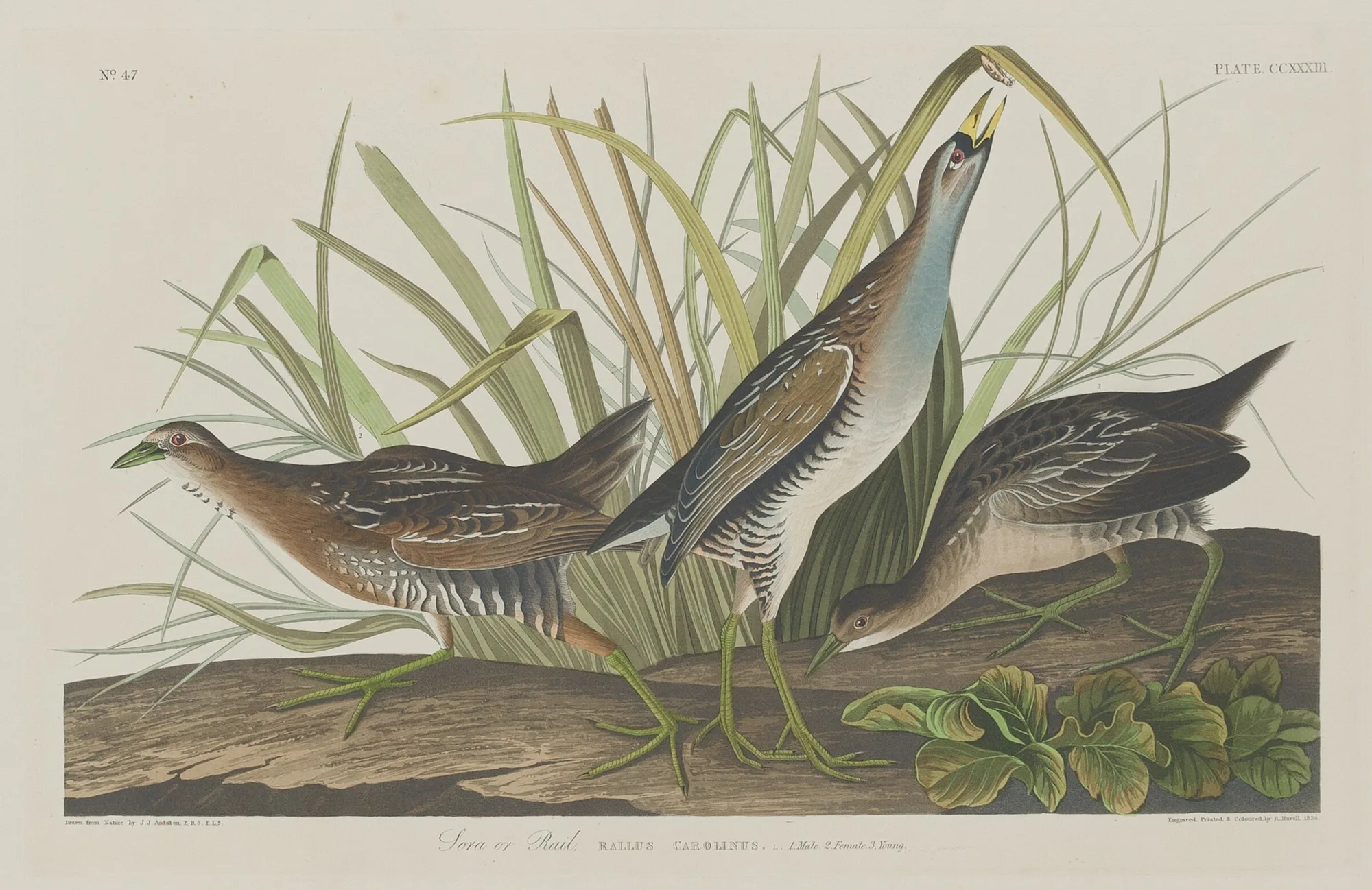
Audubon's “Sora or Rail”, The Birds of America, plate CCXXXIII
Click or press Enter to enlarge
Open the full-resolution image (2406 px, National Gallery of Art)
| Plate | 233 (CCXXXIII) |
|---|---|
| Audubon's name | Sora or Rail |
| Modern name | Sora |
| Scientific name | Porzana carolina |
| Status | Least Concern |
| Engraved by | Robert Havell, after Audubon's watercolor |
| Date | 1834 |
| Medium | Hand-colored engraving and aquatint on Whatman wove paper |
| Collections | Shorebirds, Rails and Cranes |
| This impression | National Gallery of Art, Washington, 1945.8.233; Gift of Mrs. Walter B. James |
About this plate
Plate 233 shows a male, a female and a young Sora. Adults are brown and grey with a short, stout yellow bill and a black patch on the face and throat. The young bird lacks the black face and is buff below.
Audubon opened the chapter by dismissing the old belief that Soras buried themselves in the mud for the winter, a story he grouped with geese hatching from barnacles and swans singing at their own deaths. The birds, he wrote, simply migrate. He traced spring birds from Mexico across the Gulf and the Florida peninsula toward Cape Lookout, then up the coast through Pamlico Sound to the Chesapeake and the Delaware. In autumn they gathered by the thousand in the wild-rice marshes of the Middle States, where they fed on the seeds and were shot in great numbers. He noted that they were rare in Massachusetts and unknown in Nova Scotia, where Thomas MacCulloch never saw one.
Audubon called it Rallus carolinus. It is now Porzana carolina, the most widespread rail in North America. Although it seems weak in flight when flushed from a marsh, it migrates long distances, wintering from the southern United States to northern South America.
The Sora breeds in freshwater marshes across much of Canada and the northern and western United States. It is more often heard than seen; its call is a rising whistle followed by a descending whinny. It is listed as Least Concern.
In Audubon's words
Not many years have elapsed since it was supposed by some of the inhabitants of those districts to which thousands of this species of Rail resort at particular periods, that the Soras buried themselves in the mud at the approach of cold weather, for the purpose of there spending the winter in a state of torpidity. Many wonderful tales were circulated to convince the world of the truth of this alleged phenomenon; but the fact was, as you will naturally anticipate, that the birds merely shifted their quarters, as no doubt they will continue to do, so long as the climate becomes too cold for them in winter.
John James Audubon, Ornithological Biography, vol. 3 (1835), “The Sora Rail”. Read the full chapter.



