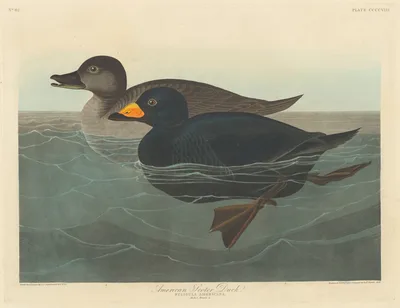
Ring-necked Duck (Plate 234)
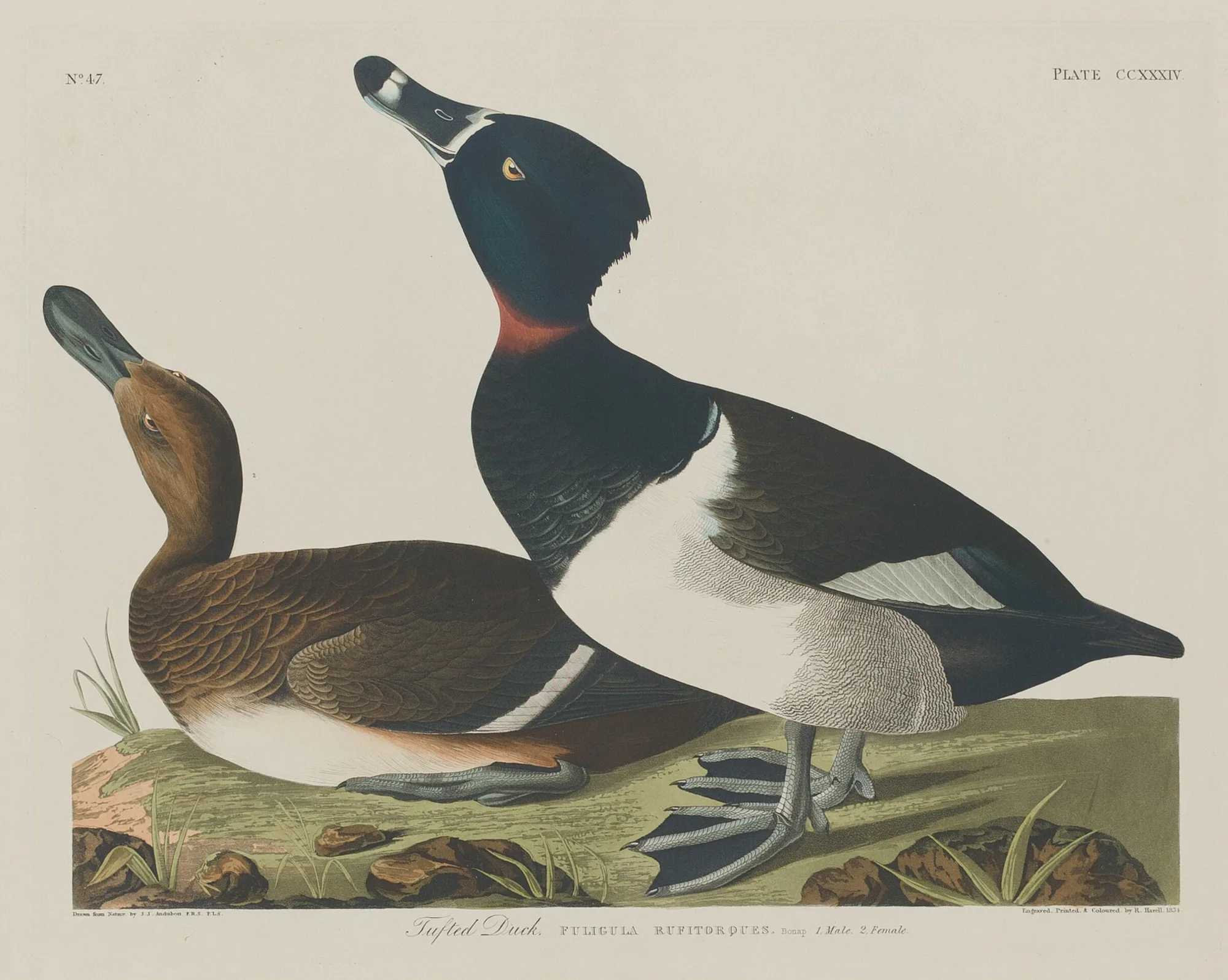
Audubon's “Tufted Duck”, The Birds of America, plate CCXXXIV
Click or press Enter to enlarge
Open the full-resolution image (2196 px, National Gallery of Art)
| Plate | 234 (CCXXXIV) |
|---|---|
| Audubon's name | Tufted Duck |
| Modern name | Ring-necked Duck |
| Scientific name | Aythya collaris |
| Status | Least Concern |
| Engraved by | Robert Havell, after Audubon's watercolor |
| Date | 1834 |
| Medium | Hand-colored engraving and aquatint on Whatman wove paper |
| Collections | Ducks, Geese and Swans |
| This impression | National Gallery of Art, Washington, 1945.8.234; Gift of Mrs. Walter B. James |
About this plate
Plate 234 is engraved Tufted Duck, but the bird is the Ring-necked Duck, and Audubon used that name in the Ornithological Biography. The male has a glossy black head and back, grey flanks with a white wedge at the front, and a grey bill crossed by a white ring. The faint chestnut collar that gave the species its name is hard to see in the field. The female is brown with a pale eye ring.
Audubon wrote that in Kentucky the bird was called the Ring-bill. It arrived on the western waters from late September to mid-October and spread from Massachusetts to Louisiana. He thought its flesh equal to that of any duck, free of the fishy taste of deeper divers. He described a courtship habit of throwing back the head and raising the crown feathers while making a note like a person blowing through a tube. Near Louisville one May he shot a male with a swollen neck and found a frog nearly two inches long lodged in its throat.
Audubon's Fuligula rufitorques is now Aythya collaris. The true Tufted Duck, Aythya fuligula, is a Eurasian species, which explains the confusion over the title.
The Ring-necked Duck breeds in wooded bogs and marshes across Canada and the northern United States and winters on lakes, ponds and rivers in the South. It is listed as Least Concern.
In Audubon's words
Whilst in ponds, they feed by diving and dabbling with their bills in the mud amongst the roots of grasses, of which they eat the seeds also, as well as snails and all kinds of aquatic insects. When on rivers, their usual food consists of small fish and crays, the latter of which they procure at the bottom. A male which I shot near Louisville, in the beginning of May, exhibited a protuberance of the neck so very remarkable as to induce me to cut the skin, when I found a frog, the body of which was nearly two inches long, and which had almost choked the bird, as it allowed me to go up within a dozen or fifteen paces before I took aim.
John James Audubon, Ornithological Biography, vol. 3 (1835), “The Ring-Necked Duck”. Read the full chapter.