Sooty Tern (Plate 235)
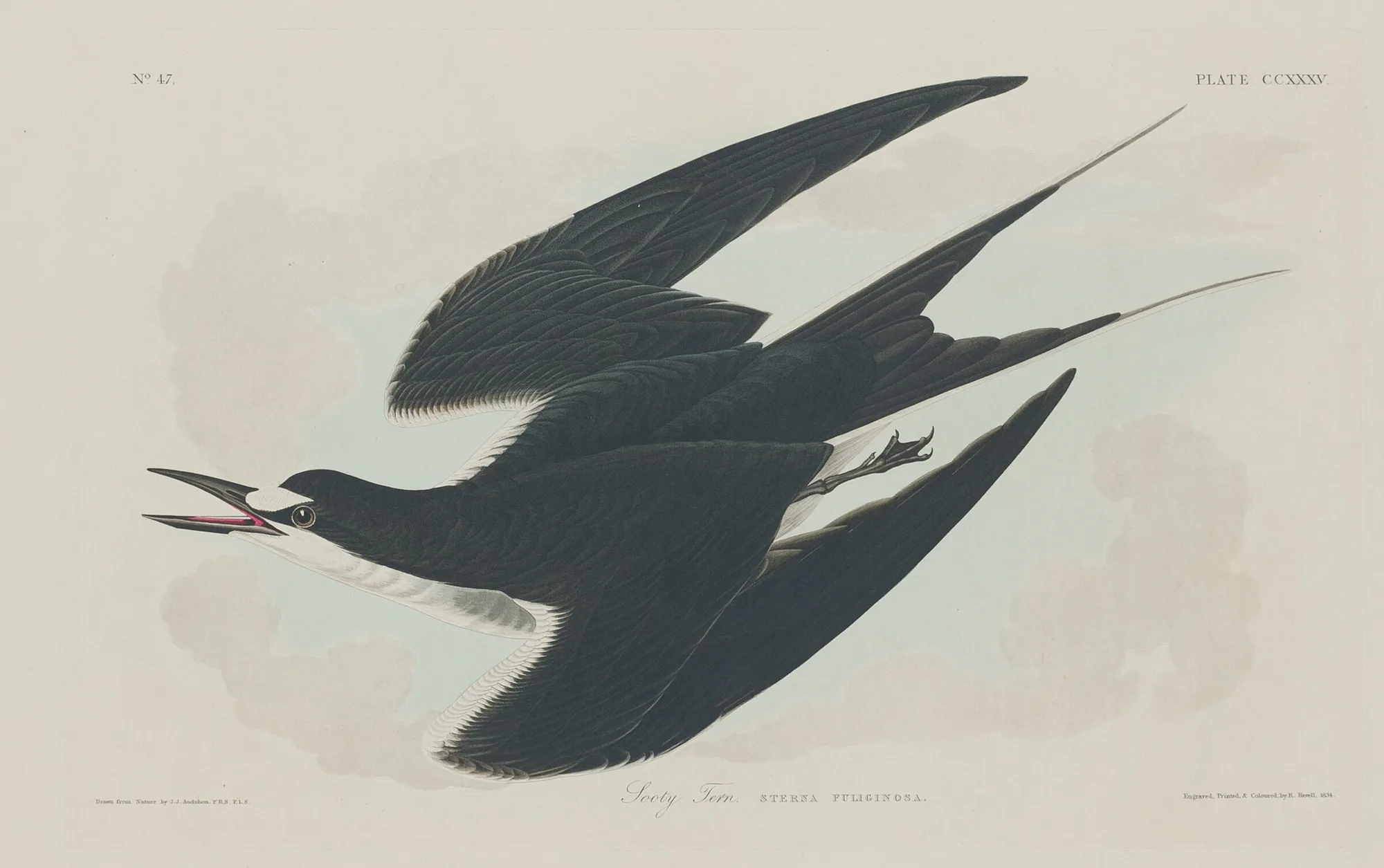
Audubon's “Sooty Tern”, The Birds of America, plate CCXXXV
Click or press Enter to enlarge
Open the full-resolution image (2518 px, National Gallery of Art)
| Plate | 235 (CCXXXV) |
|---|---|
| Audubon's name | Sooty Tern |
| Modern name | Sooty Tern |
| Scientific name | Onychoprion fuscatus |
| Status | Least Concern |
| Engraved by | Robert Havell, after Audubon's watercolor |
| Date | 1834 |
| Medium | Hand-colored engraving and aquatint on Whatman wove paper |
| Collections | Seabirds, Florida and Wading Birds |
| This impression | National Gallery of Art, Washington, 1945.8.235; Gift of Mrs. Walter B. James |
About this plate
Plate 235 shows a male Sooty Tern, black above and white below, with a white forehead, a black line through the eye and a deeply forked tail.
The chapter opens on 9 May 1832 aboard the United States revenue cutter Marion, commanded by Robert Day, as the low keys of the Tortugas came into view. The pilot told Audubon that one islet was the breeding place of the Black and White Sea Swallows and another that of the Noddies. When the anchor chain grated, a cloud of birds rose from Bird Key. Audubon wrote that on landing he felt as if the birds might lift him from the ground, and that their cries were deafening. He found the eggs laid on bare sand under the bushes about a foot apart.
Audubon's Sterna fuliginosa is now Onychoprion fuscatus. It is a tropical seabird that feeds by snatching small fish and squid from the surface. It rarely settles on the water, and young birds may stay aloft at sea for several years before returning to breed.
The species nests on islands in tropical oceans worldwide. In the United States the main colony is still in the Dry Tortugas, on Bush Key, where tens of thousands of pairs nest each spring. It is listed as Least Concern.
In Audubon's words
After various tacks, we made our way through the curious and extremely dangerous channels leading to the small harbour, where we anchored. As the chain grated the ear, I saw a cloud-like mass arise over the “Bird Key,” from which we were only a few hundred yards distant; and in a few minutes the yawl was carrying myself and my assistant ashore. On landing, I felt for a moment as if the birds would raise me from the ground, so thick were they all round, and so quick the motion of their wings. Their cries were indeed deafening, yet not more than half of them took to wing on our arrival, those which rose being chiefly male birds, as we afterwards ascertained.
John James Audubon, Ornithological Biography, vol. 3 (1835), “The Sooty Tern”. Read the full chapter.