Great Black-backed Gull (Plate 241)
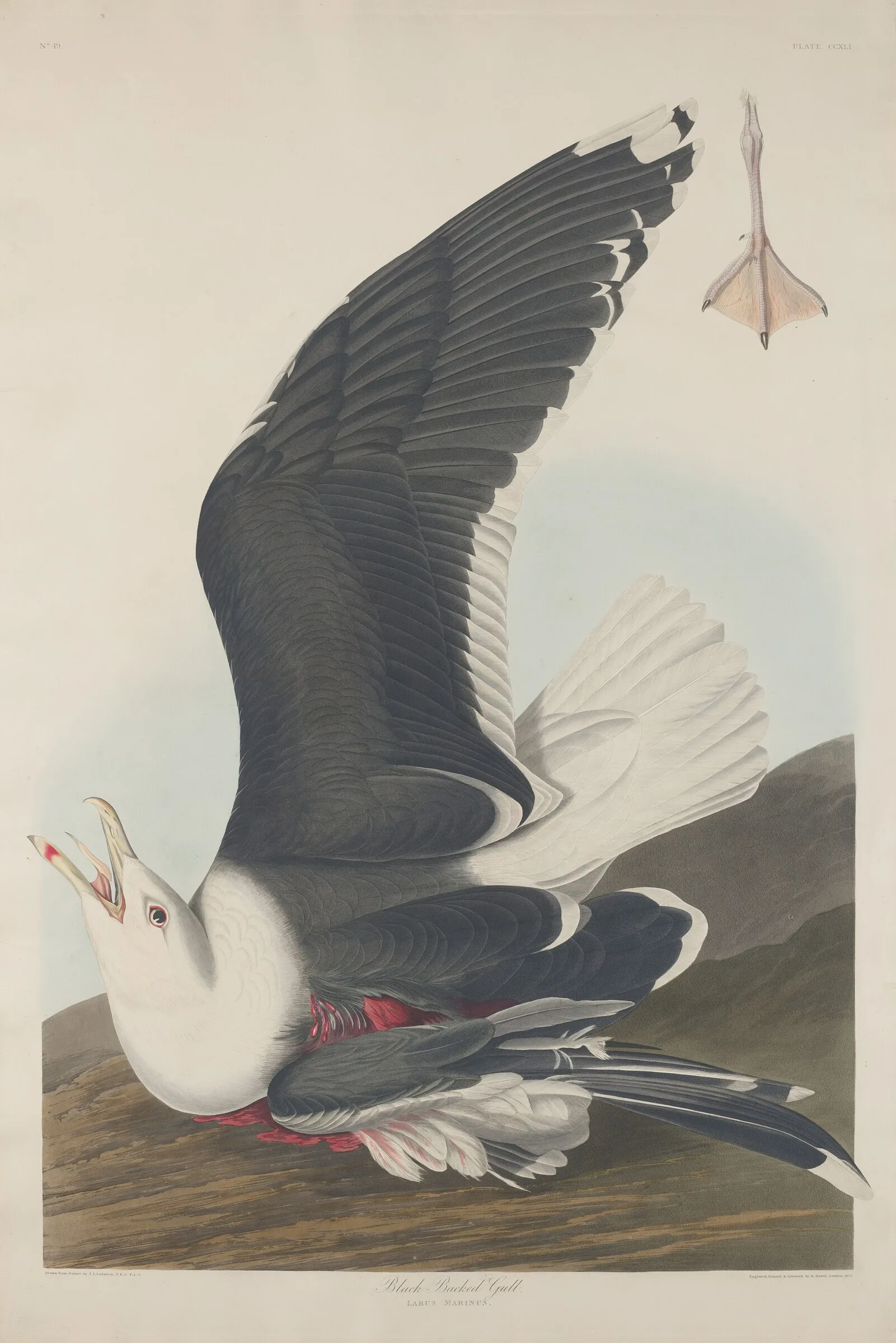
Audubon's “Black-Backed Gull”, The Birds of America, plate CCXLI
Click or press Enter to enlarge
Open the full-resolution image (4681 px, National Gallery of Art)
| Plate | 241 (CCXLI) |
|---|---|
| Audubon's name | Black-Backed Gull |
| Modern name | Great Black-backed Gull |
| Scientific name | Larus marinus |
| Status | Least Concern |
| Engraved by | Robert Havell, after Audubon's watercolor |
| Date | 1835 |
| Medium | Hand-colored engraving and aquatint on Whatman wove paper |
| Collections | Seabirds |
| This impression | National Gallery of Art, Washington, 1945.8.241; Gift of Mrs. Walter B. James |
About this plate
Plate 241 shows a male Great Black-backed Gull, white with a black back and wings, pink legs and a heavy yellow bill with a red spot near the tip.
Audubon wrote the opening of the chapter as a portrait of a tyrant. Over the coast of Labrador the gull sails like an eagle, and the breeding birds below hide their young as it passes. It tears at the carcass of a whale until it is crammed to the throat, then robs nests of eggs and chicks. Yet he called it a coward that slinks away when a skua rises against it. The chapter draws on his summer of 1833 in Labrador, where the species nested on the coastal islands.
The scientific name, Larus marinus, is unchanged. It is the largest gull in the world, with a wingspan of up to about five and a half feet. It eats fish, carrion, garbage, eggs and the young of other seabirds, and it will kill adult birds as large as eiders.
In Audubon's day the species bred mainly in Labrador, Newfoundland and the Maritimes. Protection from egg collecting and the plume trade, together with the growth of fisheries waste and landfills, allowed it to spread south during the twentieth century, and it now nests on the Atlantic coast as far as North Carolina. It also breeds in Europe. It is listed as Least Concern, although numbers have fallen in parts of its range in recent decades.
In Audubon's words
Even the shoals of the finny tribes sink deeper into the waters as he approaches; the young birds become silent in their nests or seek for safety in the clefts of the rocks; the Guillemots and Gannets dread to look up, and the other Gulls, unable to cope with the destroyer, give way as he advances. Far off among the rolling billows, he spies the carcass of some monster of the deep, and, on steady wing, glides off towards it. Alighting on the huge whale, he throws upwards his head, opens his bill, and, louder and fiercer than ever, sends his cries through the air. Leisurely he walks over the putrid mass, and now, assured that all is safe, he tears, tugs, and swallows piece after piece, until he is crammed to the throat, when he lays himself down surfeited and exhausted, to rest for a while in the feeble sheen of the northern sun.
John James Audubon, Ornithological Biography, vol. 3 (1835), “The Great Black-Backed Gull”. Read the full chapter.