Roseate Tern (Plate 240)
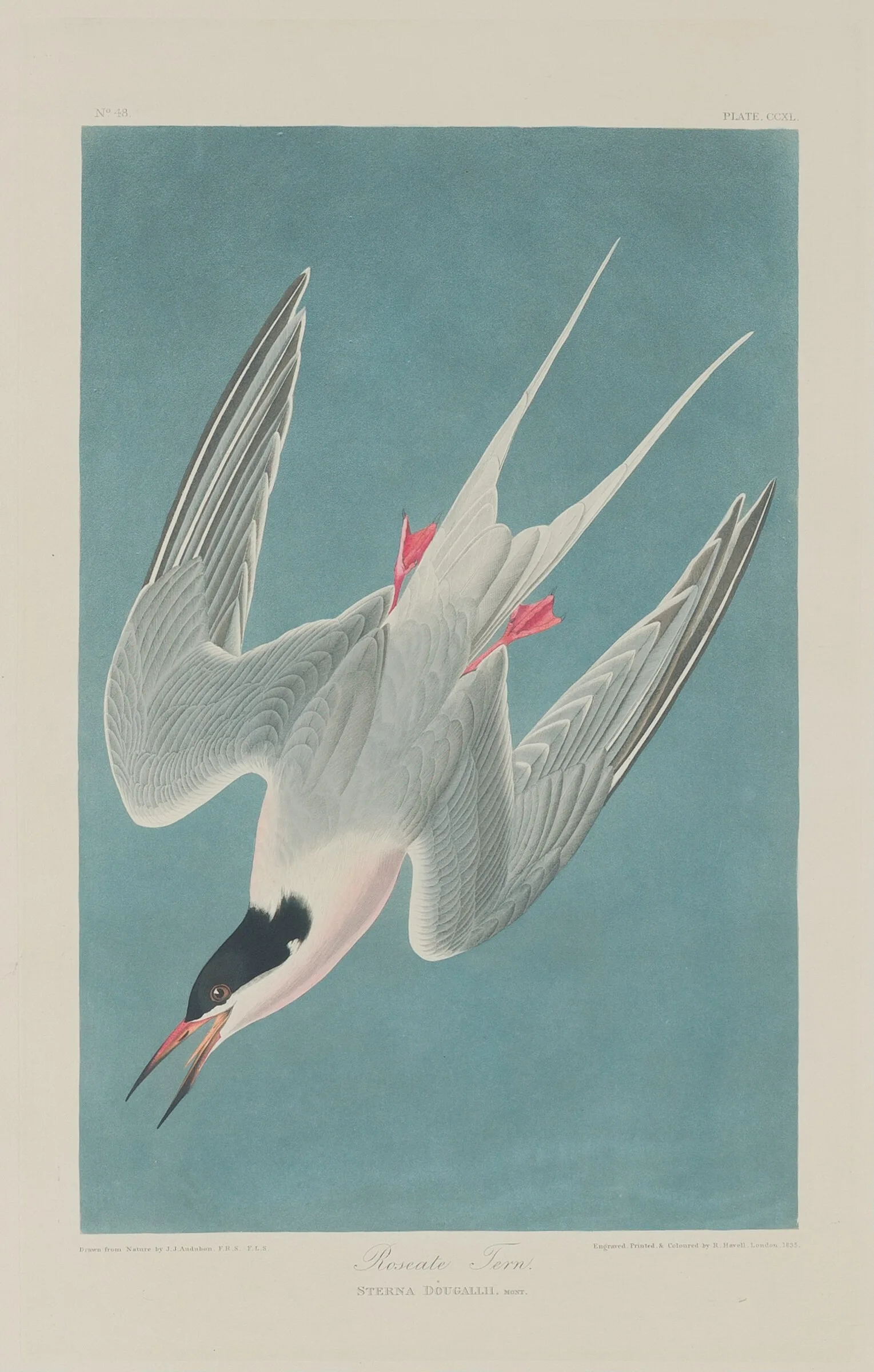
Audubon's “Roseate Tern”, The Birds of America, plate CCXL
Click or press Enter to enlarge
Open the full-resolution image (2401 px, National Gallery of Art)
| Plate | 240 (CCXL) |
|---|---|
| Audubon's name | Roseate Tern |
| Modern name | Roseate Tern |
| Scientific name | Sterna dougallii |
| Status | Least Concern |
| Engraved by | Robert Havell, after Audubon's watercolor |
| Date | 1835 |
| Medium | Hand-colored engraving and aquatint on Whatman wove paper |
| Collections | Seabirds, Florida and Wading Birds |
| This impression | National Gallery of Art, Washington, 1945.8.240; Gift of Mrs. Walter B. James |
About this plate
Plate 240 shows an adult Roseate Tern in breeding plumage: black cap, very pale grey upperparts, long white tail streamers and the faint pink flush on the breast that gives it its name.
Audubon met the species for the first time on 28 April 1832 at Indian Key in the Florida Keys. He spent a sleepless night in a hammock on a veranda during a downpour, roused his companions at four, and pushed off in the boats before six. When the rain cleared they found terns on a sand bar, fired two guns and picked up thirty-eight Roseate Terns. He wrote that the survivors danced in the air like the humming birds of the sea, and that the species was not yet in Charles Bonaparte's list of American birds. He added that he killed no more on that excursion.
Audubon's Sterna dougallii keeps its name, which honours the Scottish naturalist Peter McDougall. The species nests on islands in scattered colonies across the Atlantic, Indian and Pacific Oceans. In the Americas the main populations are in the northeastern United States and Atlantic Canada and in the Caribbean, including the Florida Keys.
It is listed as Least Concern worldwide. In the United States the northeastern population is listed as Endangered and the Caribbean population as Threatened, and most northeastern birds nest at only a few protected islands.
In Audubon's words
Beautiful, indeed, are Terns of every kind, but the Roseate excels the rest, if not in form, yet in the lovely hue of its breast. I had never seen a bird of this species before, and as the unscathed hundreds arose and danced as it were in the air, I thought them the Humming Birds of the sea, so light and graceful were their movements. Now they flocked together and hovered over us, again with a sudden dash they plunged towards us in anger; even their cries of wrath sounded musical, and although I had carried destruction among them, I felt delighted. As I have just said, I had not before seen a Roseate Tern, not even the skin of one stuffed with tow; the species was not in the Synopsis of my friend Bonaparte, and now I had my cap filled to the brim with specimens.
John James Audubon, Ornithological Biography, vol. 3 (1835), “The Roseate Tern”. Read the full chapter.