Snowy Egret (Plate 242)
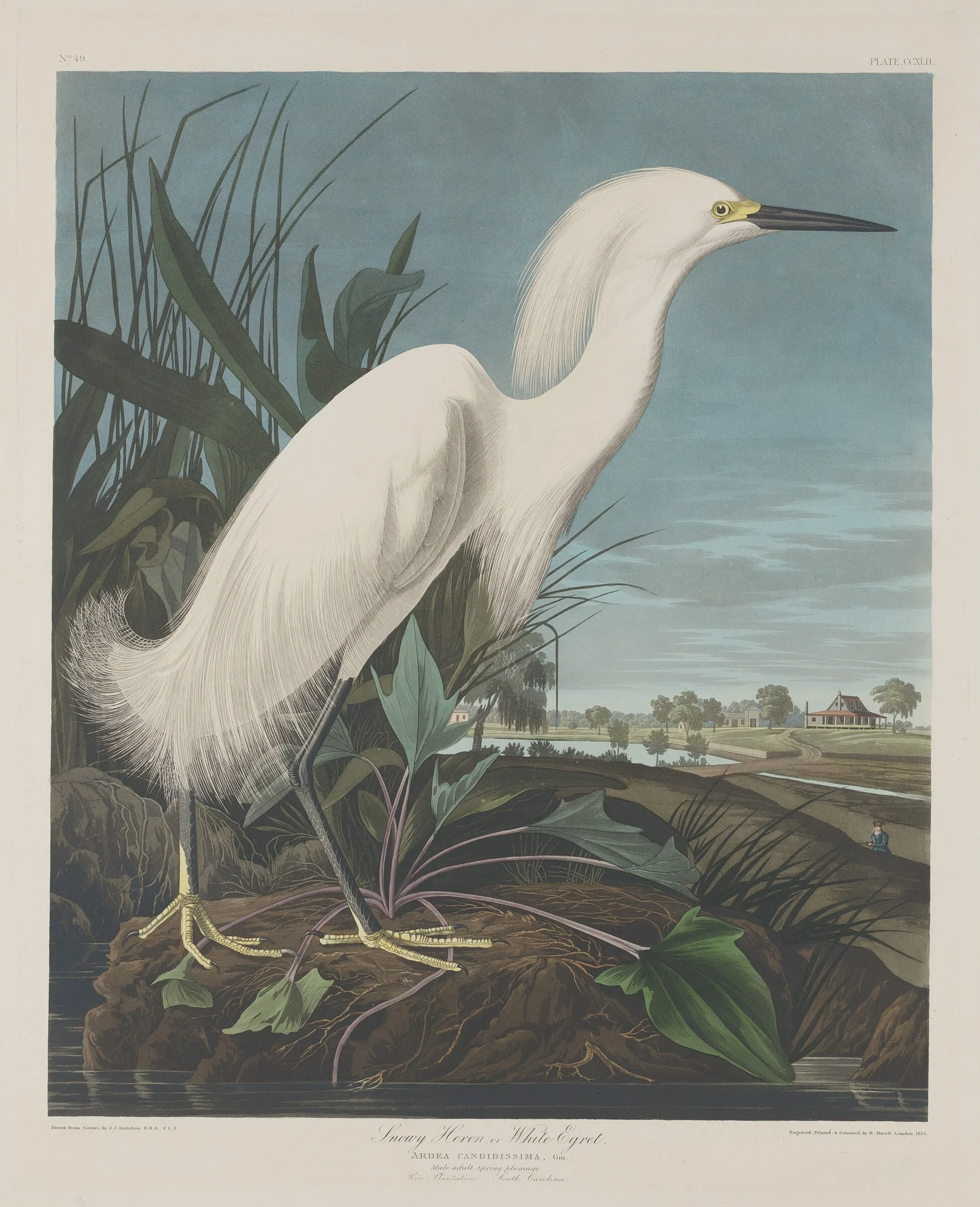
Audubon's “Snowy Heron, or White Egret”, The Birds of America, plate CCXLII
Click or press Enter to enlarge
Open the full-resolution image (3173 px, National Gallery of Art)
| Plate | 242 (CCXLII) |
|---|---|
| Audubon's name | Snowy Heron, or White Egret |
| Modern name | Snowy Egret |
| Scientific name | Egretta thula |
| Status | Least Concern |
| Engraved by | Robert Havell, after Audubon's watercolor |
| Date | 1835 |
| Medium | Hand-colored engraving and aquatint on Whatman wove paper |
| Size | plate: 65.4 x 52.7 cm (25 3/4 x 20 3/4 in.) sheet: 100 x 68 cm (39 3/8 x 26 3/4 in.) |
| Plants and setting | Plantation landscape with a hunter in the background |
| Collections | Herons and Egrets, Florida and Wading Birds |
| This impression | National Gallery of Art, Washington, 1945.8.242; Gift of Mrs. Walter B. James |
About this plate
Plate 242 shows a male Snowy Egret in breeding dress, all white with lacy plumes on the back curving upward over the tail, a black bill with yellow skin at its base, black legs and bright yellow feet. In the distance of the Havell plate a small figure of a hunter and buildings of a low-country plantation appear.
Audubon described the bird as a constant resident of Florida and Louisiana and a summer visitor north to Long Island. At Charleston in March, he wrote, few had arrived from Florida by the 18th, but by the 25th thousands were in the marshes and rice fields, all in full plumage. He disputed Alexander Wilson's claim that it ranged to the Gulf of St Lawrence. He described migrating flocks flying silently by night and day at no great height.
Audubon's Ardea candidissima is now Egretta thula. The same plumes he painted nearly destroyed the species. In the late nineteenth century plume hunters shot egrets at their nesting colonies to supply the millinery trade, and Snowy Egret plumes were among the most valuable. Public outrage over the slaughter helped found the early Audubon societies and led to laws protecting wild birds.
Under protection the Snowy Egret recovered and spread north, and it now breeds on the Atlantic coast to Maine and inland in the West. It ranges south through South America. It is listed as Least Concern.
In Audubon's words
While I was at Charleston, in March 1831, few had arrived from the Floridas by the 18th of that month, but on the 25th thousands were seen in the marshes and rice fields, all in full plumage. They reach the shores of New Jersey about the first week of May, when they may be seen on all parts of the coast between that district and the Gulf of Mexico. On the Mississippi, they seldom reach the low grounds about Natchez, where they also breed, earlier than the period at which they appear in the Middle States. While migrating, they fly both by night and by day, in loose flocks of from twenty to a hundred individuals, sometimes arranging themselves in a broad front, then forming lines, and again proceeding in a straggling manner. They keep perfectly silent, and move at a height seldom exceeding a hundred yards. Their flight is light, undetermined as it were, yet well sustained, and performed by regular flappings, as in other birds of the tribe.
John James Audubon, Ornithological Biography, vol. 3 (1835), “The Snowy Heron”. Read the full chapter.