Thick-billed Murre (Plate 245)
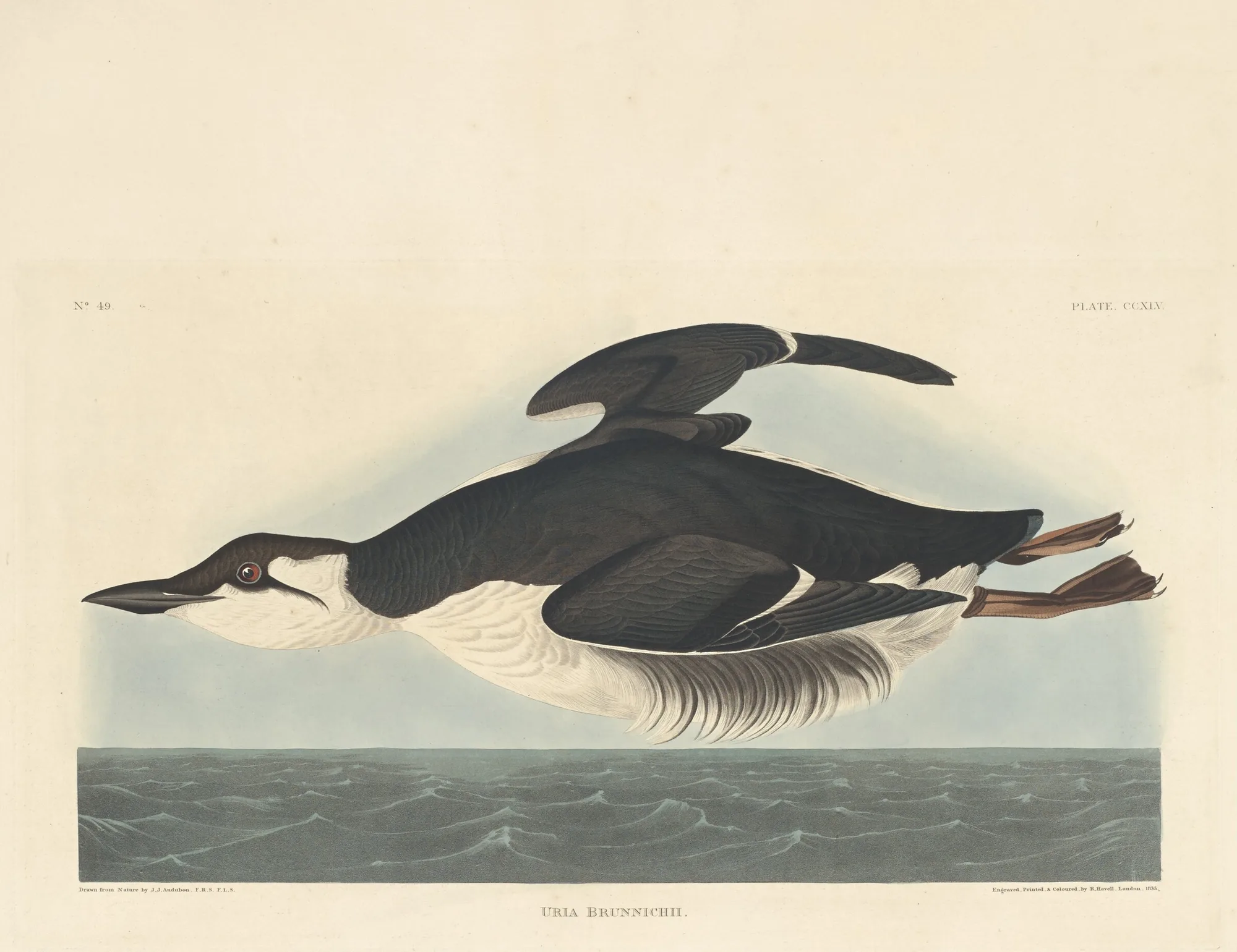
Audubon's “Uria Brunnichii”, The Birds of America, plate CCXLV
Click or press Enter to enlarge
Open the full-resolution image (3134 px, National Gallery of Art)
| Plate | 245 (CCXLV) |
|---|---|
| Audubon's name | Uria Brunnichii |
| Modern name | Thick-billed Murre |
| Scientific name | Uria lomvia |
| Status | Least Concern |
| Engraved by | Robert Havell, after Audubon's watercolor |
| Date | 1835 |
| Medium | Hand-colored engraving and aquatint on Whatman wove paper |
| Collections | Seabirds |
| This impression | National Gallery of Art, Washington, 1945.8.245; Gift of Mrs. Walter B. James |
About this plate
Plate 245 carries only the Latin name Uria Brunnichii. In the Ornithological Biography Audubon called the bird the Large-billed Guillemot. It shows an adult male Thick-billed Murre in winter plumage: black above, white below, with a heavy dagger-shaped bill marked by a white line along the gape.
Audubon never saw the species alive. The specimen he drew was sent to him packed in ice from Eastport, Maine, and reached him fresh on 18 February 1833. It had been shot with others while feeding in Passamaquoddy Bay among broken ice. The sender, Mr Curtis, reported that it flew and dived like the Common Murre, which Audubon called the Foolish Guillemot. Audubon later gave the skin to John Bachman. His party saw none on the way to Labrador that summer, and he guessed that the species returned north earlier than the Common Murre.
The bird is now Uria lomvia. In Britain it is still called Brünnich's Guillemot, after the Danish zoologist Morten Brünnich. It is larger and heavier-billed than the Common Murre and more strictly Arctic, nesting on narrow cliff ledges in huge colonies in the Canadian Arctic, Greenland, Svalbard and Russia. It can dive to more than 200 metres.
It is listed as Least Concern, though it is hunted in Greenland and Newfoundland and some colonies have declined.
In Audubon's words
The specimen from which my figure was made was sent to me in ice, along with several other rare birds, from Eastport in Maine. I received it quite fresh and in excellent plumage, on the 18th of February 1833. It had been shot along with several other individuals of the same species while searching for food in the waters of Pasmaquody Bay, which were then covered with broken ice. Its flight was described by Mr Curtis, who sent it to me, as similar to that of the Foolish Guillemot, with which it associated. No other information was transmitted, excepting that it dived and swam like the other species.
John James Audubon, Ornithological Biography, vol. 3 (1835), “The Large-Billed Guillemot”. Read the full chapter.