Common Eider (Plate 246)
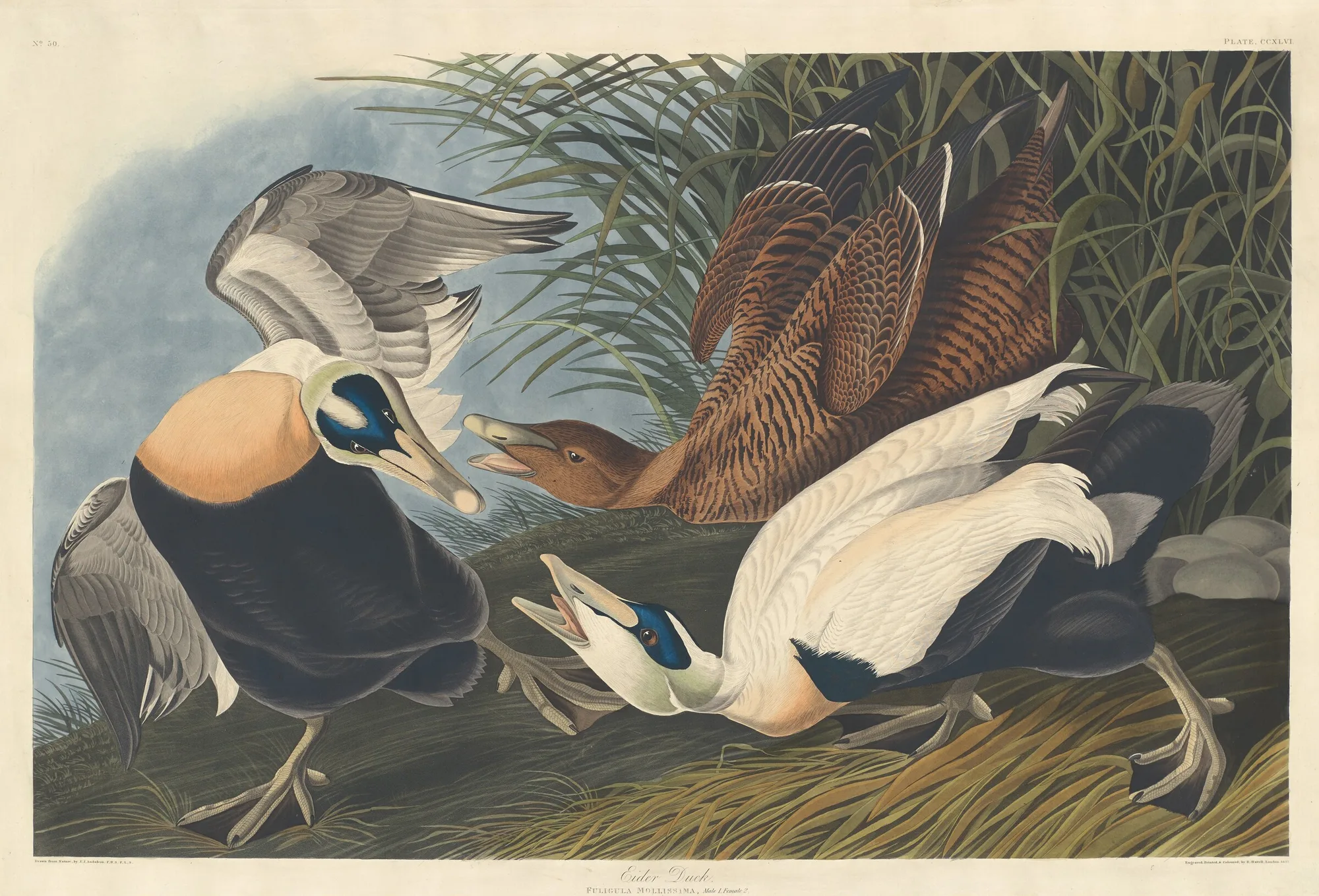
Audubon's “Eider Duck”, The Birds of America, plate CCXLVI
Click or press Enter to enlarge
Open the full-resolution image (5383 px, National Gallery of Art)
| Plate | 246 (CCXLVI) |
|---|---|
| Audubon's name | Eider Duck |
| Modern name | Common Eider |
| Scientific name | Somateria mollissima |
| Status | Near Threatened |
| Engraved by | Robert Havell, after Audubon's watercolor |
| Date | 1835 |
| Medium | Hand-colored engraving and aquatint on Whatman wove paper |
| Collections | Ducks, Geese and Swans |
| This impression | National Gallery of Art, Washington, 1945.8.246; Gift of Mrs. Walter B. James |
About this plate
Plate 246 shows a male and female Common Eider. The male is white above and black below, with a black cap, pale green on the nape and a long sloping bill. The female is warm brown, closely barred with black.
Audubon traced the species along the coast he knew. He wrote that in Wilson's time it had bred from Boston to the Bay of Fundy but that it was now seldom seen south of New York. Gunners near Boston sold eiders for fifty to seventy-five cents a pair. On 31 May 1833 his son and party killed six on Grand Manan, where the birds were starting to nest. Landing in Labrador on 18 June, the party found nests so thick on an island in Partridge Bay that a small boat could have been loaded with eggs, each nest set in grass growing in cracks of the rock.
Audubon placed it in Fuligula. It is now Somateria mollissima, the largest duck in the Northern Hemisphere. The female lines the nest with down plucked from her breast, and in Iceland and Norway this down is still gathered from managed colonies for quilts. It feeds by diving for mussels and other shellfish, which it swallows whole.
The Common Eider breeds on Arctic and northern coasts around the world. It is listed as Near Threatened because of declines in several populations, linked to hunting, oil spills and changes in shellfish stocks.
In Audubon's words
Immediately after landing on the coast of Labrador, on the 18th of June in the same year, we saw a great number of “Sea Ducks,” as the gunners and fishermen on that coast, as well as on our own, call the Eiders and some other species. On visiting an island in “Partridge Bay,” we procured several females. The birds there paid little attention to us, and some allowed us to approach within a few feet before they left their nests, which were so numerous that a small boat-load might have been collected, had the party been inclined. They were all placed amid the short grass growing in the fissures of the rock, and therefore in rows, as it were. The eggs were generally five or six, in several instances eight, and in one ten.
John James Audubon, Ornithological Biography, vol. 3 (1835), “The Eider Duck”. Read the full chapter.