Common Gallinule (Plate 244)
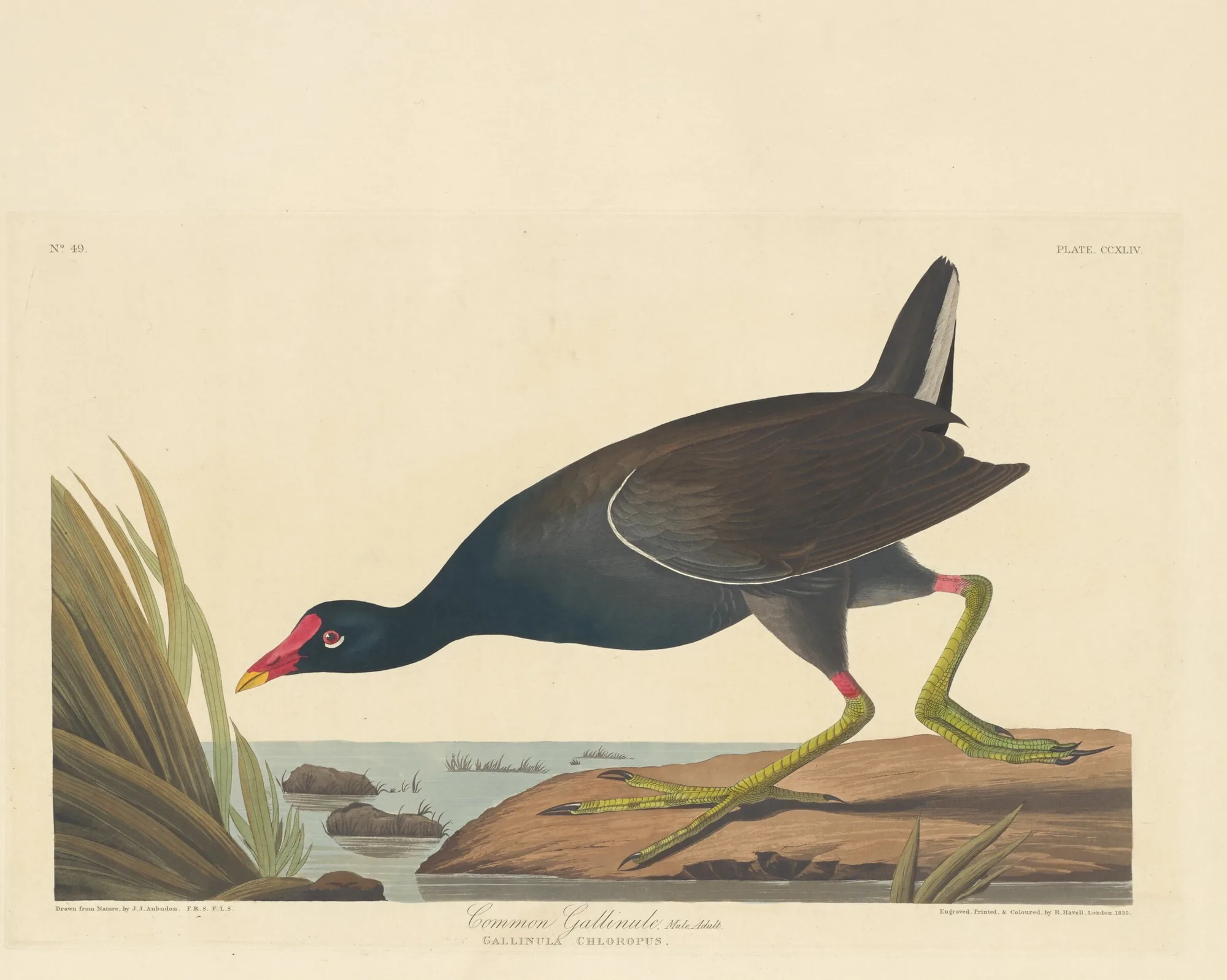
Audubon's “Common Gallinule”, The Birds of America, plate CCXLIV
Click or press Enter to enlarge
Open the full-resolution image (2869 px, National Gallery of Art)
| Plate | 244 (CCXLIV) |
|---|---|
| Audubon's name | Common Gallinule |
| Modern name | Common Gallinule |
| Scientific name | Gallinula galeata |
| Status | Least Concern |
| Engraved by | Robert Havell, after Audubon's watercolor |
| Date | 1835 |
| Medium | Hand-colored engraving and aquatint on Whatman wove paper |
| Collections | Shorebirds, Rails and Cranes |
| This impression | National Gallery of Art, Washington, 1945.8.244; Gift of Mrs. Walter B. James |
About this plate
Plate 244 shows a male Common Gallinule, dark slate grey with a brown back, a white stripe along the flanks, white under the tail, and a red bill and forehead shield with a yellow tip.
Audubon described the bird as abundant in winter along the rivers, lagoons and ponds from the Gulf of Mexico to the east coast of Florida, with some moving into the Carolinas in summer. In January at Spring Garden Spring in East Florida he saw great numbers on every bayou leading to the St Johns River, already courting. He compared them with the gallinules he watched in Regent's Park in London, where the birds walked unconcerned in the meadows within sight of people feeding the ducks and swans. He described their bulky nest of rushes with a raised rim.
Audubon treated the American bird as the same species as the European Moorhen, Gallinula chloropus. In 2011 the American Ornithological Society split them on differences in voice and DNA, and the American bird became the Common Gallinule, Gallinula galeata. The birds Audubon watched in London were Common Moorhens. For some decades the American form was also called the Florida Gallinule.
The Common Gallinule breeds in freshwater marshes in the eastern United States, the Southwest, the Caribbean and much of South America. It is listed as Least Concern.
In Audubon's words
In the lower parts of Louisiana and the Floridas, I have seen them seek their food and amuse themselves by day in the pastures and fields, and I have observed both them and the Gallinules of England enacting their courtship, while the sun was yet high above the horizon. In sight of man, however, they are timorous although not shy, and retreat from him among the grass and sedges bordering the water, to which they resort for safety. If shot at, or otherwise frightened, they run with speed, and either fly or swim off as fast as possible, to elude their enemy.
John James Audubon, Ornithological Biography, vol. 3 (1835), “The Common Gallinule”. Read the full chapter.



