White-winged Scoter (Plate 247)
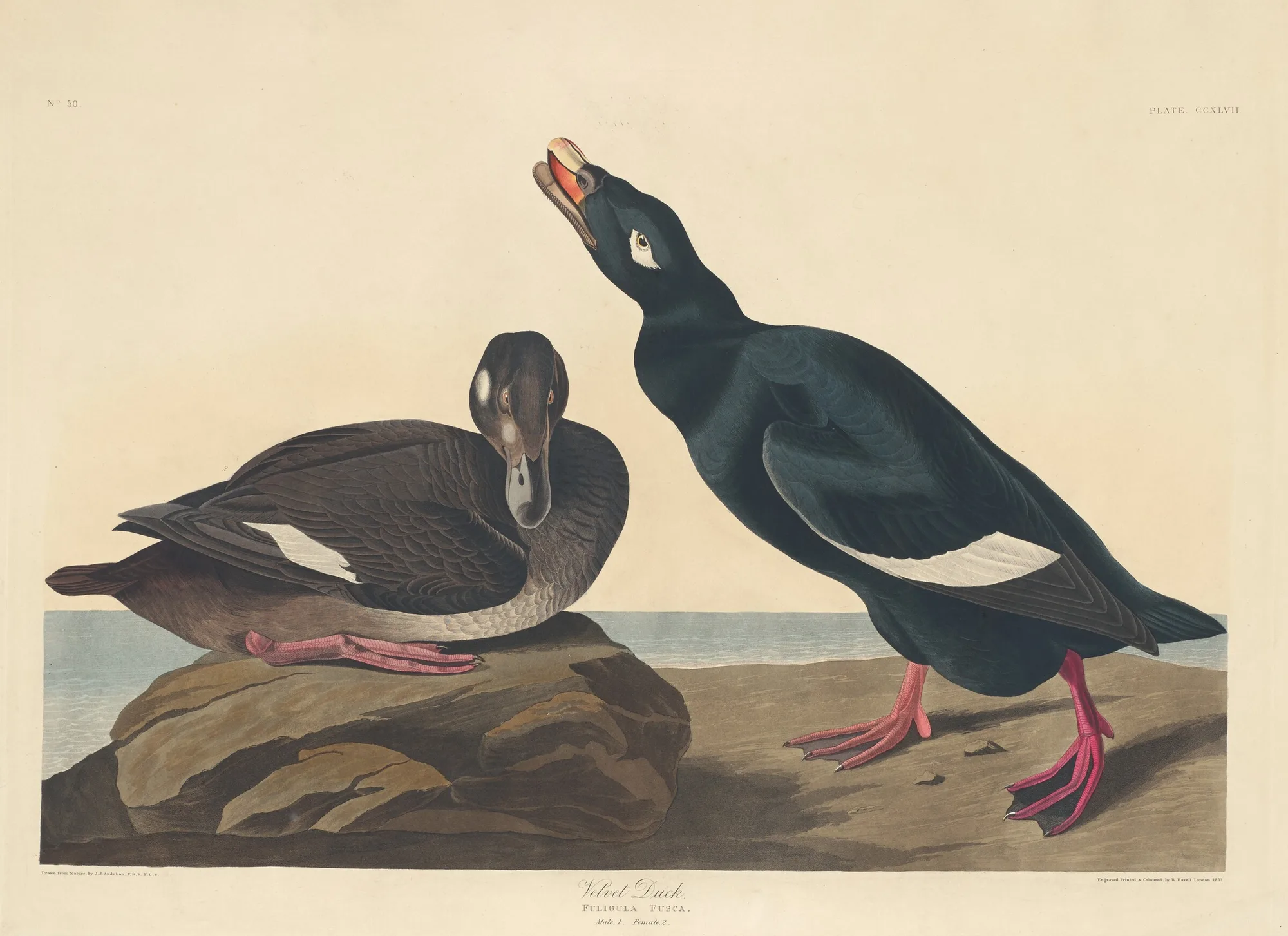
Audubon's “Velvet Duck”, The Birds of America, plate CCXLVII
Click or press Enter to enlarge
Open the full-resolution image (4344 px, National Gallery of Art)
| Plate | 247 (CCXLVII) |
|---|---|
| Audubon's name | Velvet Duck |
| Modern name | White-winged Scoter |
| Scientific name | Melanitta deglandi |
| Status | Least Concern |
| Engraved by | Robert Havell, after Audubon's watercolor |
| Date | 1835 |
| Medium | Hand-colored engraving and aquatint on Whatman wove paper |
| Collections | Ducks, Geese and Swans |
| This impression | National Gallery of Art, Washington, 1945.8.247; Gift of Mrs. Walter B. James |
About this plate
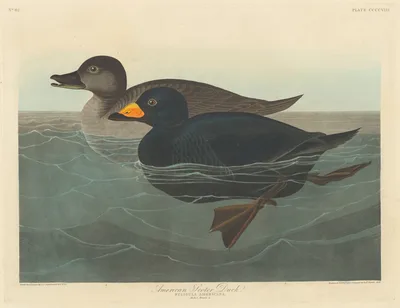
Plate 247 shows a male and female of Audubon's Velvet Duck. The male is velvety black with a small white comma around the eye, a white patch on the wing and a knobbed orange and black bill. The female is dusky brown with two pale patches on the side of the face.
Audubon wrote that the species reached the coast of the Middle States about the first of September and wintered as far south as Georgia, mostly on salt water. In April the flocks headed north in long lines close to shore. In the Bay of Fundy his party spent a day on a cape watching them pass. Approaching Labrador in mid-June 1833, they found the sea covered with dense flocks still arriving from the St Lawrence, so many that it seemed all the Velvet Ducks in the world were passing. He described nests near small lakes a mile or two from the sea, made of twigs, moss and plants.
Audubon's Fuligula fusca was the name of the Eurasian Velvet Scoter. The American Ornithological Society now treats the North American bird as a separate species, the White-winged Scoter, Melanitta deglandi, which differs in the shape and colour of the male's bill.
The White-winged Scoter breeds on lakes in the boreal forest of Alaska and western Canada, farther west than Audubon supposed, and winters on both coasts. It is listed as Least Concern, though its numbers have declined.
In Audubon's words
As we approached the shores of Labrador, we found the waters covered with dense flocks of these birds, and yet they continued to arrive there from the St Lawrence for several days in succession. We were all astonished at their numbers, which were such that we could not help imagining that all the Velvet Ducks in the world were passing before us. This was about the middle of June, which I thought late for them, but the season had been tardy, and the fishermen informed us, that when the weather is warmer, these birds pass a fortnight earlier.
John James Audubon, Ornithological Biography, vol. 3 (1835), “The Velvet Duck”. Read the full chapter.