Pied-billed Grebe (Plate 248)
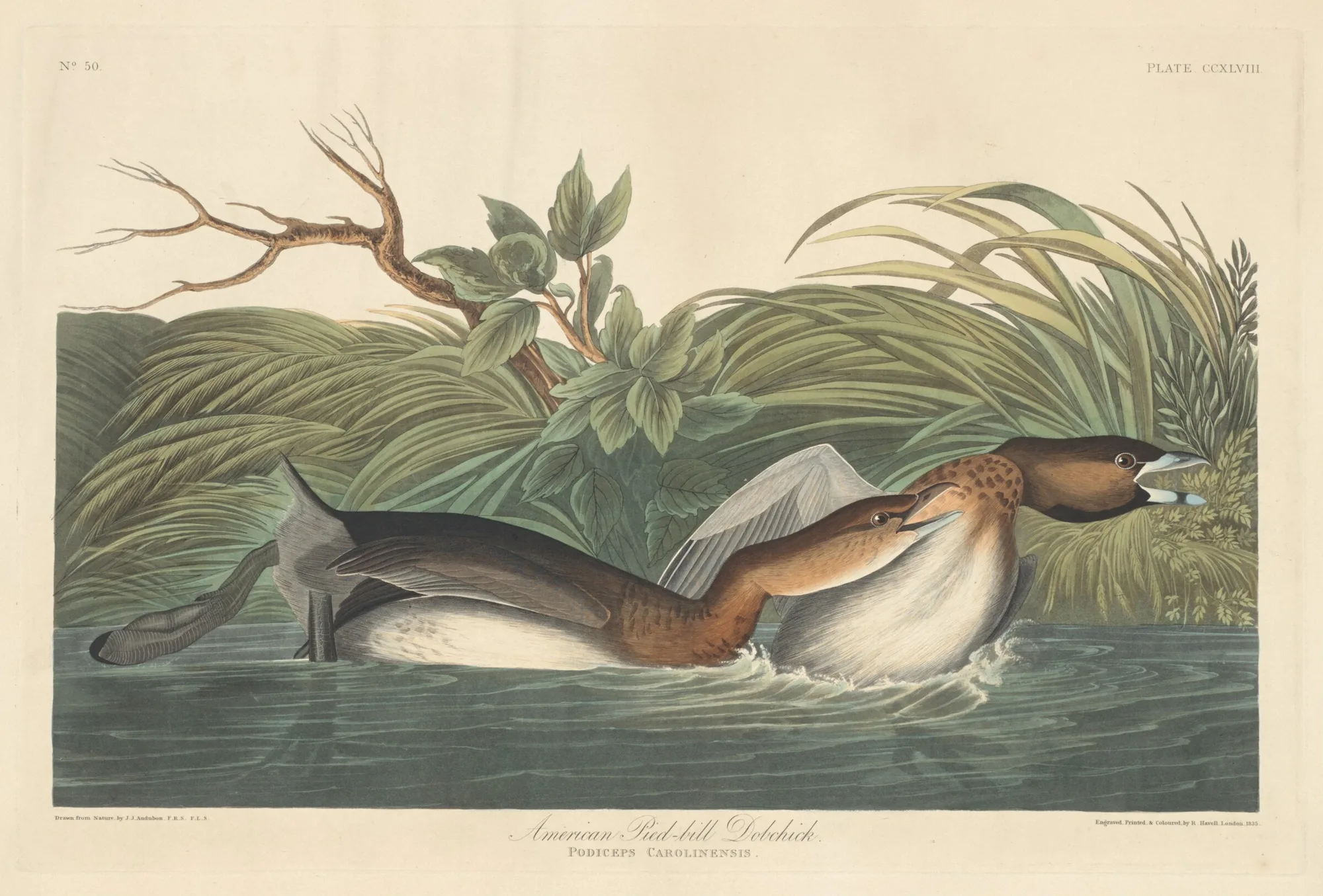
Audubon's “American Pied-Bill Dobchick”, The Birds of America, plate CCXLVIII
Click or press Enter to enlarge
Open the full-resolution image (3268 px, National Gallery of Art)
| Plate | 248 (CCXLVIII) |
|---|---|
| Audubon's name | American Pied-Bill Dobchick |
| Modern name | Pied-billed Grebe |
| Scientific name | Podilymbus podiceps |
| Status | Least Concern |
| Engraved by | Robert Havell, after Audubon's watercolor |
| Date | 1835 |
| Medium | Hand-colored engraving and aquatint on Whatman wove paper |
| Collections | Seabirds |
| This impression | National Gallery of Art, Washington, 1945.8.248; Gift of Mrs. Walter B. James |
About this plate
Plate 248 shows a male and female Pied-billed Grebe in breeding plumage: small, brown, almost tailless divers with a black throat patch and a thick whitish bill crossed by a black band.
Audubon opened the chapter by speaking directly to the birds. He watched them sink slowly backward into the water like frightened frogs until only their bills showed, then slip away toward the bulrushes, and he noted that people called them water-witches. He followed a pair through the season, from a floating bed of rushes and weeds holding five greenish-white eggs, to striped chicks swimming beside their parents, to the young taking wing in September. He took the trouble to say they could fly and migrate through the air, against authors who claimed grebes travelled by swimming.
Audubon placed it in Podiceps as Podiceps carolinensis. It is now Podilymbus podiceps. It is the most widespread grebe in the Americas, breeding on ponds and marshes from Canada to Argentina. It eats fish, crayfish and aquatic insects, and it can control its buoyancy by pressing air from its feathers, which is how it sinks without diving.
Grebes are not seabirds, but the Pied-billed Grebe often winters on sheltered coastal waters. It is listed as Least Concern. In the breeding season it is better known by its loud, cuckoo-like call than by sight.
In Audubon's words
Ah! you have reached a small secluded pool, where you intend to breed in peace and security; there you are, collecting rushes and weeds to form a large matted bed, on which you intend to deposit your pearly eggs. Labour on, mind me not, I am a true friend and admirer of your race. I see that among these plants you have fixed your tenement, in which there will soon be five eggs, which, although tinged with green, will look as if pure white. I wish I knew how many days of constant heat from your bodies it will require to hatch them. Some other time perhaps you may tell me.
John James Audubon, Ornithological Biography, vol. 3 (1835), “The Pied-Billed Dobchick”. Read the full chapter.