Tufted Puffin (Plate 249)
Audubon's “Tufted Auk”, The Birds of America, plate CCXLIX
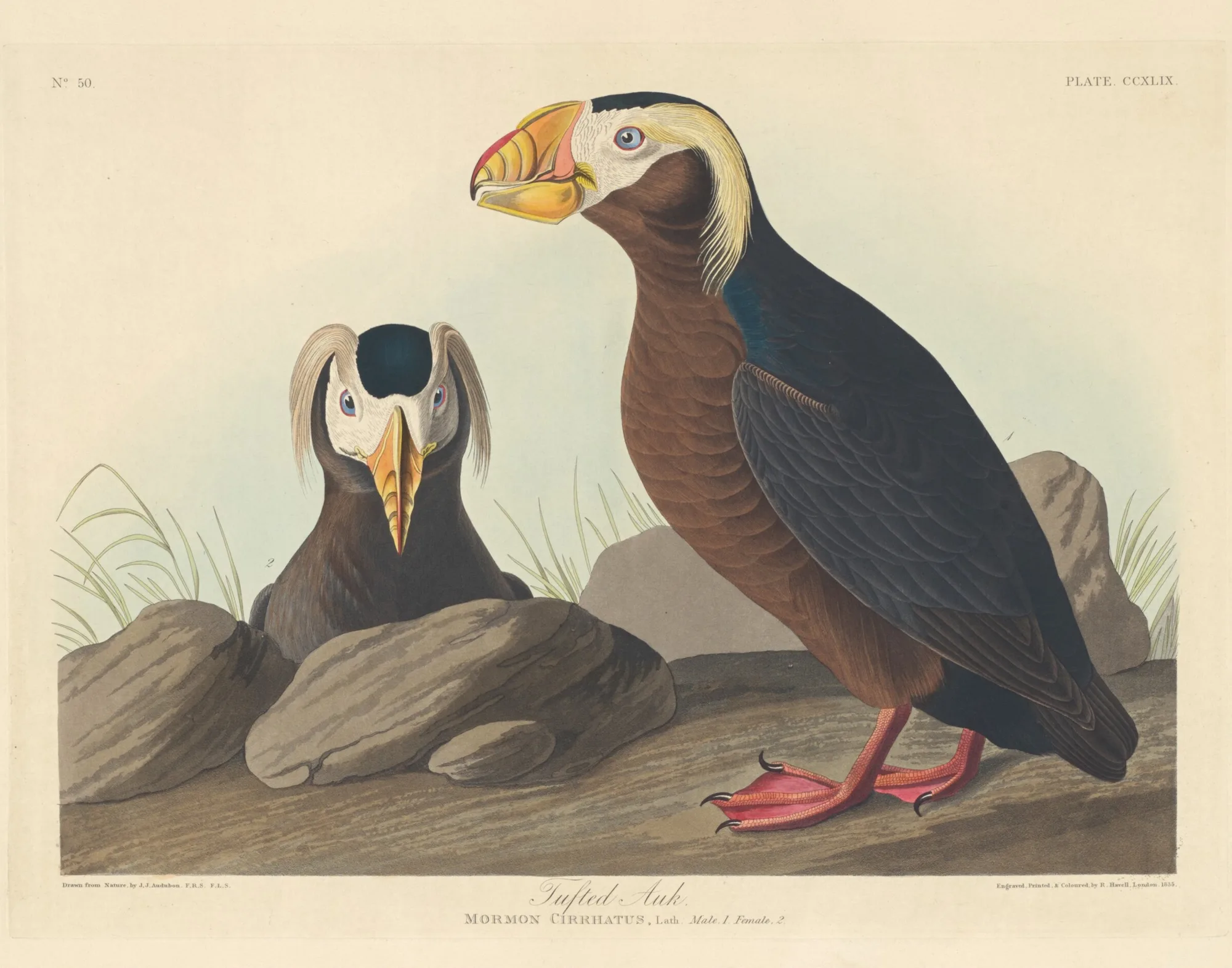
Click or press Enter to enlarge
Open the full-resolution image (2802 px, National Gallery of Art)
| Plate | 249 (CCXLIX) |
|---|---|
| Audubon's name | Tufted Auk |
| Modern name | Tufted Puffin |
| Scientific name | Fratercula cirrhata |
| Status | Least Concern |
| Engraved by | Robert Havell, after Audubon's watercolor |
| Date | 1835 |
| Medium | Hand-colored engraving and aquatint on Whatman wove paper |
| Collections | Seabirds |
| This impression | National Gallery of Art, Washington, 1945.8.249; Gift of Mrs. Walter B. James |
About this plate
Plate 249 shows two figures of a male Tufted Puffin, dark brown-black with a white face, a huge, deep orange-red bill and long, curling straw-yellow plumes that sweep back from behind the eye. Audubon titled it the Tufted Auk; in the text he called it the Tufted Puffin.
His specimen came from a surprising place. He wrote that the bird was shot by a fisherman gunner at the mouth of the Kennebec River in Maine in the winter of 1831 to 1832, while it stood on floating ice, and that no other was seen. He could learn nothing of its habits and relied on Charles Bonaparte's note that it lived in the seas between North America and Kamchatka.
Audubon's Mormon cirrhatus is now Fratercula cirrhata. It is a North Pacific bird, nesting in burrows on islands from California and Japan to Alaska and the Bering Sea and wintering far out at sea. The plumes and the colourful bill plates are shed after the breeding season.
A Tufted Puffin in Maine would be far outside the normal range. A few have reached the Atlantic in modern times, so the record is possible, but it has never been confirmed. The species is listed as Least Concern worldwide, though colonies in the southern part of its range have declined steeply.
In Audubon's words
The specimen from which I drew the figure of this singular looking bird, was procured at the mouth of the Kennebeck River, in Maine. It was shot by a fisherman gunner, while standing on some floating ice, in the winter of 1831-32. No other individual was seen. I could not obtain any information respecting its habits; but as the bird was in tolerable order, I hope that my figures of it will prove not unacceptable. It was a male, and appeared to be adult. My friend, the Prince of Musignano, mentions this species as being an inhabitant of the seas between North America and Kamtschatka, being, he adds, often found on the western coasts of the United States in winter.
John James Audubon, Ornithological Biography, vol. 3 (1835), “The Tufted Puffin”. Read the full chapter.



