Arctic Tern (Plate 250)
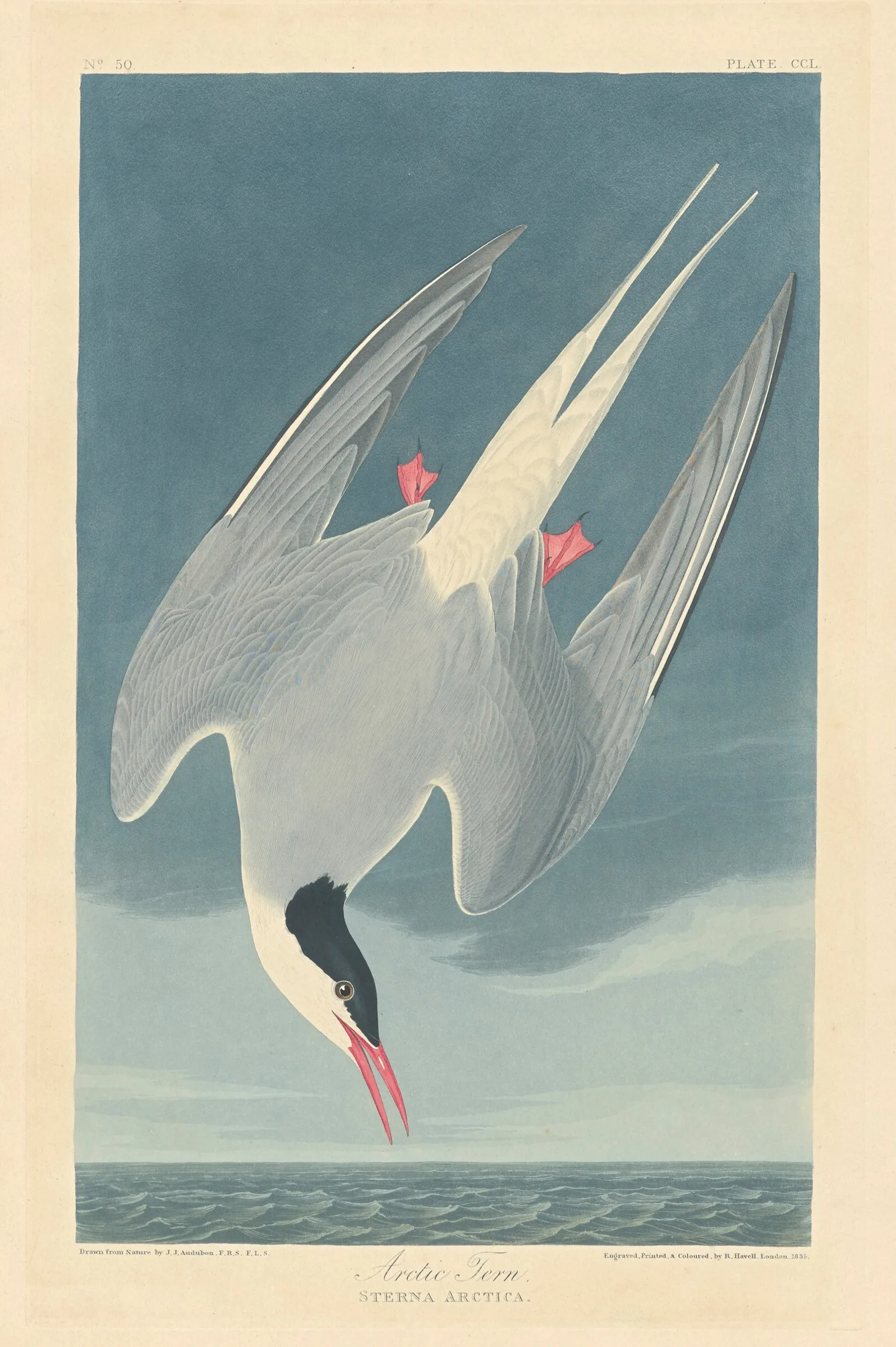
Audubon's “Arctic Tern”, The Birds of America, plate CCL
Click or press Enter to enlarge
Open the full-resolution image (2936 px, National Gallery of Art)
| Plate | 250 (CCL) |
|---|---|
| Audubon's name | Arctic Tern |
| Modern name | Arctic Tern |
| Scientific name | Sterna paradisaea |
| Status | Least Concern |
| Engraved by | Robert Havell, after Audubon's watercolor |
| Date | 1835 |
| Medium | Hand-colored engraving and aquatint on Whatman wove paper |
| Collections | Seabirds |
| This impression | National Gallery of Art, Washington, 1945.8.250; Gift of Mrs. Walter B. James |
About this plate
Plate 250 shows a male Arctic Tern in breeding plumage, pale grey with a black cap, a blood-red bill, very short red legs and long white tail streamers.
Audubon began the chapter with the bird's year: the long flight north, the brief Arctic summer of nesting, and the return south ahead of the snow. He first met the species on the Magdalen Islands in June 1833, on the way to Labrador. Walking a sand beach with his party, he watched Piping Plovers run ahead while dozens of Arctic Terns plunged into the water and caught a small fish or shrimp at every dive. The tern was new to him, and the party shot several with fine mustard-seed shot after he had studied their flight and calls.
Audubon used Temminck's name Sterna arctica. The species is now Sterna paradisaea. It is very like the Common Tern but has a shorter, all-red bill, shorter legs and longer tail streamers, and its flight feathers look translucent from below.
The Arctic Tern makes the longest known migration of any animal. It breeds around the Arctic and on northern coasts south to Massachusetts, and spends the northern winter in Antarctic waters. Birds tracked with geolocators covered more than 70,000 kilometres a year. It is listed as Least Concern.
In Audubon's words
The day after our arrival at the Magdaleine Islands, the weather was beautiful, although a stiff breeze blew from the south-west. I landed with my party at an early hour, and we felt as if at a half-way house on our journey from Nova Scotia to Labrador. Some of us ascended the more elevated parts of those interesting islands, while others walked along the shores. A clean sand-beach lay before us, and we proceeded over it, until having reached a kind of peninsula, we were brought to a stand. The Piping Plover ran and flew swiftly before us, emitting its soft and mellow notes, while some dozens of Arctic Terns were plunging into the waters, capturing a tiny fish or shrimp at every dash.
John James Audubon, Ornithological Biography, vol. 3 (1835), “The Arctic Tern”. Read the full chapter.