Brown Pelican (Plate 251)
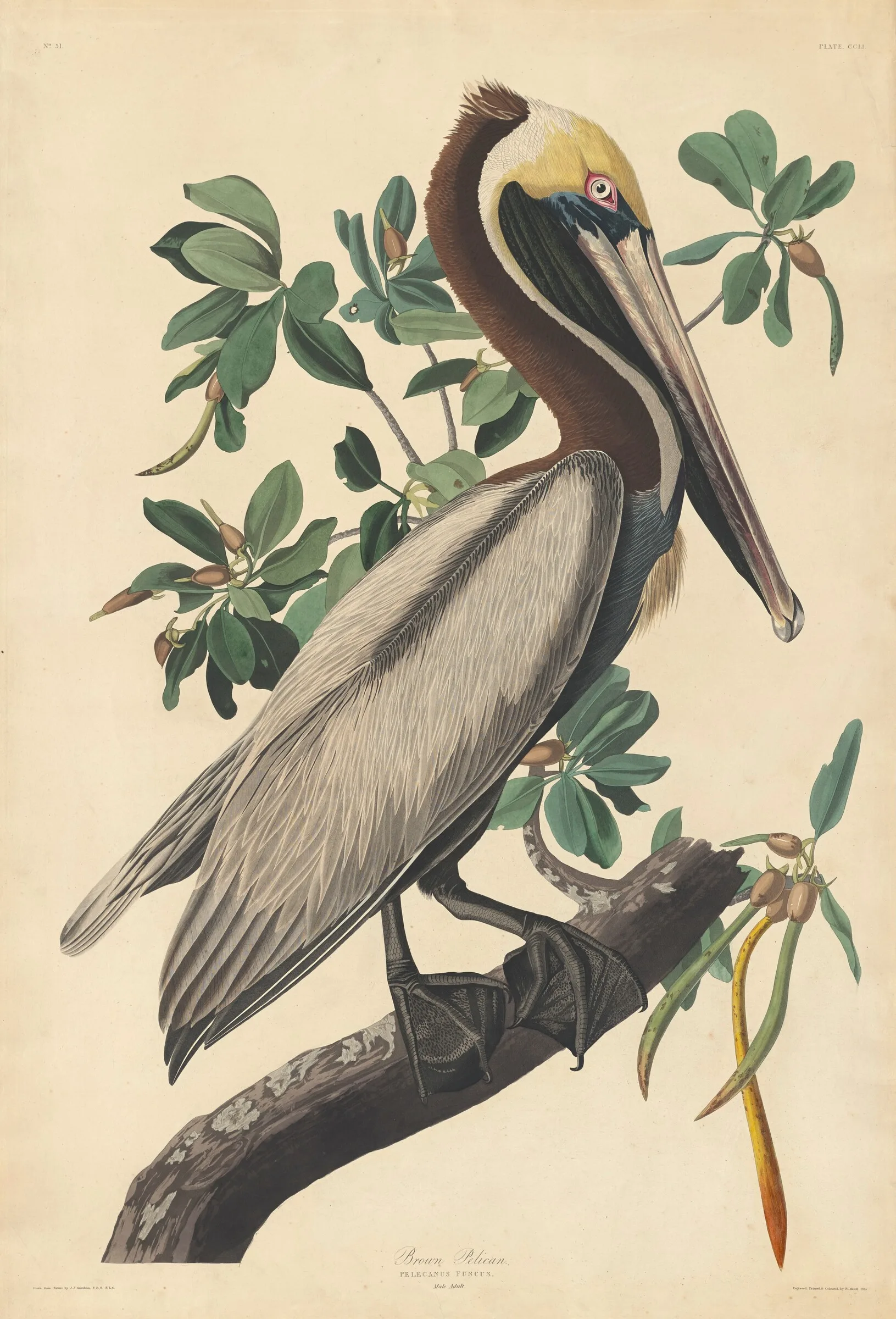
Audubon's “Brown Pelican”, The Birds of America, plate CCLI
Click or press Enter to enlarge
Open the full-resolution image (5752 px, National Gallery of Art)
| Plate | 251 (CCLI) |
|---|---|
| Audubon's name | Brown Pelican |
| Modern name | Brown Pelican |
| Scientific name | Pelecanus occidentalis |
| Status | Least Concern |
| Engraved by | Robert Havell, after Audubon's watercolor |
| Date | 1835 |
| Medium | Hand-colored engraving and aquatint on Whatman wove paper |
| Size | sheet: 100.3 x 67.3 cm (39 1/2 x 26 1/2 in.) |
| Plants and setting | Mangrove branch |
| Collections | Seabirds, Florida and Wading Birds |
| This impression | National Gallery of Art, Washington, 1945.8.251; Gift of Mrs. Walter B. James |
About this plate
Plate 251 shows an adult male Brown Pelican in breeding plumage, perched on a mangrove branch. The head is white washed with yellow, the back of the neck dark chestnut, the body silver-grey and brown, and the long bill carries a large throat pouch.
Audubon wrote that the species had already become scarce near Charleston within living memory. In Florida, John Bulow took him by barge down the Halifax River to a former nesting island, which was empty. The next morning he found dozens asleep in the mangroves, but his second barrel failed because the shot had been loaded before the powder. Later, aboard the revenue cutter Marion, he saw great numbers around Key West, where boys threw stones at birds near the wharves. He described their flight in lines, following the troughs of the waves, and their soaring in circles high over the keys.
Audubon's Pelecanus fuscus is now Pelecanus occidentalis. It is the only pelican that catches fish by plunging from the air. It lives along the Atlantic, Gulf and Pacific coasts of the Americas and in the Caribbean.
In the 1960s the pesticide DDT caused eggshell thinning and nesting failure, and the Brown Pelican disappeared from Louisiana, the Pelican State. After DDT was banned the population recovered, and it was removed from the US endangered species list in 2009. It is listed as Least Concern.
In Audubon's words
The flight of the Brown Pelican, though to appearance heavy, is remarkably well sustained, that bird being able not only to remain many hours at a time on wing, but also to mount to a great height in the air to perform its beautiful evolutions. Their ordinary manner of proceeding, either when single or in flocks, is by easy flappings and sailings alternating at distances of from twenty to thirty yards, when they glide along with great speed. They move in an undulated line, passing at one time high, at another low, over the water or land, for they do not deviate from their course on coming upon a key or a point of land. When the waves run high, you may see them “troughing,” as the sailors say, or directing their course along the hollows. While on wing they draw in their head between their shoulders, stretch out their broad webbed feet to their whole extent, and proceed in perfect silence.
John James Audubon, Ornithological Biography, vol. 3 (1835), “The Brown Pelican”. Read the full chapter.
Brown Pelican (Plate 251): the story behind one of the most famous plates in the collection →