Pomarine Jaeger (Plate 253)
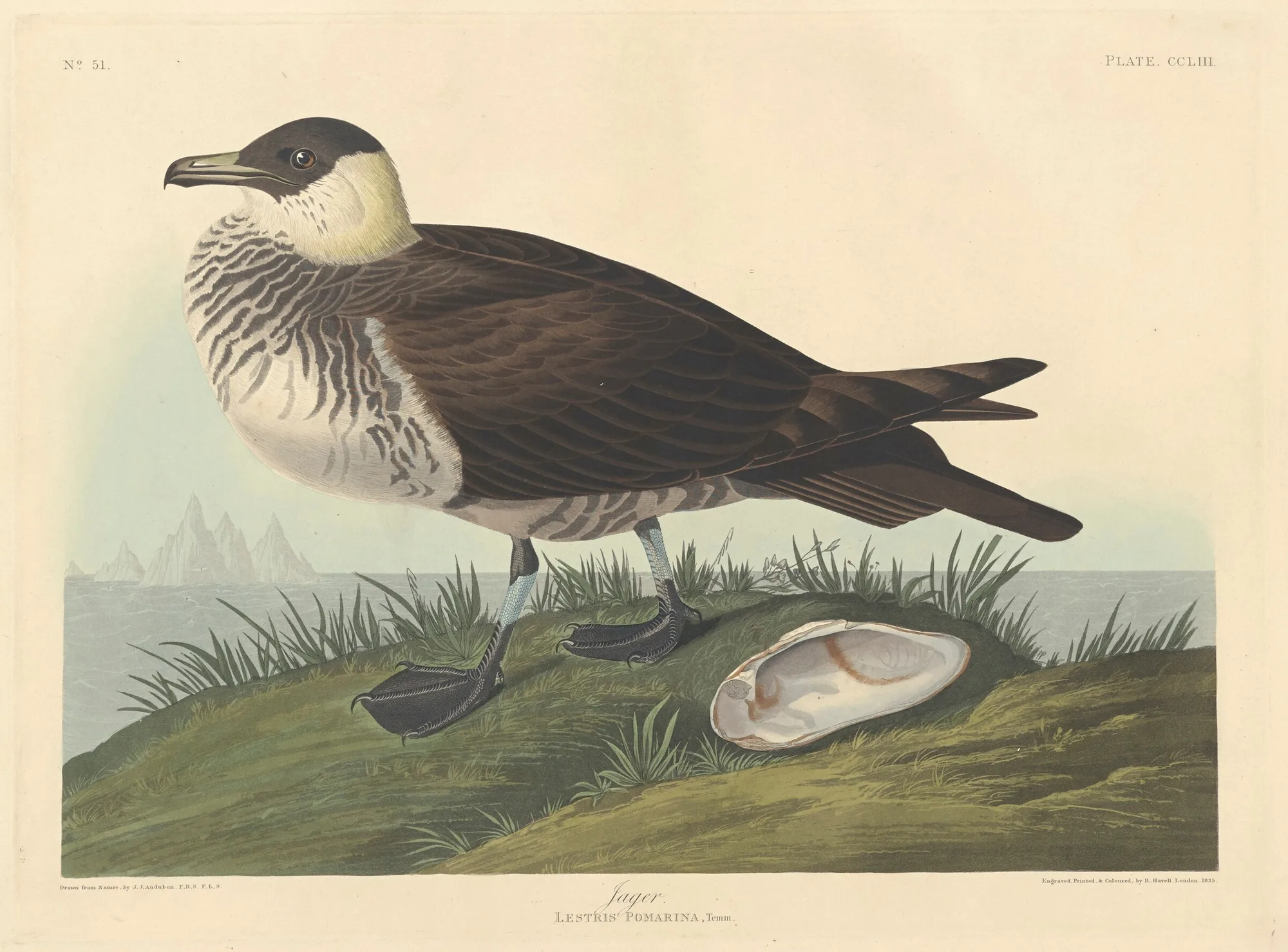
Audubon's “Jager”, The Birds of America, plate CCLIII
Click or press Enter to enlarge
Open the full-resolution image (3291 px, National Gallery of Art)
| Plate | 253 (CCLIII) |
|---|---|
| Audubon's name | Jager |
| Modern name | Pomarine Jaeger |
| Scientific name | Stercorarius pomarinus |
| Status | Least Concern |
| Engraved by | Robert Havell, after Audubon's watercolor |
| Date | 1835 |
| Medium | Hand-colored engraving and aquatint on Whatman wove paper |
| Collections | Seabirds |
| This impression | National Gallery of Art, Washington, 1945.8.253; Gift of Mrs. Walter B. James |
About this plate
Plate 253 shows an adult female Pomarine Jaeger, a dark-capped, gull-like bird with a pale breast, a dark band across the chest and broad, twisted central tail feathers.
Audubon admitted he knew the species only from his 1833 voyage to Labrador. About forty miles from Little Mecatina, one came to the ship, flying like a Merlin and settling to feed on cod liver thrown overboard, but it never came within range. On 30 July the young men of his party brought him a fine adult female, from which he drew the figure in the plate. A few days later, in a gale in the harbour at Bras d'Or, twenty or thirty jaegers swept about among the gulls. They chased Kittiwakes and Ring-billed Gulls but never approached the Great Black-backed Gulls, and they hunted low over the rocks even against the wind.
Audubon's Lestris pomarinus is now Stercorarius pomarinus. Jaeger comes from the German word for hunter, and in Britain the jaegers are called skuas. The Pomarine is the largest of the three jaegers.
It breeds on Arctic tundra in Alaska, Canada and Siberia, where it feeds largely on lemmings and nests only in years when lemmings are plentiful. Outside the breeding season it lives at sea, harrying gulls and terns for their catch. It is listed as Least Concern.
In Audubon's words
A few days after we experienced a very heavy gale while in the harbour of Bras d’Or, during the continuance of which twenty or thirty of these birds came about us, although none of them approached within shot, and no boat could have ridden the furious waves without imminent danger. On that occasion, however, I was enabled to observe some of their habits. They flew wildly about, yet with much grace, moving rapidly to and fro, now struggling against the blast, now bearing off and drifting to a considerable distance. Many Gulls were flying about, having also made for the harbour to obtain some shelter from the storm. The Lestris chased the smaller species with effect, but never approached the Great Black-backed Gulls, nor even their young, which were also flying with the rest. The Kittiwakes and the Ring-billed Gulls were the species which we saw them attack, although they did not procure much food from them, the weather being such that they could not fish.
John James Audubon, Ornithological Biography, vol. 3 (1835), “The Pomarine Jager”. Read the full chapter.